
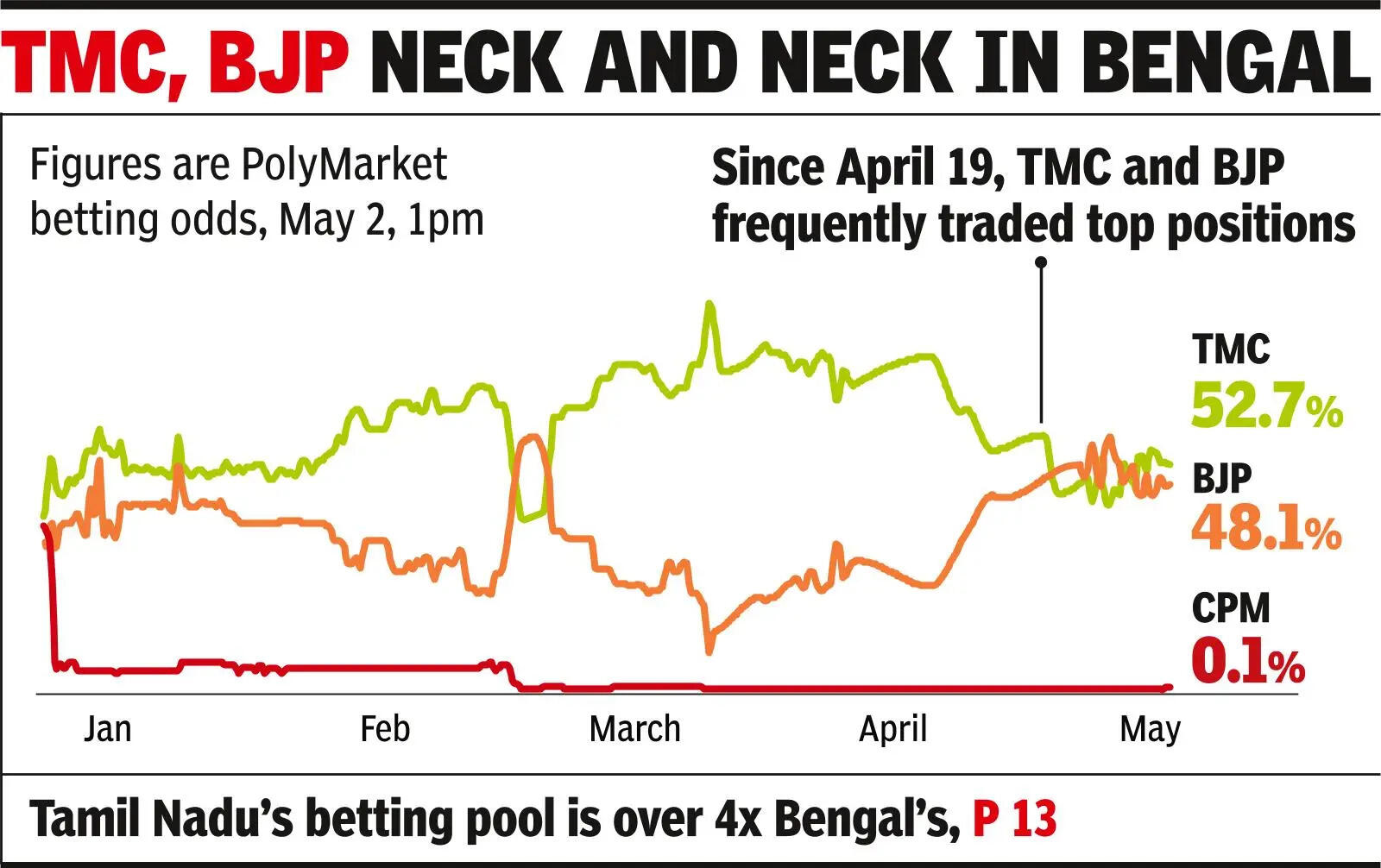
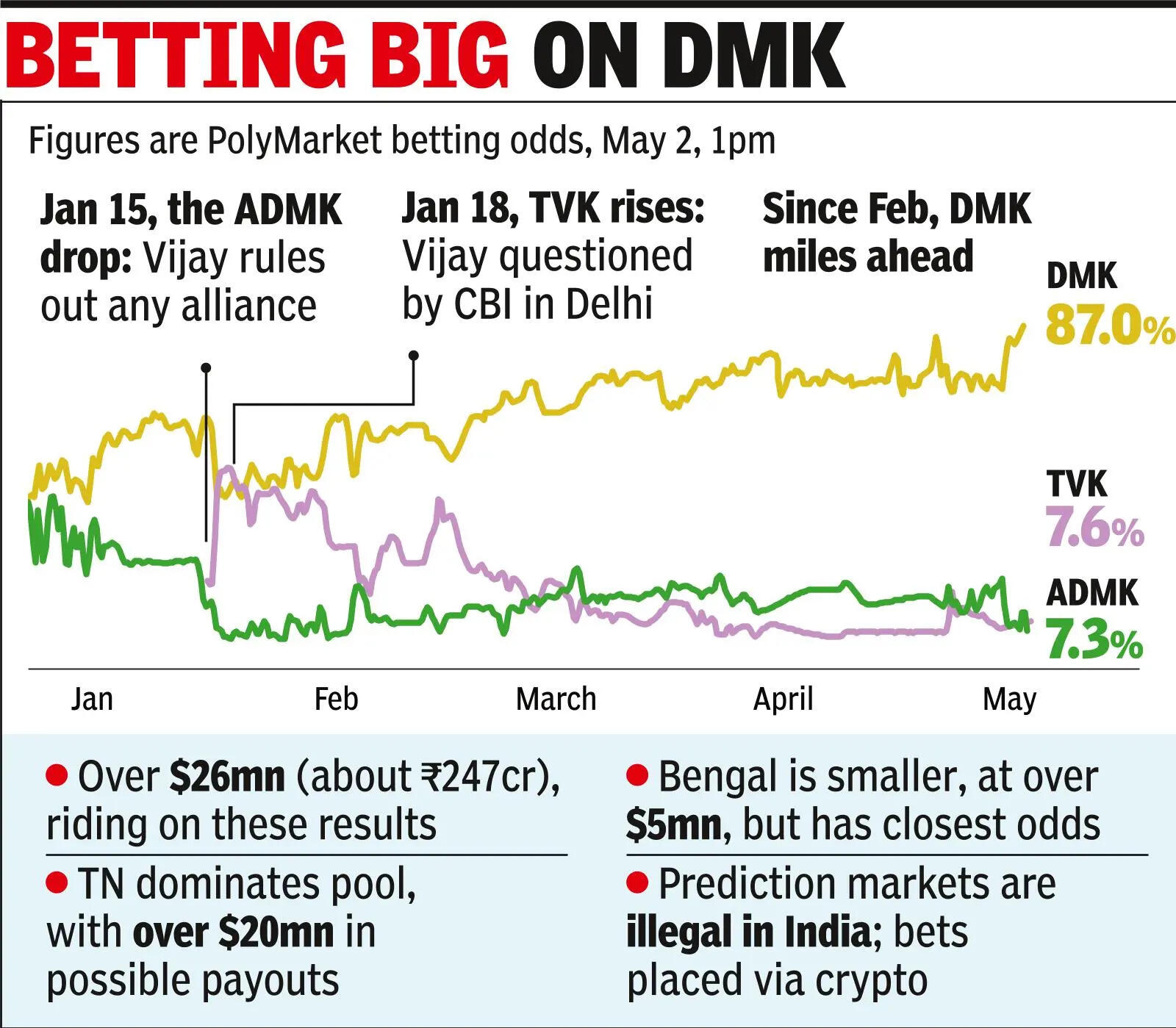
NEW DELHI: When the assembly election results are declared on Monday, at least $26 million — almost Rs 247 crore — will be paid out to those who managed to predict the winners correctly on Polymarket, the American prediction market platform.The bets opened in Dec last year and picked up pace as results draw closer.As of Saturday, the pool is almost entirely driven by bets on the Tamil Nadu election outcome. More than $20m is to be paid out when its results are declared. There’s more than $5m riding on the West Bengal election, almost $400,000 on the Kerala election, $180,000 on the Assam election, and almost $19,000 on the Puducherry election.And what do they predict? For Tamil Nadu, the odds are overwhelmingly in favour of DMK (88%). For West Bengal, Trinamool has a narrow edge in these bets (53%). In Kerala, most of the money is on Congress (75%), which has largely been in the lead except for a few swaps in the lead with CPM since the beginning of April. In Assam, the money is almost entirely on BJP (98%). And in Puducherry, almost entirely on the AINRC-led NDA alliance (86%).
Indian law doesn’t allow prediction markets to operate within India. But because Polymarket is decentralised and crypto-based, it is technically possible for Indian users to use VPN and crypto to place bets on outcomes. India is the world’s largest cryptocurrency user.Earlier this month, Forbes reported that some anonymous Polymarket wallets seemed to be winning unusually often on earnings markets for companies audited by a single global consultancy firm. The wallets had India-coded names like “Kaleenbhaiya” (a character from the series Mirzapur), the report said.
Prediction platforms rise on crowd wisdom
Prediction markets thrive in the US. Polymarket is just one prediction market. The oldest online prediction market — Iowa Electronic Markets — has been around since 1988. There’s the US-regulated Kalshi, the academically rooted PredictIt, and community-created Manifold, among others.The idea is that collective wisdom might capture something that expert analysis can’t — simply because it’s from a pool of people with beliefs strong enough to place money on it. And it’s serious money. The biggest all-time winner on Polymarket made profits of $22m with 18 correct predictions, the largest of which came from a bet on Trump becoming US president which got them $8.3m.
Prediction markets have often been accurate about future events, and have been found to be helpful with planning. A store chain in the US, for instance, used prediction market insights to determine everything from demand to when it should open the store. Obviously, they can also go wrong. For instance, in 2016, they badly misread Brexit and Donald Trump’s victory.Prediction market platforms say that, unlike a betting site, it involves people betting against each other — and not the “house”, with fixed odds set by the platform. Regulators say that the difference doesn’t really matter.In India, the same model was called opinion trading but some of the biggest platforms — Probo, Better Opinions, MPL Opinio, and TradeX have shut down.How does Polymarket work? Like a stock market for predictions for which the outcome is a neat yes or no.The platform’s markets team creates a “market” for the question, and sets down rules — how it will be resolved, when, and so on. These are carefully phrased to avoid disputes, with specific deadlines and clarifying grey areas.When there are multiple possibilities — like these assembly elections — Polymarket creates an “event” within which many separate markets, each specific to a possible yes-or-no outcome, operate. Like will BJP win Bengal? Will the DMK win TN? And so on.Once the market is live, users can buy “Yes” or “No” shares from each other.A single share on Polymarket is priced between $0 and $1, and the price directly represents what the market believes is the probability of that outcome. So, if a “Yes” share on the bet is priced at 75 cents, it means market believes there’s a 75% chance of it happening.People can cash out at any point by selling their shares at whatever the price is at that point. And prices go up and down by the same logic as the stock market — how many people are willing to place money on which outcome.At the predetermined deadline, the market is “resolved” — those with the correct prediction get $1 for each of their shares, and everyone else loses their money. If someone bought their shares at a lower price — when the odds were lower — they stand to gain more than someone who bought in when the prices — and so, the odds — were higher.For instance, one user, “orangexyz”, has bought more than 80,000 shares for TVK winning the highest number of seats in Tamil Nadu — at a little under 11 cents a share. In a scenario in which TVK does indeed end up winning the most seats, the user would make more than nine times of what they put in.On the other hand, the top holder betting on DMK winning, “Asphaleios”, has a little less than 28,000 shares — bought at about 87 cents. If DMK does end up getting the most seats, they would make a modest profit of 15% or so.

Leave a Reply