
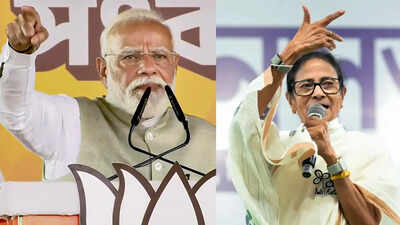
The 2026 West Bengal Assembly election is once again being fought not just on governance, welfare, or corruption, but on something far more visceral. The identity. As the campaign sharpens, the familiar charge of “bohiragoto” has returned to the centre of the political stage, with the All India Trinamool Congress (TMC) reviving a narrative that helped it decisively blunt the rise of the Bharatiya Janata Party (BJP) five years ago. The immediate trigger this time, as seen in the reaction to Leander Paes joining the BJP, shows how quickly the labels are deployed as “outsider, parachuted, not one of us”.
But if the TMC has revived the “outsider” charge, the BJP in 2026 is attempting to respond with a different line of argument rather than engaging only in denial. The party has increasingly foregrounded the issue of illegal infiltration, alleging that the state government has been “lenient” towards undocumented migrants and that this has implications for Bengal’s demographic and cultural landscape.From the BJP’s perspective, this shifts the debate from whether it is an “outsider” political force to a broader question of who constitutes an “outsider” within Bengal itself. The TMC, however, has rejected these claims and framed them as “politically motivated”, maintaining that the BJP is raising such concerns to counter the perception of being culturally disconnected from the state. This marks a significant evolution in the insider-outsider politics of Bengal or or “bhadralok vs bohiragoto” narrative.The insider versus outsider framing did not originate in 2026, but the 2021 West Bengal Assembly elections marked its most effective deployment. Faced with an aggressive BJP expansion, CM Mamata Banerjee transformed what could have been a standard anti-incumbency battle into a referendum on identity. Her message was simple and politically potent that Bengal must be governed by those who belong to it.The 2021 slogan “Bangla Nijer Meyekei Chay” reframed the contest as belonging versus intrusion. The BJP, led prominently in the state campaign by figures like Narendra Modi and Amit Shah, was cast as an external force attempting to capture Bengal politically and culturally.The BJP did have a growing base in Bengal and several Bengali leaders, but the visibility of central leadership and the party’s campaign style allowed the TMC to successfully construct the image of an “outsider party”.The results of 2021 reinforced its effectiveness. The TMC returned to power with a commanding mandate, and the outsider narrative was widely seen as one of the factors that consolidated support across regions and demographics. However, what has changed in 2026 is the BJP’s strategic response.Instead of only asserting its local credentials, the BJP is reframing the identity debate around demographics and citizenship. It has consistently accused the TMC of accommodating illegal immigrants, particularly from neighbouring Bangladesh, and argued that this is altering the cultural and electoral character of the state. In this telling, the question is no longer whether the BJP is an outsider, but whether Bengal itself is being transformed from within.The argument maybe politically loaded but it appears BJP has been trying to reposition itself not as an external force, but as a “protector” of Bengali identity as the party has claimed that unchecked infiltration would dilute local culture, strain resources, and reshape voting patterns, and that the TMC’s alleged tolerance of this process is “driven by vote-bank politics”.In a direct inversion of the TMC’s framing where Mamata Banerjee positions herself as the defender of Bengal against outsiders from Delhi, the BJP positions itself as the defender of Bengal against outsiders crossing the border.Alongside this, the BJP has also sharpened its argument to counter the “outsider party” label. It frequently invoked Syama Prasad Mukherjee, the founder of the Bharatiya Jana Sangh, the ideological predecessor of the BJP, who was himself a Bengali and a prominent figure in the state’s political history. By doing so, the BJP attempts to anchor its legitimacy within Bengal’s own political lineage.This may just not be symbolic. It is also an attempt by the BJP to counter the TMC’s framing by pointing to its ideological lineage, including figures like Syama Prasad Mukherjee, who was from Bengal. The argument, as put forward by the party’s local unit, is that its roots are not entirely external to the state, even if its current leadership and structure are national in character.At the same time, the BJP has sought to localise its campaign more carefully than in 2021, placing greater emphasis on Bengali leadership, cultural references, and region-specific messaging. This reflects an acknowledgement that electoral contests in West Bengal are shaped significantly by perceptions of cultural familiarity and regional connect.Even so, a structural tension persists. The BJP’s political model is anchored in a strong central leadership and a national identity, while West Bengal’s political culture has historically responded more strongly to regional idioms and locally rooted leadership. Managing this balance remains an ongoing challenge for the party.
Fish-ing for votes
In the polls, even food has become a flashpoint in the 2026 campaign. CM Mamata Banerjee has alleged the BJP could restrict fish, meat and egg consumption, framing it as a threat to Bengali culture. The BJP has rejected this, with leaders, including Prime Minister Narendra Modi, countering the claims and making visible efforts to signal alignment with local food traditions.In Pandaveswar, BJP candidate Jitendra Nath Tiwari filed nomination papers with a “fish procession,” supporters carrying baskets while he held a large one. He said, “If promoting West Bengal’s culture is drama, I am proud of this drama.”
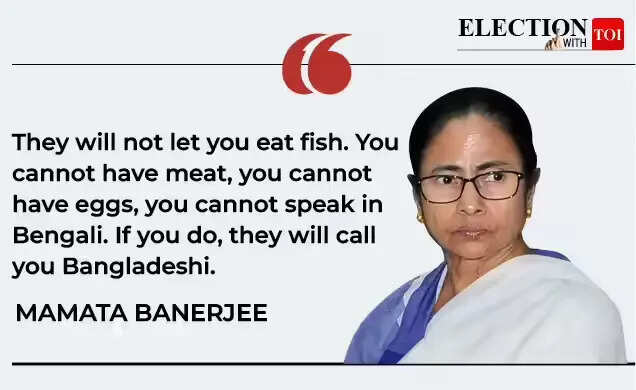
CM Mamata Banerjee
The TMC, for its part, has continued with its established framing. It emphasises language, culture, and lifestyle as markers of identity, and often questions whether the BJP’s political approach aligns with Bengal’s social and cultural context. Issues such as food habits, language use, and everyday practices are frequently invoked to underline this distinction.What makes the 2026 contest particularly notable is that both narratives are now operating simultaneously. The TMC continues to portray the BJP as an external political force, while the BJP raises concerns around illegal infiltration and its potential impact, arguing that this too is a question of identity and belonging. The TMC, however, rejects these claims and characterises them as politically motivated.The result is a layered identity debate, where the idea of an “outsider” is being defined in different ways. For voters, the choice is not only between two parties, but also between competing interpretations of belonging and representation.
The outsider question
This dynamic is not entirely unique to West Bengal, though its intensity here is distinctive.In Maharashtra, for instance, the politics of regional identity has long been associated with the Shiv Sena, which built support around the idea of protecting local interests against migrants. While the context differs, the broader linkage between identity and political legitimacy is similar.In Tamil Nadu, parties such as the Dravida Munnetra Kazhagam have historically foregrounded language and regional identity, often positioning themselves against perceived cultural imposition from outside the state.Assam presents another variation, where debates around migration and citizenship have played a central role in shaping political discourse and electoral outcomes.
Narrative vs strategy
What sets West Bengal apart is the extent to which cultural identity and electoral strategy have become intertwined. The debate extends beyond economics or migration to include language, literature, food, and a broader sense of cultural self-definition. This helps explain why the narrative continues to hold relevance in 2026.The episode involving Leander Paes also highlights how fluid the definition of “insider” can be within this context. Despite his long-standing association with Kolkata, his political shift prompted questions about belonging, underscoring how identity in political discourse can be shaped by alignment as much as by background.The BJP’s emphasis on infiltration introduces an additional dimension to the debate, adding to the existing insider-outsider framing rather than replacing it. This has broadened the conversation from political identity to questions of demography and governance, even as these claims remain contested.As voters head to the polls, this layered contest is likely to influence perceptions alongside more traditional issues such as employment, development, and law and order. Both parties appear to be combining identity-based messaging with policy-oriented promises.Over the past decade, one consistent feature of West Bengal’s politics has been the centrality of belonging in electoral discourse.In 2026, that contest over belonging continues, shaped by competing narratives and evolving political strategies.

Leave a Reply