
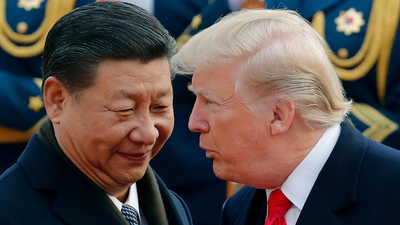
The TOI correspondent from Washington: In a conflict already defined by unpredictable volatility, US President Donald Trump has declared that he is “permanently opening the Strait of Hormuz… for China and the World,” days after imposing a naval blockade to punish Iran and throwing the world economy into a tizzy.Trump’s announcement came in one of his customary rambling social media posts in which he claimed China had assured him it would not send arms to Tehran, with which Beijing has close ties, taking in 90 percent of Iran’s oil exports. “China is very happy that I am permanently opening the Strait of Hormuz. I am doing it for them, also – And the World. This situation will never happen again. They have agreed not to send weapons to Iran. President Xi will give me a big, fat, hug when I get there in a few weeks,” Trump wrote, referring to his upcoming visit to Beijing in May preceded by a letter he has reportedly written to China’s leader Xi JinPing. China has not confirmed any such assurance and is in fact unhappy about Trump’s blockage that threatens its oil import from Iran. The lack of acknowledgment from Beijing has deepened skepticism in diplomatic circles, particularly given the broader context: Trump is simultaneously engaged in an aggressive trade confrontation with China. The US President is known to frequently use social media posts and public statements to shape negotiating dynamics, even if the underlying deals are is still fluid—or nonexistent.The MAGA supremo’s juxtaposition—military coercion paired with personal diplomacy invoking friendship, love, hugs etc —has also become a hallmark of his geopolitical style, fueling confusion about whether Washington is escalating toward a wider war or edging toward a negotiated de-escalation. Such chaos is reflected in a popular online meme that reads: Only Trump could think of a blockade to block the blockade that’s blocking the Strait that wasn’t blocked before being blocked due to a war of his choosing.Soon after Trump’s announcement of a Hormuz blockade, the Pentagon said it has “completely halted” maritime trade in and out of Iran. The move involved more than 10,000 troops, alongside warships and aircraft enforcing restrictions in one of the world’s most critical energy chokepoints. Iran has responded with threats of escalation – warning that it could extend its reach beyond Hormuz into the Persian Gulf, the Sea of Oman, and even the Red Sea, the alternate route used by Saudi Arabia for its energy exports – forcing the U.S to send more resources to the region. Yet while the military buildup intensifies—with an additional 10,000 US personnel, including forces aboard the USS George H W Bush and the Boxer Amphibious Ready Group moving into the region—Trump struck an incongruously optimistic tone. In interviews to US media outlets, he declared the conflict “close to over,” even as officials signaled preparations for further strikes or ground operations if a fragile ceasefire collapses.Meanwhile, as the US President is again extending a hand of friendship towards Beijing after being worsted in the trade war, the traditional foundations of Western security appear crumbling. European allies, fed up with Trump’s belligerence towards Nato, are moving to insulate themselves from American volatility. Ties with several European countries — notably Spain and Italy, whose premier Giorgia Meloni, a Trump favorite till recently — have soured rapidly, aggravated by his attack on the Vatican. Discussions are said to be underway in European capitals about a so-called “European Nato”—a framework that would allow the continent to defend itself using existing alliance structures but with reduced reliance on the U.S. Germany, long opposed to such a move, is now reportedly on board. The effort aims to expand European command roles and reduce dependence on US military assets.To critics, the oscillation between threats and overtures is emblematic of a presidency that thrives on unpredictability. To supporters, it is a deliberate strategy designed to keep adversaries off balance while preserving room for negotiation. Trump himself appears to embrace both interpretations. His social media post encapsulated the duality: celebrating cooperation with China while reminding the world that the US is “very good at fighting… far better than anyone else.”

Leave a Reply