
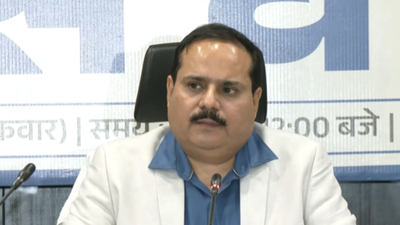
LUCKNOW: A little over 2 crore voters — a shed less than the population of Sri Lanka — have been removed after 166-day special intensive revision (SIR) campaign in Uttar Pradesh as per the final roll released by UP’s chief electoral officer Navdeep Rinwa on Friday. However, the final number, approx 13.39 crore, is 84 lakh more than 12.55 crore voters shown in the draft electoral roll published on Jan 6 after the initial phase of the SIR.The CEO appealed to the voters that those who couldn’t make it to the final list can appeal before the their respective DMs within 15 days of the publication of the final roll. “A second appeal can be filed before the CEO. If that also doesn’t solve the issue, one become a new voter by filling Form 6,” the CEO added.
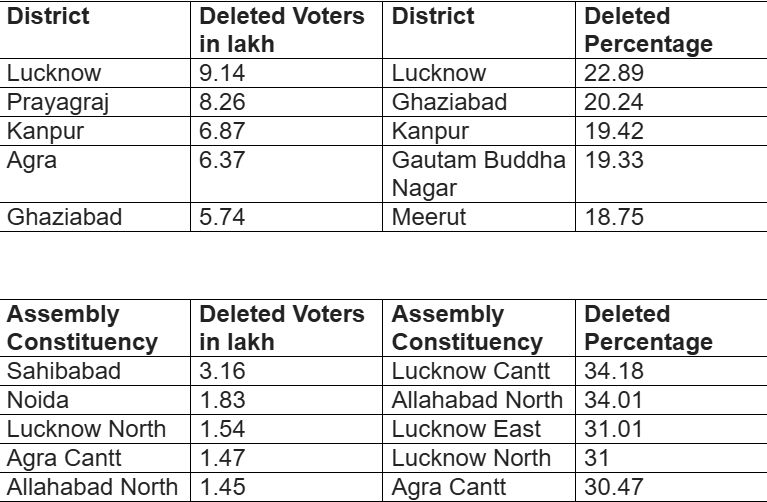
On Oct 27, 2025, when the SIR campaign started, the state had 15.44 crore registered voters, which later dropped to 12.55 crore in the draft roll. But, after three months of extensive claim, objection, hearing and verification period, the state has registered 13,39,84,792 valid voters.According to the CEO, the state capital Lucknow recorded highest 9.14 lakh (22.89 %) deletions, followed by Prayagraj 8.26 lakh (17.62 %), Kanpur 6.87 lakh (19.42 %), Agra 6.37 lakh (17.71 %), Ghaziabad 5.74 lakh (20.24 %), Meerut 5.06 lakh (18.75%) and Bareilly 4.56 lakh (13.41 %).
Among assembly constituencies, Sahibabad registered 3.16 lakh (30.36%) deletions, followed by Noida 1.83 lakh (23.85 %), Lucknow North 1.54 lakh (31 %), Agra Cantt 1.47 lakh (30.47 %) and Allahabad North 1.45 lakh (34.01%).According to the CEO, between Jan 6 to Apr 10, a total 8,15,996 voters were deleted. Out of this, 3,50,026 were deleted for not responding to notice, 3.28 lakh names were deleted as they were marked shifted, 79,076 were deleted due to multiple entries, 55,865 were deleted due to death and 2,069 who were either underage or not Indian citizens.Rinwa said during the revision process, 3.26 crore notices were served as around 1.04 crore electors were identified as “non-mapped”, while 2.22 crore cases involved logical discrepancies. Notices were issued beginning Jan 14, 2026, with hearings scheduled from Jan 31, and all notices were generated and distributed. The hearings were completed by March 27.He emphasised that no voter’s name was deleted without due process during the SIR exercise. “If a name present in the draft roll is missing in the final list, it is either due to discrepancies in the Form-6 application or a decision taken by the ERO after due hearing,” he said.According to the final roll released on Apr 10, the state has 7,30,71,061 male voters (54.54%), 6,09,09,525 female voters (45.46%), and 4,206 third‑gender voters. The number of voters in the 18–19 age group stands at 17,63,360.
Poll
Should the government take further steps to reduce the number of deleted voters?
The CEO noted that between the draft publication on Jan 6 and the final publication on April 10, UP registered a net increase of 84,28,767 voters. This includes 42,27,902 additional male voters, 42,00,778 female voters, 87 third-gender voters, and 14,29,379 newly added young voters aged between 18–19 age group. The gender ratio also improved by 10 points — from 824 to 834, indicating that more women voters have responded to the revision.Among districts, Prayagraj recorded the highest growth in voter numbers between the draft and final roll, with 3,29,421 new voters, followed by Lucknow (2,85,961), Bareilly (2,57,920), Ghaziabad (2,43,666) and Jaunpur (2,37,590).At the assembly constituency level, Sahibabad saw the highest increase with 82,898 new voters. It was followed by Jaunpur (56,118), Lucknow West (54,822), Loni (53,679), and Firozabad (47,757).UP 2nd after Guj in voter deletion percentageCEO Navdeep Rinwa claimed that UP registered 13.24 % voter deletion, while Gujarat stood first with 13.4 % voter deletion. Chhattisgarh stood third with 11.77 %, Tamil Nadu 11.55%, Goa 10.76 %, Puducherry 7.57 %, Madhya Pradesh 5.97%, Rajasthan 5.74% and Kerala 3.22 %.3rd party complaints led to 1.2 L deletionsA total of 1,20,106 voters were deleted following the Form‑7 applications filed by third parties seeking deletion of names from the electoral roll.The highest number of requests — 55,865 — cited the death of the elector. Another 49,706 applications claimed that the individual was absent or had permanently shifted. A total of 14,300 applications stated that the person was already enrolled elsewhere, while 93 objections alleged that the elector was underage. Additionally, 142 applications asserted that the individual was not an Indian citizen.CEO Navdeep Rinwa said, “These deletions have happened only after Jan 6, 2026 but some Form-7 could have been submitted earlier than Jan 6 also. The Electoral Roll of UP was frozen from October 27, 2025 to Jan 6, 2026.”A Marathon ProcessHighlighting participation by political parties, CEO Rinwa said five meetings were held with recognised political parties after the announcement of SIR to apprise them of the EC’s guidelines and seek feedback.He added that 904 meetings were conducted by the DEOs across the state with representatives of recognised political parties.A total of 5,82,877 booth-level agents participated in the process, including 1,61,581 from the BJP, 1,57,631 from the SP, 1,54,224 from the BSP, 97,153 from the Congress, 6,480 from the AAP, 5,693 from Apna Dal (S), and 315 from the CPI(M).Rinwa said 107 memoranda were received from political parties during the exercise, including 85 from the SP, 10 from the BJP, nine from the Cong, and one each from the BSP, CPI(M) and AAP. All complaints mentioned in these memoranda have been addressed, he added.The exercise was carried out with the contribution of 75 district election officers (DEOs), 403 electoral registration officers (EROs), 12,758 assistant EROs (AEROs), 18,026 booth level officer (BLO) supervisors and 1,77,516 BLOs.In addition, 5,82,877 booth level agents of recognised political parties and crores of voters extended cooperation, he said, adding that print, electronic and digital media also played a key role in awareness efforts.

Leave a Reply