
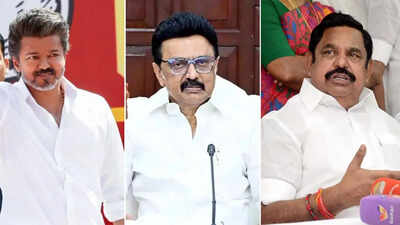
With campaign activity picking up across Tamil Nadu, the 2026 assembly election is shaping up as a high-stakes contest that could test the durability of the state’s long-standing Dravidian political order. What was once a largely bipolar contest is now evolving into a more complex, multi-cornered fight, with new entrants and shifting voter alignments adding layers of uncertainty.At the centre of the contest is MK Stalin, who heads into the election seeking a renewed mandate after completing a full term in office. The ruling Dravida Munnetra Kazhagam (DMK) will rely on its governance record, welfare delivery, and alliance network, but also faces anti-incumbency, economic concerns, and opposition attacks on issues such as law and order and corruption.
Israel Iran War
The opposition space remains fragmented. The All India Anna Dravida Munnetra Kazhagam (AIADMK), led by Edappadi K Palaniswami, is attempting a recovery after electoral setbacks, but continues to deal with internal divisions and leadership challenges following the death of J Jayalalithaa. Its alliance with the BJP-led NDA is expected to frame the election around governance gaps and anti-incumbency.Adding a new dimension to the contest is Tamilaga Vettri Kazhagam, led by Vijay, whose entry has introduced uncertainty, particularly in urban and youth voter segments. While the extent of its electoral impact remains unclear, its presence is likely to influence vote distribution in closely contested seats.The election, therefore, is not just a contest for power but a test of whether Tamil Nadu’s traditional two-party dominance can withstand emerging political fragmentation.
A shifting electoral landscape: What’s at stake
This election carries layered stakes. For the DMK, it is about continuity, consolidation, and legacy. For the AIADMK, it is about survival and reinvention. For TVK, it is about proving credibility beyond crowds and charisma. And for smaller players like NTK, it is about converting ideological presence into electoral relevance. Unlike previous elections, where alliances and voter blocs were relatively stable, this contest is marked by overlapping voter bases and fluid loyalties. Youth voters, urban middle classes, and even sections of minority communities are showing signs of shifting preferences, making electoral outcomes harder to predict.The presence of multiple contenders also raises the possibility of split mandates in several constituencies. In such a scenario, organisational strength and booth-level efficiency could prove more decisive than headline popularity.
Snapshot of past elections: Dominance with undercurrents of change
Tamil Nadu’s electoral history has long been defined by the alternating dominance of the DMK and the AIADMK, a pattern that has shaped the state’s political identity for decades. The 2021 assembly elections continued this trend, with the DMK returning to power under M K Stalin after a decade, securing a comfortable majority along with its allies.Yet, beneath this continuity, subtle shifts have been underway. The AIADMK, despite losing power, retained a substantial vote share, indicating that its support base remains intact in several regions. At the same time, smaller players began to register incremental gains. Naam Tamizhar Katchi, for instance, expanded its vote share without converting it into seats, pointing to a growing appetite for alternatives beyond the Dravidian duopoly.
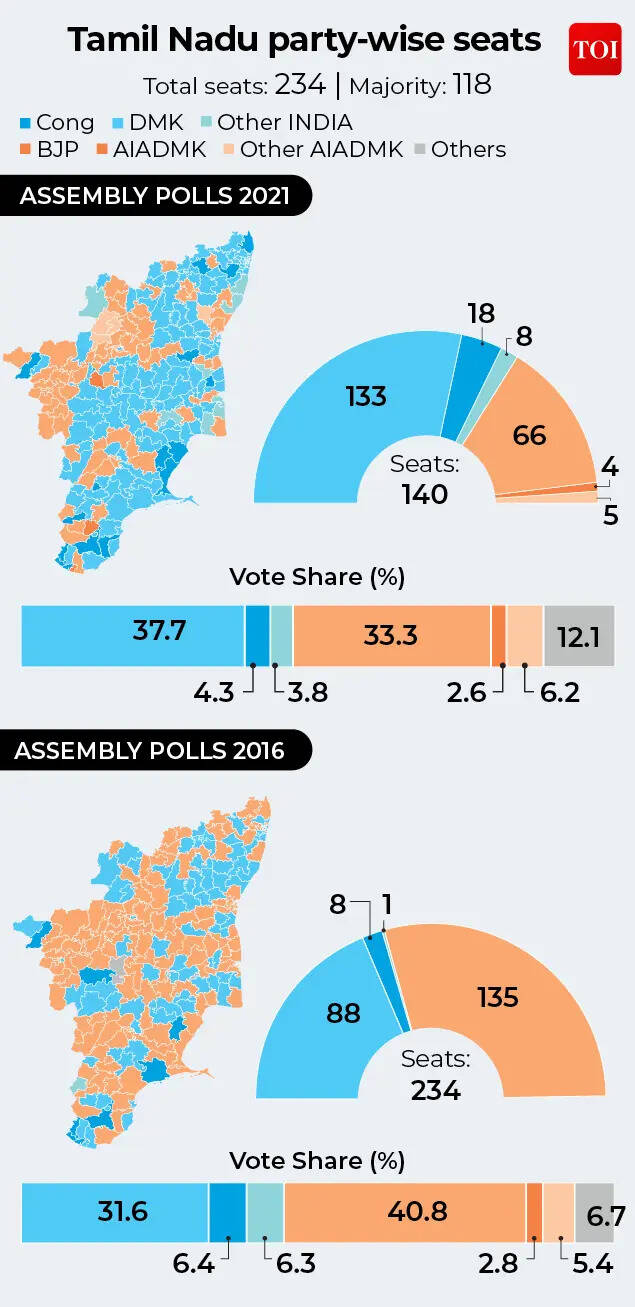
.
The Lok Sabha elections further reflected these trends, with the DMK-led alliance consolidating its position, even as the BJP made limited but noticeable inroads in select pockets. Urban voting behaviour, in particular, showed early signs of fragmentation, with younger voters displaying weaker attachment to traditional party loyalties.As the state approaches the 2026 assembly elections, these undercurrents have grown sharper. The entry of new political formations, internal fractures within established parties, and evolving voter expectations suggest that while the structure of dominance remains, the ground beneath it is steadily shifting.
High-stakes contests and leadership battles
Stalin vs the challengers: a referendum on governance
At the centre of the 2026 contest stands M K Stalin, facing what is effectively a referendum on his first full term in office. Unlike previous elections driven largely by personality clashes between towering leaders, this battle is more layered — combining leadership evaluation with scrutiny of governance delivery.Stalin’s campaign is anchored in the “Dravidian model,” which blends welfare expansion with administrative reform and a strong pitch on federal rights. Schemes targeting women, education, and social security have helped build a wide beneficiary base, while infrastructure projects in urban centres aim to reinforce a development narrative. For the DMK, the election is as much about defending this governance record as it is about retaining political dominance. However, the challenge before Stalin is not from a single, unified opponent. Instead, he faces a fragmented but collectively potent opposition. The AIADMK under Edappadi K Palaniswami is attempting to channel anti-incumbency, focusing on issues such as law and order, corruption allegations, and rising living costs. At the same time, Vijay’s Tamilaga Vettri Kazhagam is targeting urban voters and youth, seeking to convert dissatisfaction into a broader anti-establishment sentiment.This multi-front challenge makes the election less about a direct face-off and more about vote distribution. Even limited erosion of the DMK’s core support — whether among urban middle classes, youth, or minority voters — could alter outcomes in closely contested seats.Ultimately, the contest around Stalin is not just about leadership, but about continuity versus disruption. A renewed mandate would cement his position and mark a rare instance of consecutive victories for the DMK, while any setback could signal that Tamil Nadu’s electorate is ready to move beyond familiar political patterns.
The Udhayanidhi factor: Heir or emerging leader?
Another key figure in this election is Udhayanidhi Stalin. His rapid rise within the DMK has made him both an asset and a point of criticism.For supporters, he represents generational change. For critics, he reinforces the narrative of dynastic politics. This election will test whether he can move beyond being seen as a political heir and establish independent electoral credibility.
Faces to watch: Fragmentation, switches and new entrants
Sasikala’s shadow over the AIADMK
V K Sasikala’s re-entry into active politics has added a crucial variable, particularly in southern Tamil Nadu. Her influence among Thevar communities continues to matter, and even a marginal vote split could impact tight contests.Her political moves also underline the unresolved leadership crisis within the AIADMK. The continued contest over J Jayalalithaa’s legacy remains central to opposition dynamics.
O Panneerselvam’s NDA shift
The induction of O Panneerselvam into the NDA reflects ongoing realignments. Once a key AIADMK leader, his shifting political trajectory mirrors the fragmentation within the party.While his presence may help consolidate certain caste-based support, questions remain about the extent of his electoral influence in the current political climate.
Vijay’s TVK: from fandom to political force
Vijay’s Tamilaga Vettri Kazhagam is perhaps the most closely watched entrant. His ability to convert fan clubs into political units gives him a unique organisational base, especially in urban and semi-urban areas.However, the real test lies in translating crowd mobilisation into votes — a challenge that has historically tripped up celebrity-driven political ventures.
What parties will campaign on
The 2026 Tamil Nadu election is expected to be fought on a layered mix of welfare politics, governance claims, identity narratives, and emerging economic anxieties. While each party enters the contest with its own framing, there is a clear overlap in the issues they will seek to own — from household economics to questions of federalism.For the ruling DMK, the campaign is likely to centre on its “Dravidian model” of governance. Under M K Stalin, the party is expected to foreground its welfare architecture — including schemes aimed at women, education, and social security — alongside its push on urban infrastructure and public service delivery. Equally central will be its political messaging around federal rights, with the DMK positioning itself as a defender of Tamil Nadu’s autonomy against what it describes as increasing centralisation. This framing, pitched as “Tamil Nadu versus Delhi,” is likely to be used to consolidate regional pride and ideological support.The AIADMK-led NDA, on the other hand, is expected to build its campaign around governance gaps and anti-incumbency. Led by Edappadi K Palaniswami, the alliance is likely to highlight concerns over law and order, allegations of corruption, and rising costs of living. Issues such as drug circulation, crimes against women, and urban civic problems — including flooding, waste management, and traffic congestion — are expected to be used to question the DMK’s administrative record. At the same time, the NDA may attempt to balance this critique with a development-oriented narrative, drawing on central government schemes and infrastructure investments to appeal to urban and middle-class voters.For Vijay’s Tamilaga Vettri Kazhagam (TVK), the campaign is likely to take a sharply anti-establishment tone. Positioned as an alternative to both the DMK and the AIADMK, TVK is expected to focus on corruption, accountability, and systemic reform. Its messaging is likely to resonate with younger voters, gig workers, and urban professionals who feel disconnected from traditional party politics. TVK may also emphasise transparency and clean governance, attempting to contrast itself with what it portrays as entrenched political structures.Meanwhile, Seeman’s Naam Tamizhar Katchi (NTK) is expected to stay rooted in its ideological core. Its campaign will likely revolve around Tamil nationalism, environmental protection, agrarian distress, and local resource rights. Issues such as water sharing, land acquisition, and ecological degradation are expected to feature prominently, particularly in rural and coastal constituencies.Across parties, economic concerns are likely to form a common thread. Inflation, employment opportunities, and household financial stress are emerging as key voter concerns, especially among the urban middle class and lower-income groups. Women voters, who have become a decisive electoral bloc, are expected to be at the centre of competing narratives — whether through welfare delivery, safety concerns, or household economics.In essence, while the DMK will seek to defend its record and ideological positioning, the opposition will attempt to convert dissatisfaction into votes, and new entrants will try to redefine the terms of the debate. The election, therefore, is set to be a contest not just of promises, but of competing political narratives about governance, identity, and the future direction of Tamil Nadu.
Campaign themes: Identity, governance and aspiration
Welfare vs economic pressure
The DMK’s campaign is expected to foreground welfare schemes — from free bus travel for women to financial assistance programmes. These initiatives have created a broad beneficiary base, particularly among women.However, rising costs of living, employment concerns, and urban civic issues could temper this advantage. The opposition is likely to frame the election as a question of economic pressure versus welfare delivery.
Law and order and governance narrative
Issues such as crime, drug circulation, and urban infrastructure gaps are expected to feature prominently. The AIADMK-led NDA is likely to target these concerns to build an anti-incumbency narrative.
Tamil identity vs national alignment
The DMK is expected to sharpen its federalism pitch, positioning itself as a defender of Tamil identity against perceived central overreach. This has historically been a powerful narrative in the state.On the other hand, the AIADMK’s alliance with the BJP introduces a contrasting framework — one that emphasises national integration and development, but also risks alienating sections sensitive to identity politics.
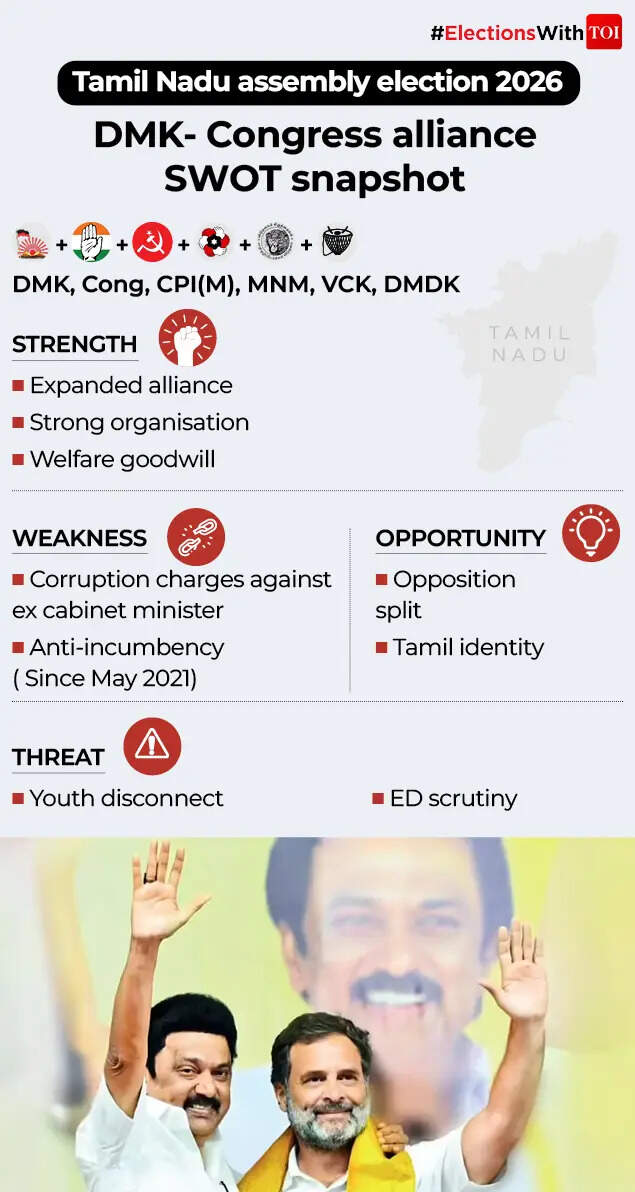
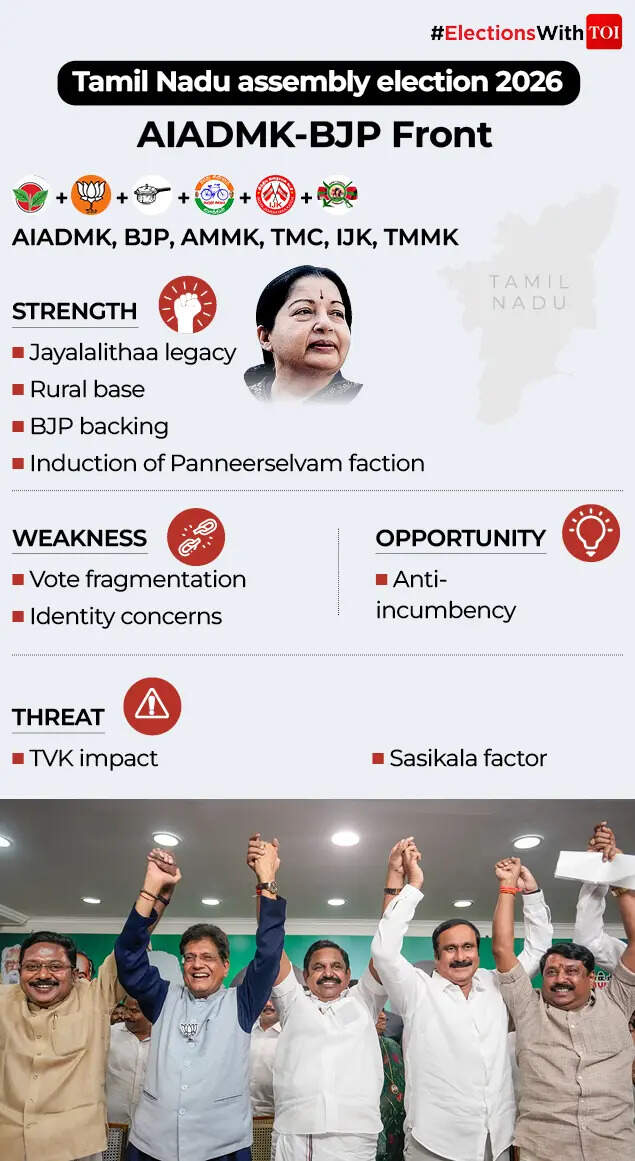
A SWOT analysis of key parties highlights their prospects and hurdles:
DMK-led front
Strength: Under M K Stalin, the DMK has emerged as the most structurally stable political force in the state, combining leadership continuity with a strong organisational backbone. Its cadre-driven machinery, deeply embedded at the booth level, gives it a clear mobilisation advantage across regions. The party’s expansive alliance — spanning minorities, Dalits, Left parties and regional players — allows it to consolidate a broad social coalition and reduce vote fragmentation.The DMK’s governance pitch is anchored in welfare delivery and visible urban development. Schemes such as financial assistance for women, education initiatives, and social security programmes have built a loyal beneficiary base, while infrastructure upgrades in cities like Chennai reinforce its development narrative. Stalin’s positioning as a steady administrator and a vocal advocate of federal rights further strengthens the party’s appeal.
.
Weakness: After a full term in power, the DMK faces the weight of anti-incumbency. Concerns around rising living costs, employment stagnation, and urban civic issues — including flooding, waste management and congestion — have created pockets of dissatisfaction.The opposition has also sharpened its attack on the perception of dynastic politics, particularly around Udhayanidhi Stalin’s growing prominence. Allegations of corruption involving senior leaders and recurring law and order concerns add to the party’s vulnerabilities, even if not electorally decisive on their own.Opportunity: A fragmented opposition remains the DMK’s biggest advantage. With votes likely to be split between the AIADMK-led NDA, TVK, and NTK, the ruling front stands to benefit in closely contested constituencies.The party can also deepen its outreach among women voters through welfare schemes, while leveraging its alliance network to tailor constituency-level strategies. Its federalism plank — framing the contest as one between Tamil Nadu and central authority — continues to resonate and offers a strong ideological anchor.Threat: The rise of Vijay’s Tamilaga Vettri Kazhagam poses a direct challenge, particularly among youth, urban voters, and sections of minorities.At the same time, if the AIADMK-led NDA succeeds in consolidating anti-incumbency and presenting a unified narrative, it could tighten contests in key seats. Economic pressures, including inflation and household financial stress, also risk diluting the impact of welfare-driven politics.
AIADMK-led NDA
Strength: Despite recent setbacks, the AIADMK retains a residual but significant grassroots network, particularly in western and southern Tamil Nadu. Its cadre base, built over decades, continues to provide electoral depth. The enduring legacy of J Jayalalithaa still carries emotional weight among sections of voters, especially women and rural communities.Its alliance with the BJP-led NDA adds financial resources, campaign infrastructure, and a broader national narrative centred on development and governance. The front is also well-positioned to capitalise on anti-incumbency against the DMK.
.
Weakness: The absence of a unifying, charismatic leader remains the alliance’s biggest structural challenge. While Edappadi K Palaniswami has consolidated organisational control, the party lacks the emotional connect once commanded by Jayalalithaa.Internal fragmentation — including the parallel influence of leaders like V K Sasikala and O Panneerselvam — has weakened its traditional vote base. The alliance with the BJP has also led to erosion of minority support, while its urban presence and appeal among younger voters remain limited.Opportunity: The AIADMK-led NDA’s primary opportunity lies in effectively consolidating anti-incumbency. By foregrounding issues such as law and order, corruption allegations, and rising costs, it can position itself as the principal alternative to the DMK.Strategic caste consolidation through alliance partners and renewed outreach to women voters on issues of safety and household economics could help rebuild its social coalition. It can also appeal to urban middle classes through a development-focused narrative.Threat: The emergence of TVK poses a major threat by splitting the anti-DMK vote, particularly among youth and urban voters.The continued influence of Sasikala in southern districts risks fragmenting the AIADMK’s core support base. Additionally, credibility issues arising from past corruption allegations weaken its ability to attack the DMK on similar grounds. Organisational fatigue and repeated electoral losses could further impact cadre mobilisation.
Tamilaga Vettri Kazhagam (TVK)
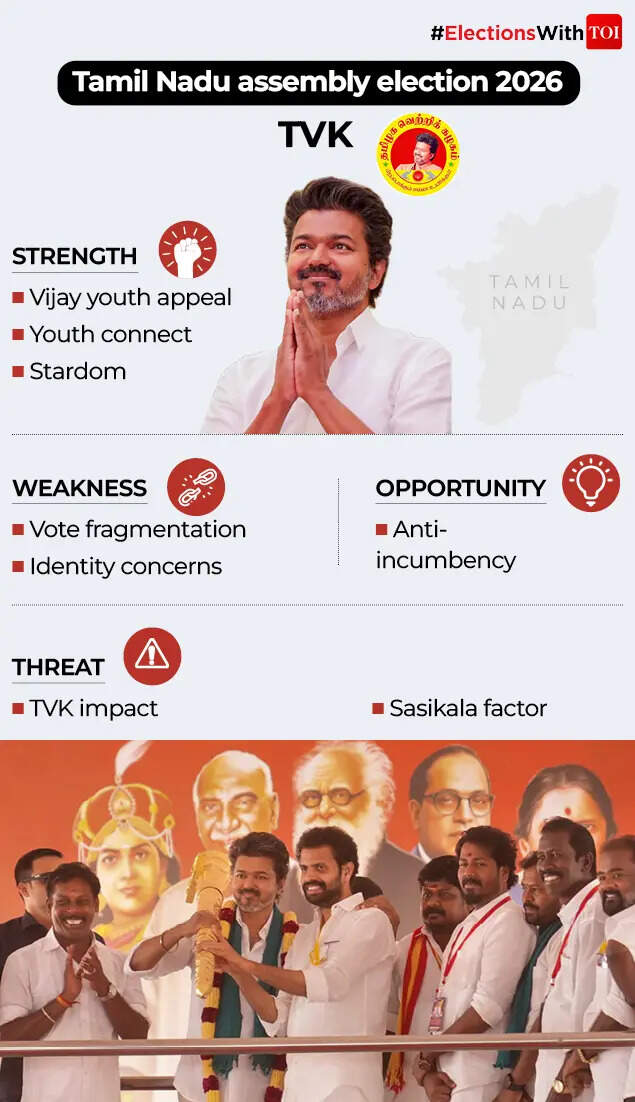
Strength: Led by Vijay, TVK’s biggest strength lies in its ability to convert celebrity appeal into political mobilisation. Its fan clubs provide a ready-made grassroots network, particularly in urban and semi-urban areas.The party has struck a chord with youth and first-time voters, positioning itself as a clean, anti-establishment alternative. Its strong digital presence and high-energy campaign style give it visibility that rivals established parties.
.
Weakness: Despite its momentum, TVK lacks a tested organisational structure capable of delivering votes at the booth level. Its heavy dependence on Vijay’s personal charisma raises questions about depth and scalability.The absence of governance experience and a second line of leadership adds to scepticism among voters, particularly in rural areas. Candidate selection, largely reliant on newcomers, may also affect electoral credibility.Opportunities: The fragmentation within the AIADMK and the broader opposition space presents TVK with a significant opening. It can attract disillusioned voters seeking an alternative to both Dravidian majors.Urban centres such as Chennai, Coimbatore, and Madurai offer fertile ground, with higher youth populations and visible dissatisfaction with traditional politics. Even a modest electoral performance could establish TVK as a long-term political force.Threat: One of the biggest risks for TVK is being perceived as a “vote-cutter,” inadvertently benefiting the DMK by splitting opposition votes.There also remains a gap between crowd mobilisation and actual vote conversion. Established parties are likely to question its credibility, governance readiness, and ideological clarity. Competition with Seeman’s NTK for similar voter segments could further divide the anti-establishment vote.
The larger question: Continuity or transition?
For M K Stalin, this election is about more than just returning to power. It is about legacy — achieving what M Karunanidhi never did: winning consecutive terms.For the opposition, it is about survival, relevance, and reclaiming lost ground. For new entrants like TVK, it is about breaking into a system that has historically resisted disruption.As Tamil Nadu heads to the polls, the key question is no longer just who will win. It is whether the state’s political structure itself is beginning to change.Will the Dravidian model adapt and endure, or is this the election where new forces begin to redraw the map?The answer will shape not just the next government, but the future trajectory of Tamil Nadu politics.

Leave a Reply