

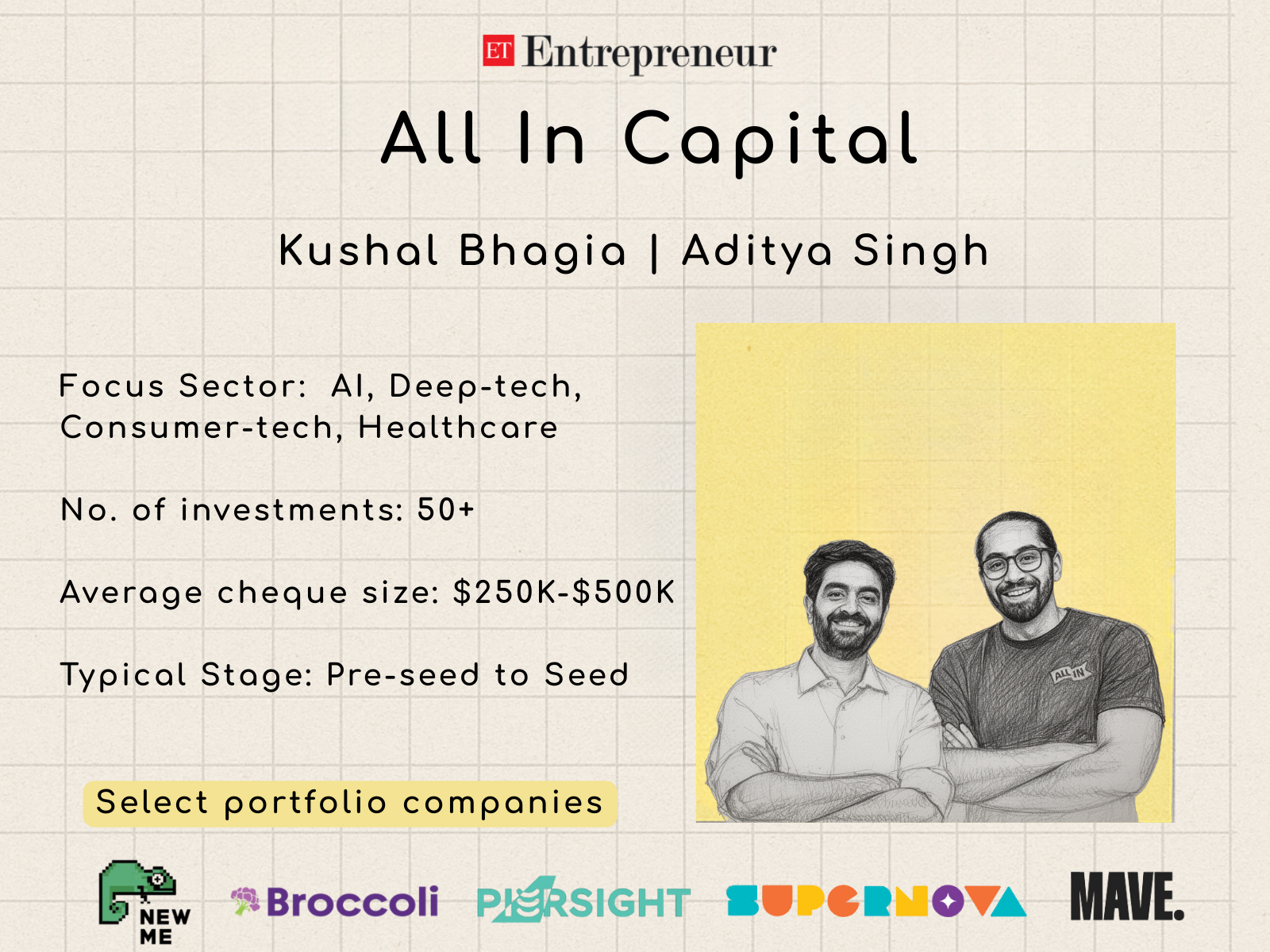
 The Bengaluru-based VC firm primarily invests at the pre-seed and seed stages, backing founders at the idea, early product, or early traction phase.
Before becoming an investor, Kushal Bhagia began his journey as a founder, learning the realities of entrepreneurship the hard way. It was in 2012, when he launched Nayi Disha Studios to build educational games for children and ran the company for nearly four years.
The startup raised a small seed round, signed up over 100 paying schools, and saw more than 10,000 children use its platform.
While the business ultimately did not scale, the experience gave Bhagia an early, unfiltered learning in building and navigating uncertainty, becoming lessons that would go on to shape his investing mantra.
Post that stint, Bhagia moved into venture capital through early stage VC firm IndiaQuotient, where he launched Firstcheque, a scout-led investment program.
Over three years, the fund deployed into nearly 100 startups, backing now popular companies such as GIVA, FleetX, Seekho, DrinkPrime, The ePlane Company, among others.
That conviction ultimately led him to take the plunge. In 2022, Bhagia teamed up with fellow entrepreneur Aditya Singh to launch All In Capital.
“That was really my first brush with investing and backing founders as an investor rather than building things on my own… And I loved that. I was meeting founders every single day and learning what conviction really feels like at day zero,” Bhagia tells ETEntrepreneur.
Today, the Bengaluru-based VC firm primarily invests at the pre-seed and seed stages, backing founders at the idea, early product, or early traction phase.
The gap larger funds left behind
By the time All In Capital launched four years ago, India’s VC ecosystem had grown larger and more capital-rich. But as fund sizes crossed $200 million, many firms began moving upmarket, preferring startups with traction over idea-stage bets.
“I realised that most other funds had graduated $200 million-plus funds in size. And that meant that the ability to actually take a risk and pre-seed, and back founders on day zero, actually goes down,” he explained.
Larger funds, he argued, cannot consistently write $250,000–$500,000 cheques for first-time founders with just an idea.
“That’s how we decided to back non-obvious founders at day zero and do whatever it takes to help them win, supporting them through to their first $2–$3 million seed round,” Bhagia said.
For All In Capital, that means designing the fund around access. This includes showing up early, committing quickly, and showing confidence when very few others are willing to.
The firm launched Fund I as an $11 million vehicle that backed 50 startups. With Fund II, a $25 million fund, the firm typically writes cheques between ₹2 crore and ₹5 crore, while setting aside a major portion of the capital for follow-on investments in its strongest portfolio companies.
Some of these startups from Fund II span across sectors such as consumer, deep tech and AI.
Finding founder-market fit
Typically, early-stage founders are less concerned about valuation and more focused on finding someone willing to build alongside the big risks. In Bhagia’s view, that early belief is often what gives first-time founders the push to take the next leap.
“What a founder is looking for is basically a believer; that I can make this happen and I can get this off the ground. So that’s how we designed our fund…to attract really talented, hungry founders whom we can believe in on day zero,” he added.
Bhagia says the real filter is also finding the right ‘founder–market fit’. He more often looks for founders who understand a problem viscerally and can articulate on why a company should exist.
“After doing multiple investments, we certainly look at traits for each sector we invest in. The second thing we look for is a ‘why now’. That’s one of the most important questions to try and address while we first evaluate a company,” he explained.
The ‘why now’ could stem from new technology such as AI tooling, a regulatory inflection point, or a clear change in consumer behaviour.
Rather than compete in crowded categories, the firm prefers to enter early, backing founders in emerging pockets where timing creates an advantage.
“No great company starts with only one person having an idea; if it’s a good idea, there will usually be multiple people working on it. And that’s typically because something in the world has changed to make that idea possible at that moment,” he said.
Going all in on AI
AI, Bhagia noted, has changed the economics and speed of early-stage building.
For the first time, small founding teams can operate with the leverage of much larger organisations. What previously required a 15–20 member team can now be achieved by two or three highly technical founders armed with the right AI stack.
“Pre-AI, $10 million ARR (annual recurring revenue) used to be like the Series B gold of a SaaS company. Now three founders can do this because they can just ship that much faster,” he noted.
For All In, this opportunity plays out in two major areas: building AI products from India for US enterprises, or building AI solutions for Indian consumers.
He added how with use cases such as English tutors, tax planners to wellness coaches, AI lowers the cost of expertise, making premium services accessible through subscription and micro-payment models.
One such portfolio company building along the same lines is Supernova, an AI-led edtech platform offering solutions around spoken English and communication skills.
The company has scaled to over $11 million in ARR by helping users learn English.
Traditional English courses with a skilled teacher can cost ₹5,000-₹10,000 and offer just a few hours of interaction each week. By contrast, the startup’s AI-powered teacher is accessible anytime on a user’s phone for a fraction of the cost, at ₹200.
“This is how AI is redefining access and quality in education. Whatever services that the rich can afford will be delivered to everyone at a mass scale in the form of an AI,” Bhagia said.
Going ahead, All In Capital plans to invest in approximately 50 startups over a three-year deployment period from its second fund.
While venture capital has become more structured and traction-focused, Bhagia’s conviction is far from writing cheques on the largest deals and closer on winning the earliest ones. Ultimately, going all in, before anyone else does.


Leave a Reply