

 The Health Factory first gained traction with its protein bread and later with its zero maida positioning. But Maheshwari resists being boxed into the protein wave.
The Health Factory sells between 35 and 40 lakh units a month. It has grown 200x since 2022, expanded across major metros and raised capital from Peak XV’s Surge. But ask co-founder Vinay Maheshwari what matters most, and he doesn’t begin with protein percentages or growth rates.
“Taste comes first, then texture and then nutrition,” he said. In a market flooded with protein claims and clean-label positioning, Maheshwari’s wager is different: don’t change what India eats. Upgrade it.
What began in 2017 as an attempt to fix what he saw as empty calories in everyday bread has since evolved into a broader ambition.
Execution before optics
The origin story is less romantic than it sounds.
Maheshwari says it took between 800 and 900 trials and nearly nine months to crack the first version of the brand’s protein bread. “Brands are built with time. Products are built with time, not with money,” he said, pushing back against the idea that capital can accelerate everything.
In the early days, there was little of either. The founders, Maheshwari and Mohit Sankhala, delivered bread on a scooter, pitched retailers door to door and personally handled customer calls. Covid nearly derailed the business; at one point, the company had a month of runway left. The team shrank back to the two co-founders.
But the approach did not change. “Distribution also equals branding,” Maheshwari said. In a category where advertising budgets often dominate, The Health Factory leaned on physical availability and repeat purchase.
The company’s philosophy was simple: behave bootstrapped, even when capital arrives. Maheshwari says the business must never become dependent on someone else opening the door for it to survive. “Let’s never be in a position ‘ki dukaan kisi ke darwaze par khatkhataye aur agar darwaza nahi khula toh dukan band ho jaye. Dukaan kabhi band nahi hogi,’” he said.
Today, he claims profitability is “90 days away, whenever we choose to.”
Building inside the staple
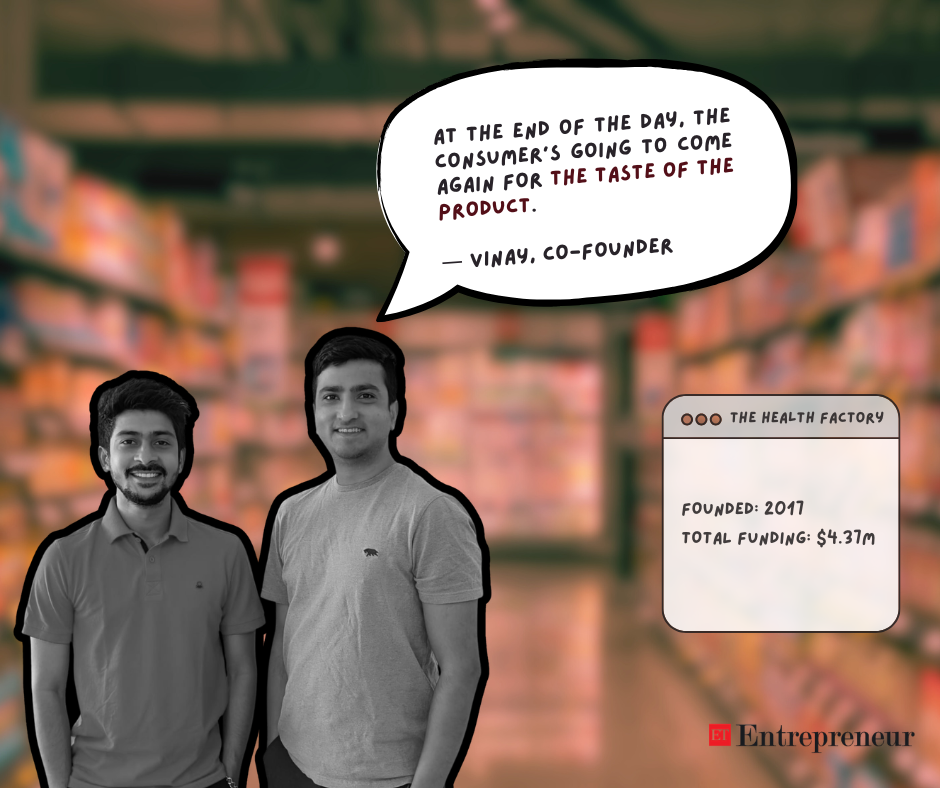
The Health Factory first gained traction with its protein bread and later with its zero maida positioning. But Maheshwari resists being boxed into the protein wave.“Don’t do everything protein,” he said. In his view, too many brands lead with macronutrient marketing and compromise on flavour. “At the end of the day, the consumer’s again going to come for the taste of the product.”
The insight underpinning the brand’s expansion is behavioural. Instead of introducing new formats or asking consumers to rethink diets, The Health Factory focuses on staples: bread, buns, rusk, pizza bases and mini cakes.
The thesis is straightforward: upgrade everyday food without forcing habit change.
When the company launched its rusk variant, sugar content was brought down significantly from category norms while maintaining texture. Within months, Maheshwari said, the product was selling over 120,000 units a month. The hierarchy held: taste first, nutrition must follow.
The brand has also expanded into sourdough, multigrain and low GI variants. Increasingly, fibre has become central to formulation.
“I think fiber is going to become very mainstream,” he said. Protein may dominate headlines, but absorption and gut health, he argues, are equally important. “A happy gut equals a happy mood.”
Quick commerce and visibility
If formulation was the foundation, quick commerce became the accelerator.
The Health Factory was an early participant on platforms such as Blinkit, Swiggy Instamart and Zepto. Maheshwari describes them as partners, with conversations evolving from brand-level growth to category expansion.
The company’s scale-up coincided with the rise of rapid grocery delivery across urban India. Between mid-2022 and early 2023, Maheshwari says, revenue grew 10x following its first fundraise.
The brand’s visibility received an additional boost after the co-founders appeared on Shark Tank India. While the company did not secure a deal on the show, the exposure expanded awareness at a time when consumer interest in functional foods was rising.
For The Health Factory, however, television was not a turning point so much as an amplifier. By the time the episode aired, the company had already begun scaling its Zero Maida and protein portfolio across multiple metros.
Beyond bread
The Health Factory no longer positions itself as just a bread brand. Expansion into adjacent staples is deliberate and paced. The strategy, Maheshwari says, is to go deep into a category before widening the portfolio, ensuring formulation and distribution strength before chasing scale for its own sake.
Growth, too, is framed differently. “I stopped understanding percentage growth and only understanding 2Xs, 3Xs and 4Xs,” he said, suggesting a focus on step-change expansion rather than incremental gains.
But the ambition extends beyond multiples.
“Earlier, I used to have a small or a petty vision saying I want to be as big as that brand,” Maheshwari said. “Then, I slowly and steadily turned that narrative to, I wanna build a Health Factory, and suddenly it has no ceiling.”


Leave a Reply