
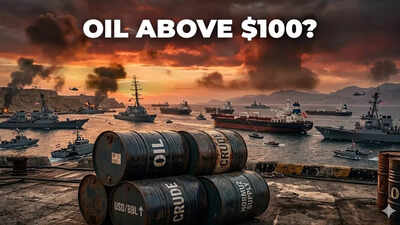
The Strait of Hormuz serves as the primary outlet for most crude exports from the Persian Gulf. (AI image)
Will oil prices hit $100 due to ongoing tensions and conflicts in the Middle East? Oil, quite literally, is the fuel that drives global economies. Rising oil prices in turn can trigger inflation across goods and services in major economies. In fact, the war between US-Israel and Iran have sparked fears that a 1970s style energy shock may be loading!Global oil markets are preparing for potential supply disruptions after US airstrikes on Iran over the weekend revived concerns that shipments through the Strait of Hormuz could be affected.
US President Donald Trump’s move to launch strikes on Iran has introduced fresh uncertainty for a major chunk of global oil supplies.
Israel attacks Iran
Iran produces over 3 million barrels of crude per day, accounting for roughly 3% of worldwide output and ranking as the fourth-largest producer within OPEC. However, its strategic position gives it influence that extends well beyond its production share.The more significant concern is whether the situation could escalate into a prolonged disruption of crude exports from the Gulf region.
The 1970s energy shock
During the 1970s, there were two major shocks to the oil markets that sent ripples across global markets. The first crisis happened in 1973–74, when Arab OPEC nations enforced an oil embargo against the United States and other countries that backed Israel during the Yom Kippur War. This led to sharply reduced supplies, causing oil prices to rise substantially resulting in fuel shortages, high inflation and economic hits in many Western nations.Also Read | Middle East on the boil after Khamenei’s death: What does it mean for India’s trade, exports, crude oil & LPG supply?The second problem happened in 1979 in the wake of the Iranian Revolution, which severely affected Iran’s oil production. Concerns over constrained output once again drove crude prices steeply higher.
Strait of Hormuz & its vital role
This time around, if Iran were to successfully shut the Strait of Hormuz, the fallout for global oil markets could be profound.“This could present a scenario three times the severity of the Arab oil embargo and Iranian revolution in the 1970s, and drive oil prices into the triple digits, while LNG prices retest the record highs of 2022,” Saul Kavonic, head of energy research at MST Marquee told CNBC.
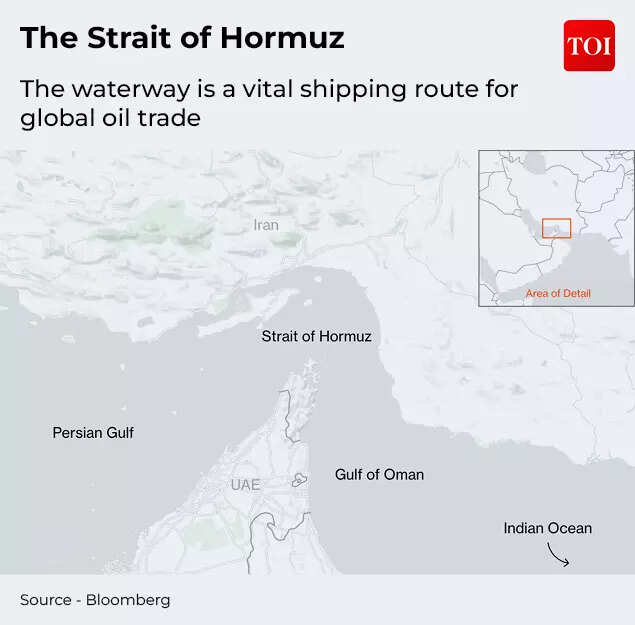
Strait of Hormuz
As tensions mount, focus has once again turned to the Strait of Hormuz, where any blockage would have swift and far-reaching implications for global crude and LNG supplies.Located between Oman and Iran, the narrow waterway functions as a vital transit corridor and a potential bottleneck for international oil trade. Data from Kpler indicates that around 13 million barrels per day passed through the strait in 2025, accounting for roughly 31% of total seaborne oil flows.The Strait of Hormuz serves as the primary outlet for most crude exports from the Persian Gulf, along with refined products including diesel and aviation fuel. Qatar, a leading exporter of liquefied natural gas, also depends on this route. Ship-tracking data suggest that LNG shipments through the passage have nearly come to a standstill.
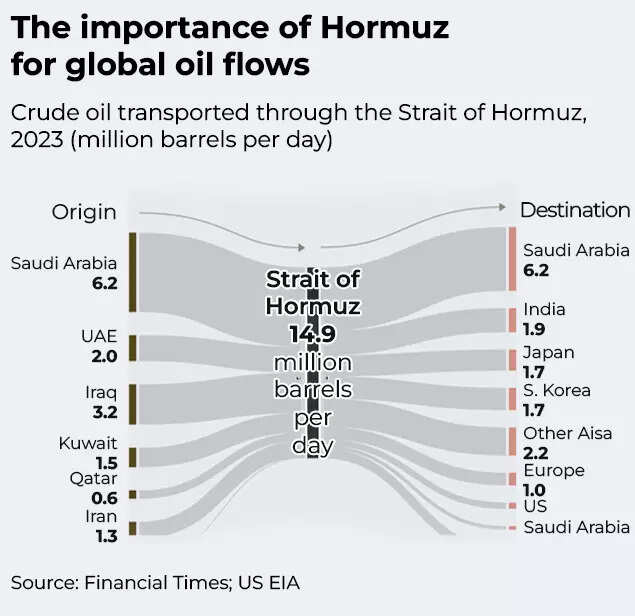
Iran has on several occasions over the years warned it could shut the narrow Strait of Hormuz in retaliation for attacks against the Islamic Republic.The route connects leading Gulf oil producers such as Saudi Arabia, Iran, Iraq and the United Arab Emirates to the Gulf of Oman and the Arabian Sea.Reuters reported on Saturday that an official from the European Union’s naval mission, Aspides, said commercial ships had received VHF radio warnings from Iran’s Revolutionary Guards stating that “no ship is allowed to pass the Strait of Hormuz.”The official added that Tehran had not officially confirmed any order to shut the passage.Following the attacks in the region that began on Saturday, vessel movement through the passage declined sharply, with reports indicating that three ships were targeted near the entrance to the Persian Gulf.Also Read | US-Israel strikes on Iran: How will India be hit by Strait of Hormuz closure? Explained
Alternative Export Routes
Some OPEC producers, notably Saudi Arabia and the United Arab Emirates, have limited capacity to redirect crude shipments through pipelines that circumvent the Strait of Hormuz.According to a Bloomberg report, Saudi Arabia can channel part of its exports through a 746-mile pipeline stretching across the country to a Red Sea terminal, from where oil can be loaded onto tankers for further transport. The East-West Pipeline has a throughput capacity of up to 5 million barrels per day.
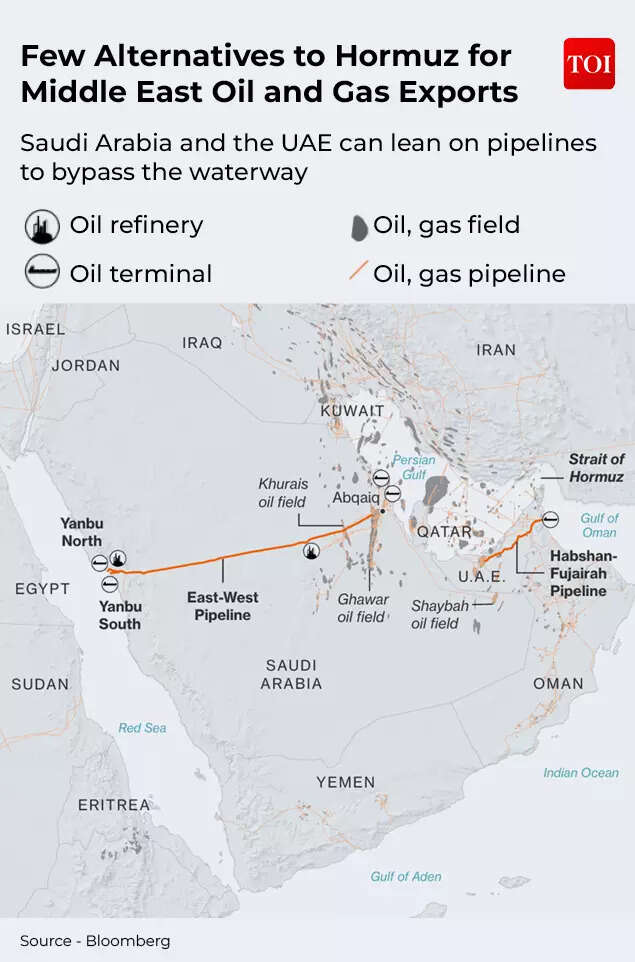
Few alternatives to Hormuz
The UAE also has a partial workaround. It operates the Habshan-Fujairah pipeline, which links its oil fields to a port on the Gulf of Oman, allowing it to bypass Hormuz to a certain extent. This pipeline can handle around 1.5 million barrels of crude daily.Iraq, the second-largest producer in OPEC, has a pipeline running through Turkey to the Mediterranean. However, this route only carries oil from northern fields. As a result, the vast majority of Iraqi crude exports are shipped from the southern port of Basra and must transit the Strait of Hormuz.Kuwait, Qatar and Bahrain do not have alternative routes and remain entirely dependent on the strait for their oil exports.Despite these pipeline options, a shutdown of the waterway would still significantly disrupt global supply flows and push crude prices higher.
Iran’s Oil Output
Iran’s crude production rose to roughly 3.3 million barrels per day, up from under 2 million barrels per day in 2020, even as international sanctions remain in place. The country has improved its ability to bypass these restrictions, with nearly 90% of its oil exports currently directed to China.For exports, Kharg Island in the northern Persian Gulf serves as the main shipping and storage hub. Kharg Island is equipped with multiple loading berths, jetties, offshore mooring points and storage tanks capable of holding tens of millions of barrels of crude. In recent years, the terminal has managed export volumes of more than 2 million barrels per day.Any direct strike on the Kharg Island export terminal would deal a severe blow to Iran’s economy.
Worst-case scenario: Oil above $100
According to the CNBC report, analysts suggest outcomes could range from minor interruptions to Iranian exports to a complete closure of the Strait of Hormuz.For global markets, the gravest risk is not limited to reduced Iranian supply but extends to a wider breakdown in maritime traffic through the strait.“Early indications are of a broader scale attack on Iran, with counterattacks which could escalate to draw in multiple Gulf countries,” said Saul Kavonic.
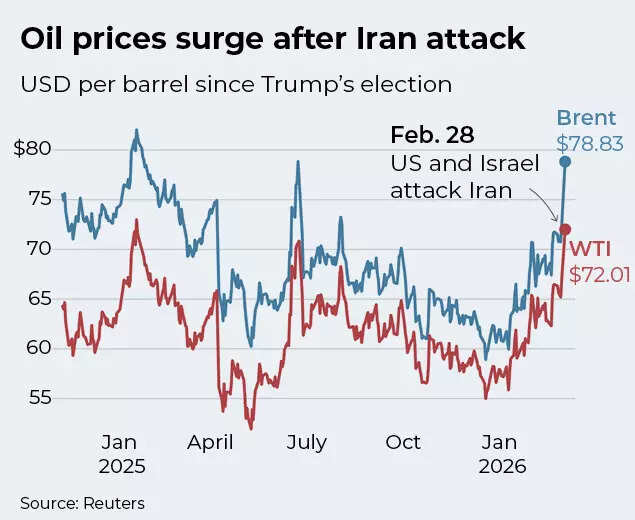
Kavonic said traders are likely to factor in a range of possibilities at the outset, from the loss of as much as 2 million barrels per day of Iranian exports to strikes on regional infrastructure or, in the most extreme case, a halt in transit through Hormuz.“If the Iranian regime feels they face an existential threat, attempts to block the Strait of Hormuz cannot be ruled out,” he said, while noting that the United States and its allies would probably deploy naval protection to safeguard shipping routes.
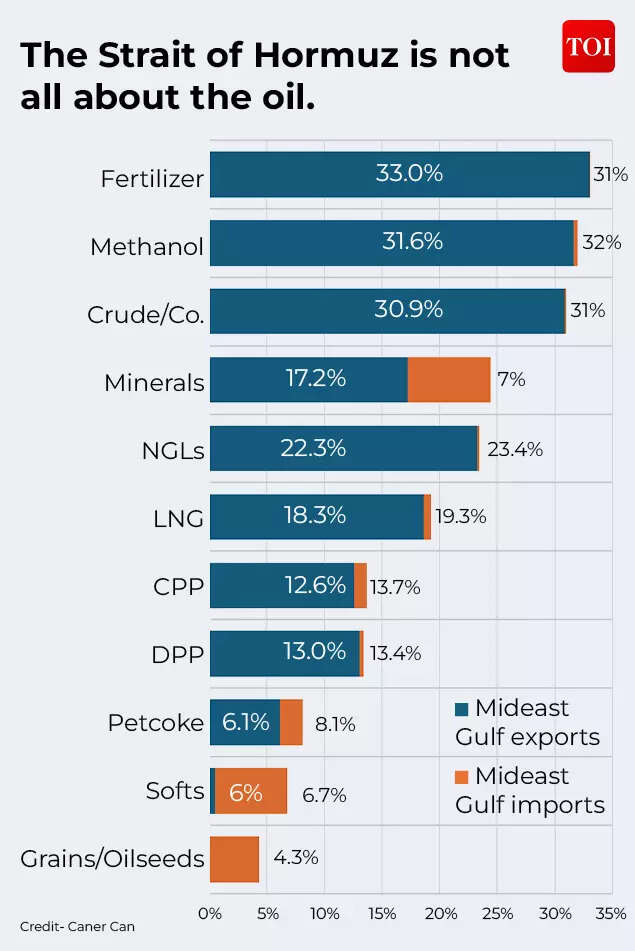
The Strait of Hormuz is not all about oil
“At this point, it seems we are looking at a full-scale military conflict between the U.S. and Iran, which would be unprecedented and the trajectory impossible to assess,” said Vandana Hari, CEO of energy research firm Vanda Insights.“If it carries on for days with Iran and its proxies retaliating to the fullest extent, we are looking at the worst-case scenarios for oil, including a major disruption of oil flows through the Middle East,” Hari told CNBC. Bob McNally, president of Rapidan Energy Group described the situation as “a very serious development” for global oil and gas markets, given their heavy reliance on production and transit through Hormuz.Industry experts stressed that the key factor now is how long the tensions persist. McNally said the scale of any surge in oil and LNG prices would hinge on both the duration and the breadth of disruptions to output and shipments from the Gulf.Andy Lipow, president of Lipow Oil Associates, said the recent strikes have materially increased the likelihood of supply disruptions in the region, even though Iranian oil installations have not yet been directly hit.He characterised the most severe scenario as “an attack on Saudi oil infrastructure followed by a complete closure of the Strait of Hormuz.” Lipow placed the probability of such an outcome at around 33 per cent, suggesting Iran could take drastic measures if it feels cornered.(Disclaimer: Recommendations and views on the stock market, other asset classes or personal finance management tips given by experts are their own. These opinions do not represent the views of The Times of India)

Leave a Reply