

 Fund III has already deployed into seventeen companies, with several raising strong follow-on rounds.
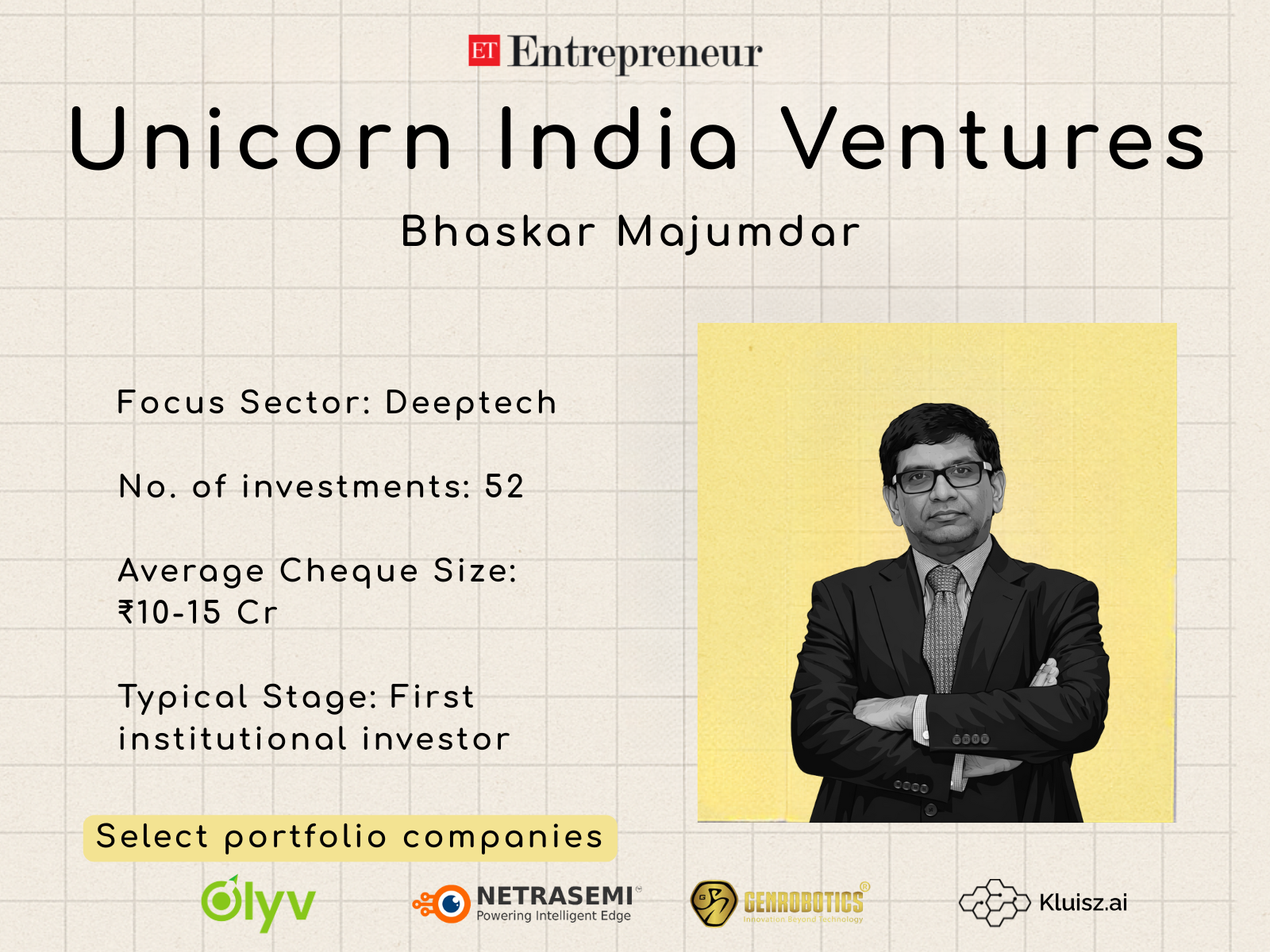
When Bhaskar Majumdar looks at the rush of Indian VCs suddenly rushing into deep tech, he does not say much. He does not need to. The last decade already tells its own story.
“We are an engineering VC. Software was never our DNA,” he said. “Deep tech is not a theme for us. It is how we have always invested.”
The firm has operated with an engineering-first mindset since its first cheque in 2016, long before the current wave of interest in drones, semiconductors, and space.
Majumdar’s point is not that others should not enter deep tech. It is that deep tech requires something Indian VC culture rarely cultivates: patience, operational immersion, and the ability to work with founders who have spent twenty years mastering their craft.
“Early-stage investing is an art, not a science,” he said. “You need to feel for the entrepreneur. The models will change. The market will change. The only constant is the founder.”
For Unicorn, this philosophy has shaped everything.
How an engineering mindset became a VC playbook
In a landscape where most early funds were software-first, Unicorn followed a different path. Majumdar’s own career had moved through media, technology, international markets, and two startup exits. His co-founder, Anil Joshi, had spent years investing at a time when India had little understanding of startups at all. Both carried scars and intuition from the real work of company building.So when they raised their first ₹100 crore fund, their approach was already formed.
Unicorn would be the first institutional investor. It would use only 20 per cent of its capital to build its initial portfolio. It would use the remaining 80 per cent to double down on the winners. It would avoid idea-stage bets, but enter as soon as a product was in motion. It would take meaningful positions early and then stay involved for a decade.
Most of all, it would treat exits not as a distant hope but as something that must be engineered.
“We cannot control the exit price. We can definitely control the entry price,” Majumdar said. “That has been our discipline.”
The results justified the method. Fund I returned more than three times capital in its first year of distributions and is on track for a six times DPI. Fund II is pacing toward a four to four and a half times outcome. Fund III has already deployed into seventeen companies, with several raising strong follow-on rounds.
Majumdar credits this to saying no in 2021 and 2022, when easy capital flooded the market and valuations detached from reality.
“It was not easy for the team,” he said. “We would work on a deal for months, say no, and two weeks later see a bigger fund close it. But staying disciplined saved us.”
India’s deep tech moment is structural
If Unicorn’s philosophy was ahead of its time, the market has finally caught up.
The shift is visible across policy, academia, and global supply chains.
“The next global fight for control will not be territorial. It will be about technology,” he said. “AI, data centers, silicon chips. These are strategic priorities for every government of scale. India is no exception.”
The change is visible in the PLI and DLI schemes, in patent enforcement norms that did not exist five years ago, and most importantly, in how academic institutions are behaving.
For decades, IIT and IISc patents gathered dust. Today, they are being commercialized by professors who are becoming co-founders. Unicorn’s portfolio already includes five companies where faculty members are active builders.
There is also the China plus one shift, which has opened opportunities across manufacturing, electronics, and orbital technologies. India’s cost structures, engineering talent, and maturing regulatory clarity have aligned in a way the ecosystem has never seen before.
Unicorn’s own portfolio reflects this conviction. The firm has invested in drones, defense technology, semiconductors, AI infrastructure, climate tech, and space.
Betting on AI infrastructure
Majumdar is blunt about the current AI frenzy. He believes too many Indian companies are front-end wrappers with little defensible value, that the excitement exceeds differentiation, and that valuations are outpacing fundamentals.
“We are unsure where the front-end AI story will land,” he said. “So we avoid it.”
Instead, Unicorn is investing where AI becomes infrastructure. It backed Netra Semi, which is developing a local AI chip. It is exploring radar and computational technologies emerging from IISc.
“Regardless of who wins at the application layer, India will need its own AI infra,” he said. “Security, defense, public sector, everything depends on it.”
It is a sober view that mirrors his earlier calls during the 2021 bubble.
The founders they choose
Unicorn’s average founder age is over forty. It is a deliberate choice.
Their ideal entrepreneur has spent fifteen to twenty years inside the industry they are now disrupting. They know the operational pain points. They have built teams before. They understand the regulatory terrain. They have lived in the market.
“These founders do not need us for product advice. They need us for organization building, financial structure, and strategic doors,” Majumdar said.
Unicorn by 2030
Majumdar’s ambition is crisp.
“I want to build a multi-stage private markets firm,” he said. “Early, growth, and eventually pre-IPO. All within private markets.”
It is a natural next step for a fund that has evolved from ₹100 crore to ₹1,200 crore, and brought one third of Fund III from international investors.
But beneath the scale, the philosophy remains intentional. Deep tech, engineering-first, disciplined entry, concentrated conviction, structured exits, and long-term partnerships with founders who treat the next decade as the real horizon.


Leave a Reply