

 Malpani’s path into venture capital has been unusually interdisciplinary, and she is explicit about why that matters in the age of AI.
When artificial intelligence (AI) entered the mainstream conversation after the ChatGPT moment, venture capital moved quickly to grab their seats. For Natasha Malpani, the shift demanded a more fundamental rethink.
“AI is not just another technology cycle,” she said. “It’s going to change how companies are built and how investing itself is done.”
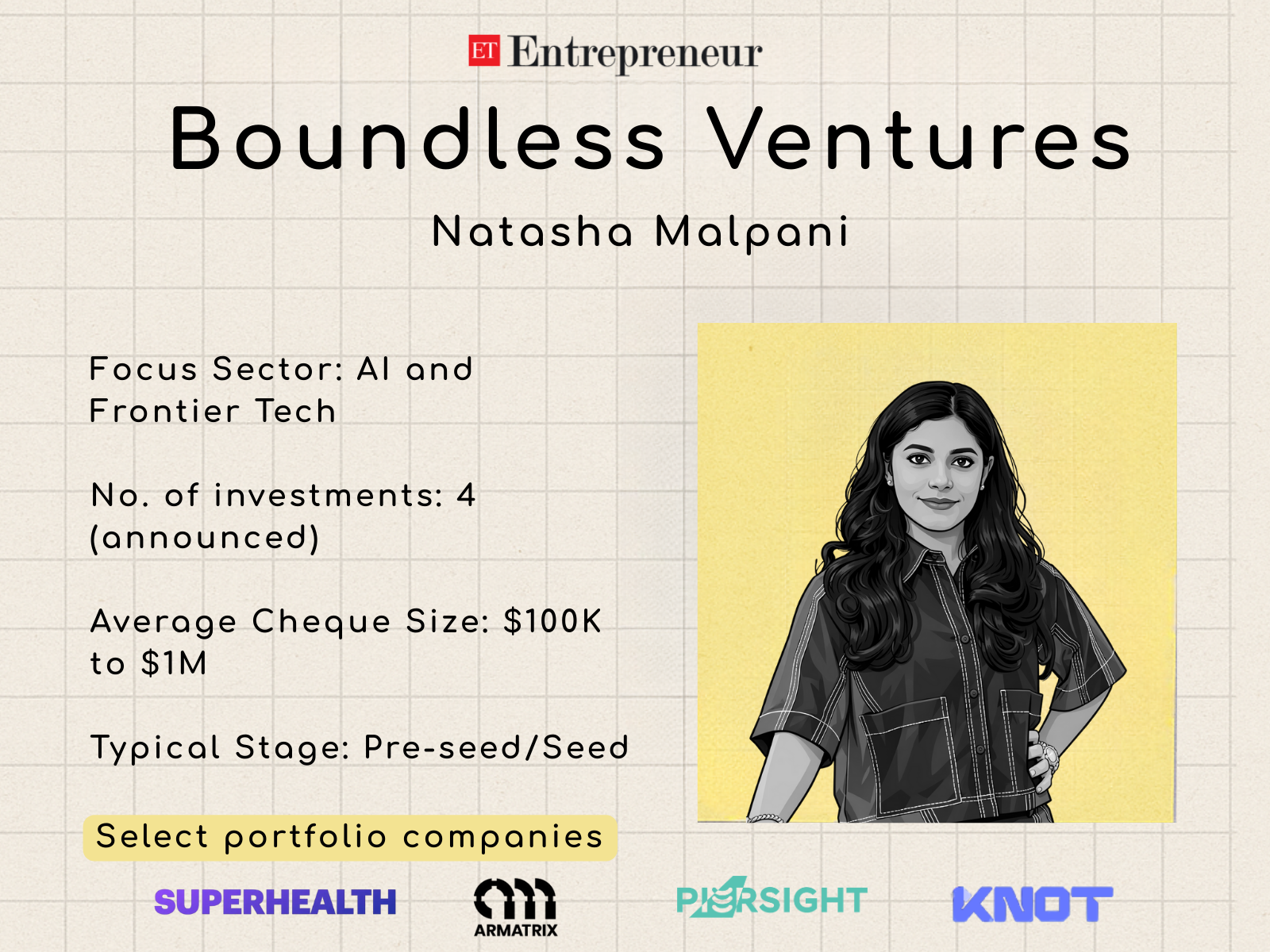
Boundless Ventures, which Malpani launched mid-2025, is her response to that belief. The fund is explicitly AI-first, investing at the pre-seed and seed stage with initial cheques ranging from $100,000 to $1 million, and reserves set aside to back companies through later stages.
It looks across consumer AI, vertical AI, infrastructure, and frontier technologies.
The positioning is deliberate. Malpani believes the AI wave is still at “day minus one”, with both founders and investors only beginning to understand what matters.
“The next ten years are going to look nothing like the last ten,” she said.
Jill of many trades
Malpani’s path into venture capital has been unusually interdisciplinary, and she is explicit about why that matters. She trained as an immunologist at Oxford University, coming from an illustrious family of doctors, before deciding she would rather invest in healthcare than practise it. She spent five years at Better Society Capital in London, helping build the healthcare portfolio of the billion-dollar impact fund from its early days.
From there, she went to Stanford University for an MBA, intending to return to India to invest. Instead, she added another feather to her cap: storytelling. A long-time writer, Malpani joined Pocket Aces, ran Dice Media, and later founded Boundless Media, producing content across formats, including the Bollywood film Uunchai.
“I’ve been a founder, an operator, and an investor,” she said. “Early-stage investing is the place where all of that comes together.”
That mix of science, media, and capital is not incidental to how she invests today. Malpani argues that AI favours founders and investors who can move across domains rather than specialise narrowly.
“I don’t believe there’s one career path anymore,” she said. “Range and perspective actually make you better at judgment.”
The boundlessness of AI
Malpani joined Kae Capital, one of India’s oldest home-grown venture capital firms, as generative AI began reshaping technology conversations globally. There, she developed the firm’s GenAI thesis and executed early AI investments. But the speed and scale of the shift convinced her that a dedicated pool of capital was necessary.
“In an AI wave like this, you don’t want to be catching up,” she said. “You want to have a point of view before consensus forms.”
Boundless Ventures reflects that conviction. The fund has already made four investments across India and cross-border markets, spanning consumer applications, deep tech, and frontier technologies.
But Malpani is careful to stress that the fund is not model-layer focused.
“The foundational models will keep getting better,” she said. “That’s not where the edge is.”
Instead, Boundless is focused on the application layer, where AI intersects with behaviour, workflows, and context. Malpani believes India’s advantage lies here: not in building large models, but in using them to reimagine products and systems.
“We already have more intelligence than we know what to do with,” she said. “The real question is how you use it.”
The application layer
Malpani divides AI investing by behaviour.
In consumer AI, she points to companies building ambient or invisible agents that respond to context rather than commands, or rethinking discovery in areas such as travel and local experiences. These businesses, she argues, could not have existed earlier, either because the technology was missing or because consumer behaviour had not matured.
“Middle-income India wasn’t doing weekend trips ten years ago,” she said. “That demand exists now.”
In frontier and deep tech, Boundless backs teams working on problems that require long-term horizons: autonomous aircraft, robotic inspection systems, ocean intelligence, and healthcare infrastructure. These companies often blend hardware, software, and AI in ways that defy clean categorisation.
“This is not about hype cycles,” Malpani said. “Founders are coming in with very long-term visions, solving problems that haven’t been solved before.”
Healthcare remains a core interest, reflecting her background. Boundless has backed companies such as Superhealth that combine physical delivery with AI-driven workflow automation, addressing inefficiencies across patient intake, diagnostics, insurance, and hospital operations.
“Healthcare delivery is broken for patients, doctors, caretakers, and insurers,” she said. “AI is just a tool. The question is how you reimagine the system.”
Global becomes local
Malpani is bullish on India’s role in the AI ecosystem, though not for the reasons most commonly cited. Cost advantages and talent depth matter, but she places equal weight on data, engagement, and behaviour.
“These models are forever hungry for context,” she said. “India is a necessary market.”
She expects global AI firms to deepen their presence in the country, not just through engineering teams but through products that learn from Indian usage patterns. The growing role of global capability centres, she argues, reflects this shift.
“We’re no longer just the back office,” she said. “We’re at the forefront of building the next wave.”
Boundless is structured to support founders navigating this cross-border reality. Malpani spends time between Mumbai, Bengaluru, and San Francisco, helping Indian founders access global markets while also highlighting the attractiveness of building for India itself.
Day minus one
Boundless plans to make roughly 30 investments from its current fund, with about 40 per cent allocated to initial cheques and the rest reserved for follow-on rounds. The firm is explicitly not exit-driven.
“If you build a great company, the exit will happen,” Malpani said. “We’re founder-first and market-first.”
That philosophy echoes across her views on AI more broadly. While job displacement and sustainability concerns dominate public debate, Malpani frames AI as a tool for augmentation rather than replacement.
“We should call it augmented intelligence,” she said. “The goal is to amplify human capability, not erase it.”
Fifteen years from now, she believes both investing and company-building will look fundamentally different. Boundless Ventures is her attempt to be positioned before that reality becomes obvious.
“We are absolutely at the starting line,” she said. “This is the beginning.”


Leave a Reply