
(This article forms a part of the Science for All newsletter that takes the jargon out of science and puts the fun in! Subscribe now!)
How far can plant life be pushed in harsh environments? Climate change as much as humans’ plans for colonies on the moon or Mars make this question urgent. Scientists already know that some microbes and crop seeds can tolerate heavy doses of radiation, deep cold, and vacuum.
Mosses and other bryophytes were among the first plants to colonise land and have survived repeated shifts in the earth’s climate, yet their limits in true space conditions were not well known. Previous space experiments mostly used vascular plants, which have specialised tissues to transport water and minerals through their bodies. Research on mosses stopped at simulations in labs.
In a study on November 20 in iScience, researchers from Japan chose the model moss Physcomitrium patens because its life cycle and stress responses have been well studied in the lab. They examined which moss tissues could withstand extreme stress, and whether any of them could stay alive in open space outside the International Space Station (ISS).
The team first compared three moss tissues — young filaments (protonemata), stress-induced brood cells, and spores inside their capsule — in simulated conditions, including intense ultraviolet (UV) light, freezing, high heat, vacuum, and vacuum plus short-wave UV. Then they sent the most resilient stage, spores encased in their sporangium, to a platform outside the ISS for nine months and measured how many spores still germinated when they returned.
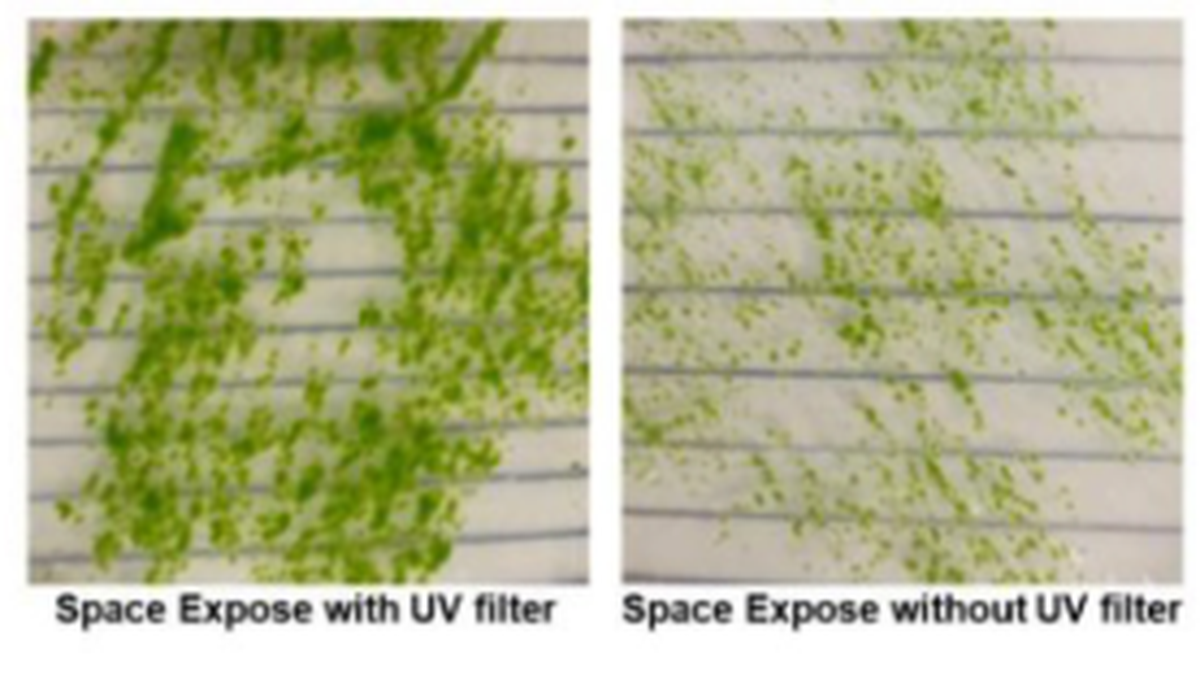
In the ground tests, protonemata died quickly under strong UV, long freezing at minus 80 °C, and when heated to 55 °C. Brood cells performed better but still failed under the strongest treatments. Spores protected by the sporangium were far tougher: many survived UV doses about 1,000x higher than brood cells, 30 days of deep freezing, and 30 days at 55 °C, with only partial loss of germination. They also tolerated nearly a month in high vacuum and strong vacuum-UV with almost no drop in viability. In space, spores from all dark and UV-shielded groups germinated at about 95%, showing that vacuum, temperature swings, and microgravity had little effect. Even in the fully exposed group, which received space UV, about 86% of spores still germinated.
The results suggested while the P. patens spores themselves were intrinsically stress-resistant, the sporangium added a protective shell against radiation, temperature extremes, and vacuum — echoing the way seed coats protect embryos in higher plants, and may reflect early evolutionary solutions that helped the first land plants cope with dry, exposed conditions.
By comparing UV tolerance across many organisms, the authors also showed that moss spores rival or exceed famous radiation-resistant microbes and some crop seeds, especially in their ability to handle very-short-wavelength UV. At the same time, the study noted the spores were less impressive at ultra-low temperatures than some tree seeds, that pigment damage could matter over longer missions and estimated that spores might survive 15 years in space based on limited data and needs testing.
Even so, the authors added, their work strengthened the idea that bryophytes could help “green” future extraterrestrial bases and support closed life-support systems while giving astrobiologists a clearer view of how robust plant life could be beyond the earth.

Leave a Reply