
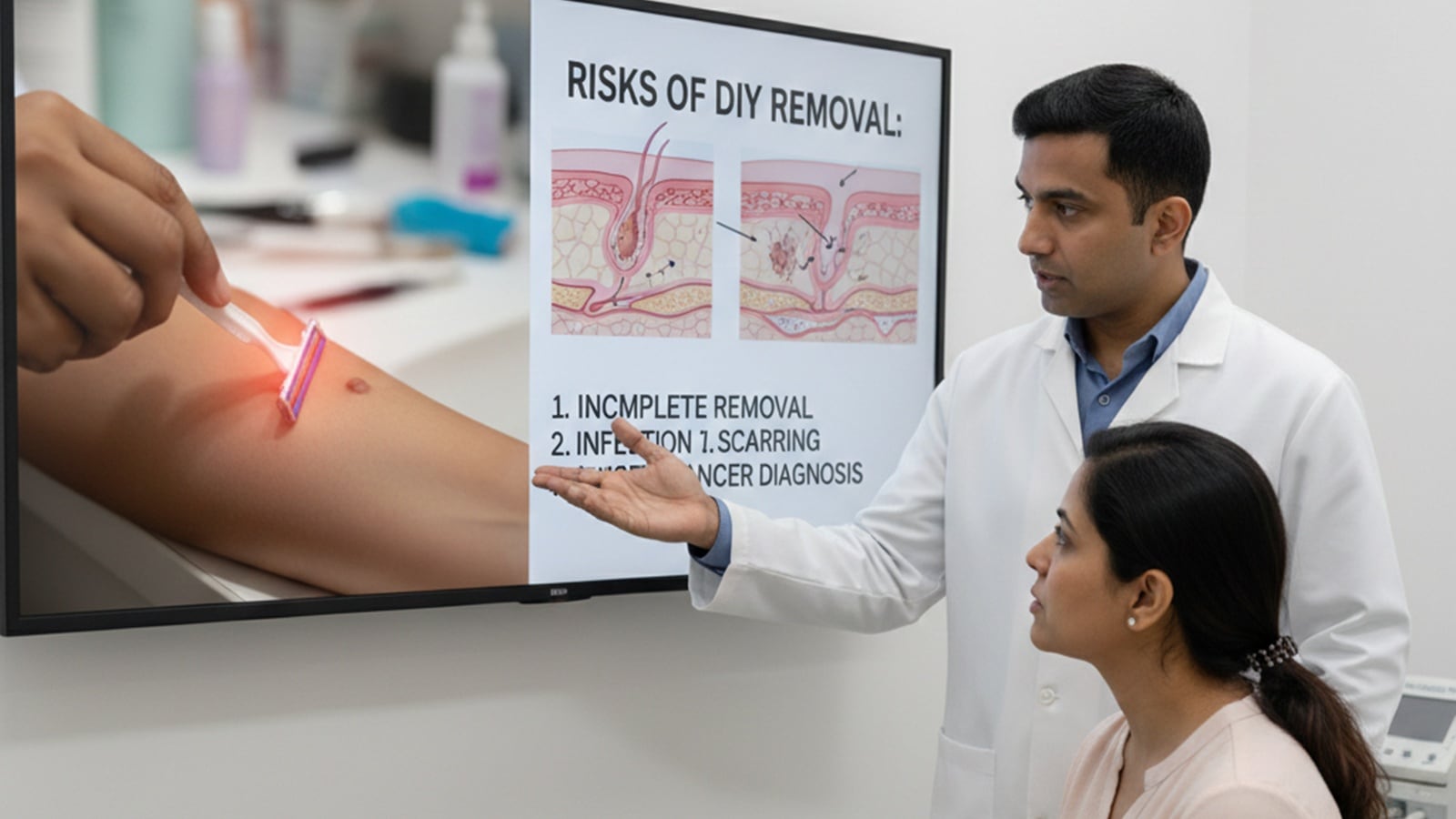
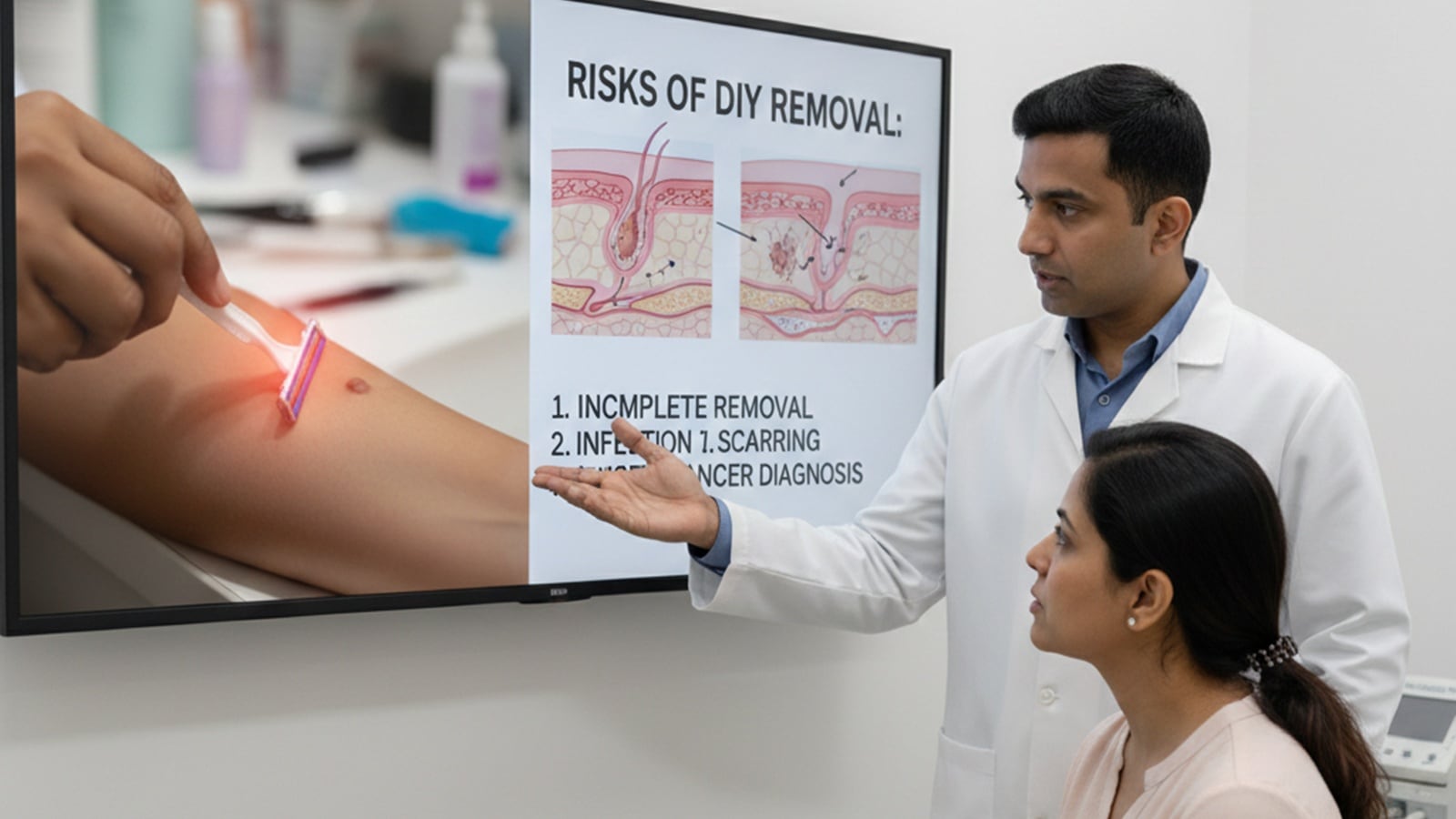
With DIY health hacks flooding social media, it has become increasingly common for people to address skin concerns on their own, sometimes quite literally. From using razors to burning or cutting off skin growths at home, many assume that removing a mole is a quick fix that saves time, money, and a visit to the dermatologist. Dr Mahyar Maddahali, a physician specialising in aesthetic medicine and vascular and endovascular surgery, in an Instagram video called out this disturbing habit, cautioning people against “playing dermatologist at home.” He mentioned, “If there is something growing on your skin and you think you can grab a razor and become a dermatologist, I’m sorry, but that’s absolutely dangerous.”
One of the biggest dangers, Dr Maddahali explains, is misidentification. What appears to be a harmless mole could be something entirely different, ranging from non-cancerous conditions such as acne, psoriasis, shingles, melasma, cherry angiomas or skin cysts, to far more serious issues like basal cell carcinoma, squamous cell carcinoma, or melanoma. He stresses, “Not everything you think is a mole is a mole. That little bump could be five different things, and none of them want you playing DIY surgeon.”
Another lesser-known but potentially frightening risk involves the blood supply. Some skin growths are connected to feeder blood vessels, so cutting them can cause significant, uncontrollable bleeding. Dr Maddahali explains this vividly, saying, “Some of these bumps have feeder blood vessels, meaning you cut it and suddenly your bathroom needs Benoit Blanc to figure it out.”
Infection is another major concern. He warns, “Third problem, infection. Oh yeah, because skin plus open wound plus TikTok advice equals big pharma corporate party. Not to mention, when you traumatise a lesion, it often grows back like a tree. But now it’s angry, distorted, and way harder for an actual dermatologist to diagnose correctly.” He ultimately urges people to avoid shortcuts altogether, concluding, “So don’t cut it, don’t burn it. It is one shortcut that makes things way worse.”
Harmless mole vs. a skin lesion that needs urgent medical evaluation
Dr Swetha Sridhar, medical director, Dr Swetha’s Skin Sutra Clinic, tells indianexpress.com, “Most harmless moles are symmetrical, evenly coloured, and remain stable in size and shape over time. They usually do not cause pain, bleeding, or itching. However, any skin lesion that shows a change should be evaluated by a dermatologist.”
She adds that warning signs that should never be ignored include rapid increase in size, irregular or blurred borders, multiple or uneven colours, spontaneous bleeding, persistent itching, pain, or ulceration. “A mole that looks different from others on the body, often referred to as the ‘ugly duckling,’ is another important red flag. Sudden appearance of a new mole in adulthood also warrants medical attention, as early detection of malignant changes significantly improves outcomes.”
Why cutting or burning a skin lesion at home makes future diagnosis and treatment more difficult
“Cutting or burning a mole at home can destroy critical tissue architecture that dermatologists rely on for accurate diagnosis,” warns Dr Sridhar, adding that when a lesion is improperly removed, it becomes impossible to assess its depth, margins, or cellular behaviour under a microscope, which are essential to rule out skin cancer.
Partial removal can also leave malignant cells behind, Dr Sridhar states, allowing the disease to progress silently beneath scar tissue. Additionally, home procedures increase the risk of infection, excessive scarring, uncontrolled bleeding, and delayed healing. In some cases, these actions can worsen the condition and complicate future surgical or medical treatment.
Story continues below this ad
Safest and most effective medical approach to mole removal
Dr Sridhar explains that the safest approach to mole removal is a dermatologist-performed procedure after a thorough clinical and, when needed, dermoscopic evaluation. Depending on the mole, this may involve surgical excision, shave removal, or biopsy under sterile conditions with appropriate anaesthesia.
“Removal is medically necessary when a mole shows suspicious changes, causes symptoms like bleeding or pain, or interferes with daily function. Cosmetic removal is considered only when a mole is confirmed to be benign, and the patient desires removal for aesthetic reasons,” concludes Dr Sridhar.
DISCLAIMER: This article is based on information from the public domain and/or the experts we spoke to. Always consult your health practitioner before starting any routine.

Leave a Reply