
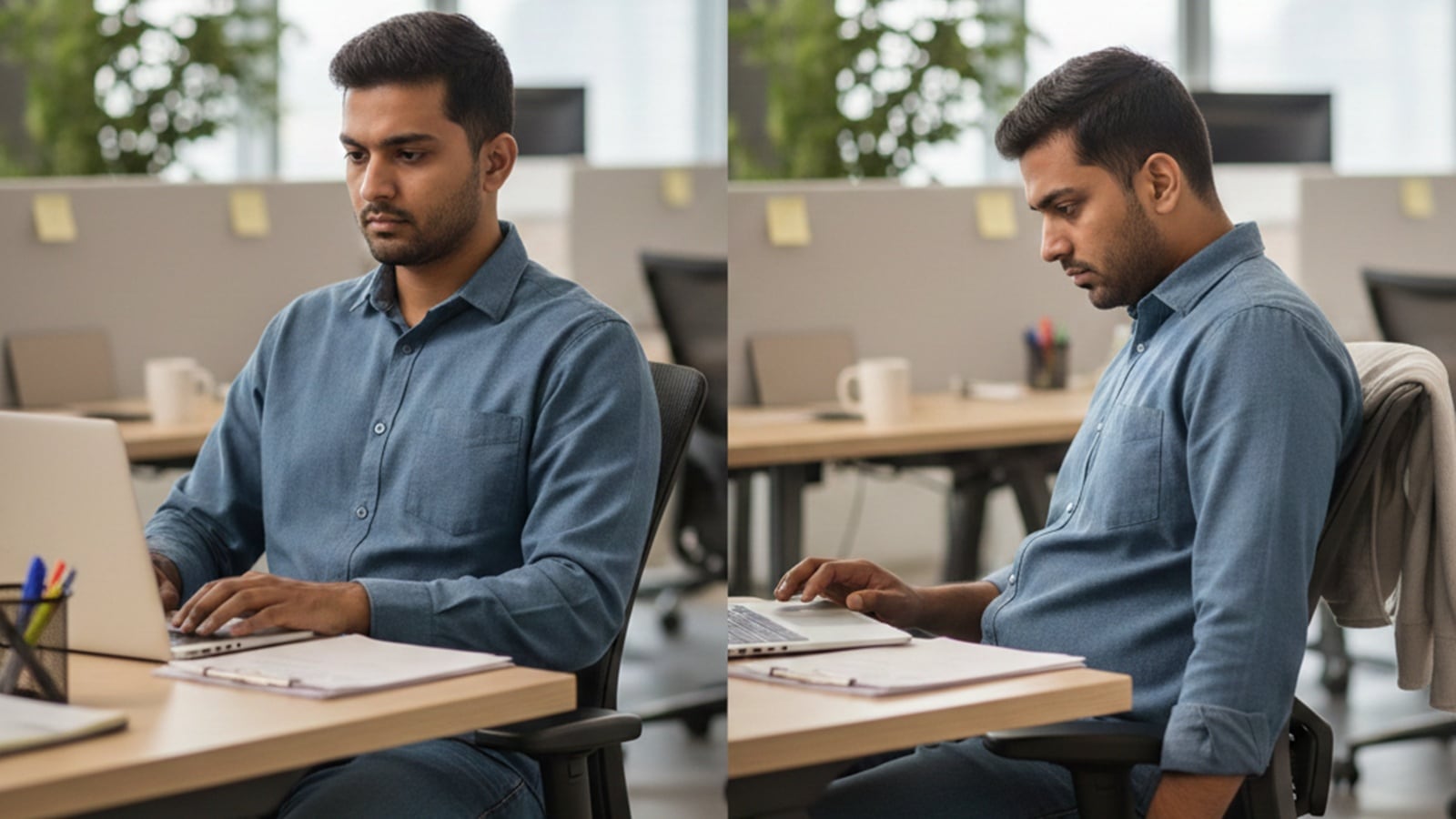
In a recent Instagram video, Dr Manan Vora, an orthopaedic surgeon, breaks down how different sitting styles at work can affect spinal load and why the duration of a posture matters as much as the posture itself. He states, “Which sitting posture is correct? Number one, sitting straight or number two, sitting slightly slouched? If you chose number one, you’re wrong. If you chose number two, you’re also wrong because there is no single posture that protects your spine.” He goes on to explain that sitting itself places greater pressure on the spine than standing, and that holding any position for too long can create problems.
He explains, “We already know that sitting puts more pressure on the lower back than standing. Research shows that forcing yourself to sit upright for long periods can actually increase spinal compression because your core muscles stay constantly tense. On the other hand, fully slouching flattens the spine’s natural curve and often increases disc stress even more.” Instead of choosing one rigid posture, he suggests a more flexible approach that considers movement and support.
According to him, “So, neither perfectly straight nor fully slouched is safe for hours. A slightly reclined position with good back support usually places less load on the spine. But even that becomes a problem if you stay there for too long. Your spine is not a pillar. It’s a dynamic structure made of 24 movable vertebrae, elastic discs, ligaments, and muscles. It is biologically designed for movement, not stiffness.” The takeaway is that variation and regular movement may be more important than chasing a single “correct” posture.

He emphasises, “That’s why any posture held for too long becomes stressful, even if it’s a good one. Moral of the story, the healthiest posture is the one you change regularly.”
Practical sitting habits during long workdays
Dr Raju Vaishya, senior consultant orthopaedic and joint replacement surgeon at Indraprastha Apollo Hospitals, New Delhi, tells indianexpress.com, “There is no single ‘perfect’ posture — the best posture is the next posture. The spine tolerates movement better than sustained static loading. During long workdays, aim for a neutral spine: ears over shoulders, shoulders relaxed, elbows at 90°, hips slightly higher than knees, and feet flat on the floor. Avoid prolonged slouching (lumbar flexion) or rigid upright sitting.”
He continues, “Distribute weight evenly on both sit bones and maintain gentle lumbar support to preserve natural lordosis. Keep the head aligned over the torso to reduce cervical strain. Avoid crossing legs for prolonged periods. Most importantly, vary posture frequently — alternate between upright sitting, slight recline (100–110°), and standing if possible. Small postural adjustments throughout the day reduce disc pressure, muscle fatigue, and ligament strain more effectively than maintaining any one “ideal” position.”
Frequency of position changes and beneficial micro-breaks
Dr Vaishya states, “Prolonged static sitting beyond 30-45 minutes increases disc pressure, muscle fatigue, and reduced circulation. Ideally, change position every 20-30 minutes and take a brief movement break at least once every hour. Even 1–2 minutes of standing, walking, or gentle mobility work significantly reduces spinal loading.”
Effective micro-breaks, according to him, include:
- Back extension stretch (standing, hands on hips, gentle backward bend)
- Chin tucks to counter forward head posture
- Shoulder rolls and scapular retraction
- Seated spinal rotations
- Hamstring and hip flexor stretches
Role of chair design, desk height, and screen placement
Ergonomics significantly influence spinal stress. “A supportive chair should provide adjustable height, lumbar support, and allow slight recline (100–110°), which reduces disc pressure compared to rigid 90° sitting. The seat height should permit feet flat on the floor with knees at or slightly below hip level,” mentions Dr Vaishya.
Story continues below this ad
Desk height should allow elbows at 90° with relaxed shoulders. If the desk is too high, shoulder elevation causes trapezius strain; too low encourages slouching. Dr Vaishya adds, “The monitor should be at eye level, about an arm’s length away, with the top of the screen at or slightly below eye height to prevent forward head posture. Laptops should ideally be used with an external keyboard and mouse.”
DISCLAIMER: This article is based on information from the public domain and/or the experts we spoke to. Always consult your health practitioner before starting any routine.

Leave a Reply