
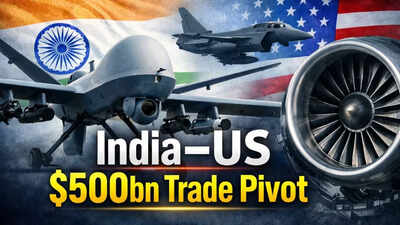
Driving the newsIndia has committed to significantly scale up purchases of US petroleum, defence systems, and commercial aircraft under a newly announced trade deal that US President Donald Trump framed as a tariff-slashing, $500 billion boost for American exports.Trump unveiled the agreement on Monday, saying the US would lower tariffs on Indian goods from 50% to 18% in exchange for India reducing trade barriers, halting Russian oil imports, and committing to expanded American purchases.
“India has agreed to buy more American goods, with purchases rising to as much as $500 billion spanning energy, coal, technology, agricultural and other products,” Trump said during the announcement.The trade deal is being hailed by officials in both countries as a landmark that reshapes bilateral ties, tilting them toward long-term procurement in defence and aviation.Why it mattersThis is more than a tariff adjustment. The agreement could remake India’s defence and energy trajectories for years – and deepen its economic alignment with the US at a time of intensifying global realignments, especially amid US-Russia tensions and the ongoing war in Ukraine.“The commitment to buy US products covers sectors like pharmaceuticals, telecom, defence, petroleum and aircraft. It will be done over the years,” a senior Indian official told Reuters.In particular, the agreement casts American arms and aerospace firms as long-term players in India’s national security toolkit, with deeper industrial cooperation and high-value platform sales – from jet engines to surveillance drones – as the centerpiece.The big pictureWhile neither Washington nor New Delhi released a line-by-line breakdown of the purchases, the contours are already visible in recent and ongoing deals.Drones: Spying and keeping people from doing bad thingsIndia’s 2024 deal to buy 31 MQ-9B SeaGuardian and SkyGuardian drones from General Atomics was a big step forward in maritime intelligence and keeping an eye on the border all the time. The new trade deal could speed up those deliveries or let the buyer get more systems, weapons, base support, and long-term maintenance.These drones are “high-altitude, long-endurance” (HALE) platforms-ideal for monitoring sensitive zones, including the Indian Ocean, Himalayas, and critical chokepoints like the Malacca Strait.Naval aviation: Sustaining what’s already deployedIndia’s growing fleet of MH-60R Seahawk helicopters-built by Lockheed Martin-already benefits from US-approved sustainment packages. These platforms serve frontline maritime roles like anti-submarine warfare and search and rescue.Under a trade-linked purchase commitment, analysts expect India to negotiate faster spare-part pipelines and longer-term lifecycle support deals.Helicopters: Quiet workhorsesRotary-wing assets are likely to see expanded buys. India is already a major operator of US helicopters, including the AH-64E Apache attack platform and CH-47F Chinook heavy-lift helicopters. Both are built by Boeing and have previously been acquired in small batches.Because helicopters are operationally versatile and acquired in tranches, they fit naturally into a multi-year, incremental procurement structure – perfect for “buy more over time” language.Jet engines: The long gameOne of the most strategic moves in recent India–US defence ties is GE Aerospace’s 2023 memorandum with Hindustan Aeronautics Limited to co-produce F414 engines in India for the Tejas Mk2 fighter program.This isn’t a typical commercial aircraft buy – it’s industrial cooperation that expands to include spares, production technology, upgrades, and possibly new engines for future Indian platforms.The new trade agreement could further institutionalize such technology-sharing ventures, particularly in propulsion and avionics – two areas where India has historically relied on foreign partners.Bottom line: The arms portion of this pact is likely to bundle drones, helicopters, engines, and maintenance support into a broader roadmap – not just one flashy contract.Zoom in: Aircraft means more than militaryThe biggest civilian upside could come in aviation – an area where Indian airlines have already made global headlines.Air India recently confirmed it had added 30 Boeing 737 MAX aircraft to its growing order book. That followed a record-breaking 2023 order for both Boeing and Airbus aircraft – part of the carrier’s plan to modernize its fleet and capture international market share.These orders – driven by routes, fuel efficiency, and delivery timelines – also carry political weight. Commercial aircraft deals are among the most visible, high-dollar imports any country can make from the US.Under the $500 billion framing of the agreement, privately negotiated commercial aircraft purchases could be tallied alongside state-led defence buys to boost headline numbers.For the US, this means jobs, exports, and geopolitical messaging. For India, it’s a politically “clean” way to demonstrate purchasing intent while avoiding friction in sensitive sectors like agriculture.Between the lines: The Russia oil clausePerhaps the deal’s most geopolitically loaded requirement is India’s commitment to halt Russian oil imports – a major ask, given the scale and price benefits India has enjoyed since 2022.Reuters reports that Indian refiners have asked for a phased wind-down, citing existing contracts and logistical realities.Still, the direction is unmistakable. Closer energy alignment with the US removes friction from arms sales that come with strict end-use monitoring and tech export controls – particularly relevant for high-end systems like drones, radars, and fighter engines.In short: the less India buys from Russia, the easier it becomes to deepen US-India defence tech cooperation.What they’re sayingIndian officials framed the agreement as one that boosts confidence and clarity in the market.“The announcement of a trade deal between India and United States has reduced a great deal of global uncertainty,” said economic affairs secretary Anuradha Thakur.Markets agreed: the Nifty 50 index rose and the rupee strengthened after the announcement, Reuters reported.Indian exporters welcomed the tariff cuts.“Lower tariffs will not only improve price competitiveness but also help Indian exporters integrate more deeply into U.S. supply chains,” said SC Ralhan, president of the Federation of Indian Export Organisations.Moody’s Ratings added that reduced tariffs could reinvigorate Indian goods exports to the US in general- especially in sectors like chemicals, auto parts, and electronics.What’s nextThe senior Indian official who spoke to Reuters said this is not the final form – a broader agreement is coming.Negotiations over the next few months will determine whether these purchases are translated into a structured procurement timeline with delivery milestones and industrial partnerships – or remain aspirational targets that help justify tariff relief.The ministry of commerce and the US trade representative’s office are expected to meet in early spring to begin formalizing a more detailed roadmap, per Indian officials.The bottom lineThis deal shifts the centre of gravity in India–US trade away from low-margin consumer goods and toward high-value systems that fly – drones, helicopters, airliners, and jet engines.What matters most: not the sticker price, but the defence ecosystems, industrial co-production, and decades-long sustainment relationships that come bundled with the buys.With Russia drifting further from India’s supplier map and the US opening more technology doors, the skies are becoming the new frontier of strategic trade.

Leave a Reply