
Satellite imagery from Iran shows that the Khamenei-regime is accelerating efforts to fortify key nuclear and missile sites, as the United States ramps up its military presence in the region and warns that time for diplomacy is running out.The images, captured between late 2024 and February 2026, show new concrete shielding, buried tunnel entrances and reconstruction at missile bases previously struck during last year’s Israel-Iran conflict, as reported by Reuters.
The developments come amid renewed nuclear talks and increasingly blunt rhetoric from Washington. The United States has also deployed its largest military presence in the Middle East since the 2003 invasion of Iraq, heightening concerns over possible strikes against Iran as President Donald Trump considers his next move. According to sources cited by CNN, US forces could be prepared to act as soon as this weekend, though no final decision has been made. Trump is said to be consulting advisers and foreign leaders, balancing the risks of military action against the prospects for diplomacy.President Donald Trump convened senior advisers this week to discuss next steps following negotiations in Geneva. According to Axios, officials described the administration as closer to a potential military campaign than many Americans realise. White House press secretary Karoline Leavitt said “there are many arguments one can make in favor of a strike against Iran”, though she added that the president prefers diplomacy and that “Iran would be wise to make a deal”.Against that backdrop, satellite images offer a rare window into Tehran’s parallel strategy on the ground.
Concrete shield at Parchin raises fresh questions
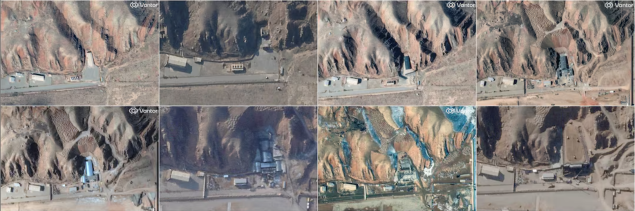
At the sensitive Parchin military complex, around 30km south-east of Tehran, imagery shows the rapid evolution of a damaged structure into what experts describe as a hardened bunker.Israel reportedly struck Parchin in October 2024. Images taken shortly afterwards show extensive damage to a rectangular building. By November that year, reconstruction was under way. Satellite photographs from October 2025 reveal the skeleton of a large new structure, flanked by two smaller buildings. By mid-November, a metallic roof appeared to cover the main facility.However, images from December show the structure partially concealed. By 16 February 2026, it was no longer visible, hidden beneath what analysts say is a concrete overbuild covered in soil.The Washington-based Institute for Science and International Security (ISIS) described the development as a “concrete sarcophagus” around a facility it identified as Taleghan 2. In earlier analysis, ISIS said imagery indicated the presence of a long cylindrical chamber inside the building, possibly a high-explosives containment vessel approximately 36 metres long.“High-explosive containment vessels are critical to the development of nuclear weapons,” ISIS said, while noting they may also have conventional uses.William Goodhind, a forensic imagery analyst at Contested Ground, told Reuters the roof had likely been covered with dirt “to obscure the concrete colour”. ISIS founder David Albright wrote that burying the facility would provide “significant protection from aerial strikes”.Iran has consistently denied seeking nuclear weapons.
Tunnel entrances buried at Isfahan and reinforced near Natanz
Further west, at the Isfahan nuclear complex, satellite images show all three tunnel entrances to an underground complex have now been backfilled with soil.The site was among three enrichment facilities bombed by the United States during last year’s 12-day war between Israel and Iran. Diplomats say parts of Isfahan have stored enriched uranium.ISIS reported in late January that two entrances had been buried; by 9 February, a third had also been sealed. A 10 February image confirmed the tunnels were “completely buried”.According to ISIS, backfilling would help dampen the impact of airstrikes and complicate any ground raid aimed at seizing or destroying nuclear material.Near the Natanz nuclear facility, imagery also points to activity at a tunnel complex under a mountain roughly 2km away, known as Pickaxe Mountain. Analysts observed numerous vehicles, including cement mixers and dump trucks, suggesting ongoing efforts to “harden and defensively strengthen” the entrances.ISIS said Iran’s precise plans for the facility remain unclear.

Leave a Reply