
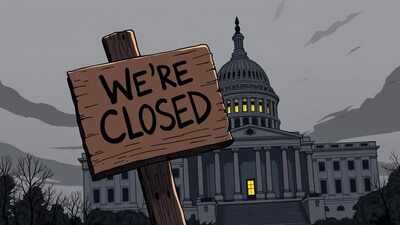
Government shutdowns in the United States can sometimes feel like a long-running TV soap. Just as one funding standoff is resolved, reports of another closure begin to surface.The repetition of the term “shutdown” can create confusion, raising many questions like, “Didn’t this just happen? Does a shutdown mean the entire government simply goes on vacation? Does it imply federal agencies have run out of money?”The reality, however, is far more nuanced. Not every shutdown is the same. Some affect large parts of the federal government, while others disrupt only specific agencies. More often than not, these episodes stem from political deadlock rather than financial collapse.The US is once again dealing with a government shutdown. For many observers, it may feel like déjà vu. Not long ago, the country emerged from what became the longest shutdown episode in its history, surpassing the previous record set in 2018–19. Notably, this marks the third shutdown of Donald Trump’s second term.Let’s take a closer look at how a US government shutdown actually works — what happens, why it happens, and why it might be feeling like a recurring feature of American politics.
What is a government shutdown?
To understand the intricacies, let’s start with the basic question of “what”. A US government shutdown happens when Congress fails to pass the appropriations legislation needed to fund federal agencies and programs before existing spending authority expires.Federal agencies and programmes generally cannot spend money or make payments without that legal authority. Under the Antideficiency Act, agencies are prohibited from incurring obligations or spending funds without an appropriation, even if cash remains available.The US Government Accountability Office defines Antideficiency Act as, “prohibiting federal agencies from obligating or expending federal funds in advance or in excess of an appropriation, and from accepting voluntary services.”
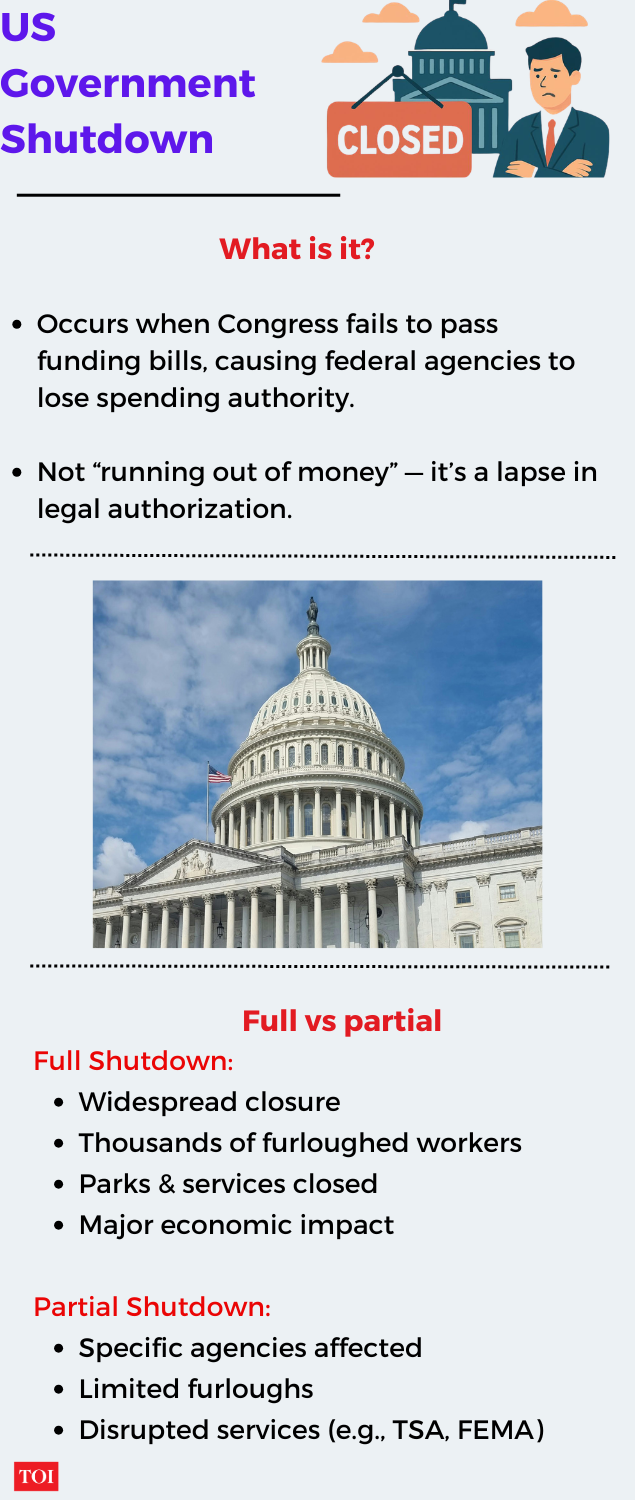
As a result, agencies affected by a lapse in appropriations must cease operations except in limited circumstances.In practice:
- Appropriations are laws passed by Congress that grant federal agencies the legal authority to spend money each fiscal year, with different agencies funded through separate appropriations bills.
- If Congress doesn’t pass all necessary appropriations (or a temporary continuing resolution) before the deadline, funding gaps occur. The agencies affected by these gaps are required to stop discretionary activities and stick to only necessary ones, until new appropriations are passed.
- Certain essential functions and programmes that are authorised by other laws — such as national security operations or mandatory spending like Social Security and Medicare — generally continue even during a shutdown.
In short, it means that a shutdown isn’t triggered because the government ‘runs out of money’, but because the authority for agencies to spend has lapsed.Let’s understand the differences in the ‘shutdowns’ through the three most recent ones
Three shutdowns, one term: Why funding crises keep returning
Since returning to the White House for a second term, Donald Trump’s presidency has already seen three separate government shutdowns We have to understand each of these separately, as lumping them together hides certain key details.These all were “shutdowns”, so to say, but were not the same kind of crisis.One was historic. Two were partial. Each tells a different story about how US government funding works.
The big one: Longest in US history
The most consequential episode began on October 1, 2025.Congress failed to pass key appropriations bills needed to fund large parts of the federal government for the new fiscal year. Thus, agencies were forced to halt operations.Despite Republicans controlling both chambers, Senate rules required 60 votes to advance the legislation. With Republicans holding 53 seats, the bill depended on Democratic support.That support did not materialise. Democrats resisted the measure, arguing it should include an extension of expiring tax credits that help lower health insurance costs for millions of Americans. The disagreement stalled negotiations, allowing funding authority for several federal agencies to expire.What appeared to be a routine funding standoff soon escalated, with neither side willing to compromise and the shutdown stretching for 43 days.
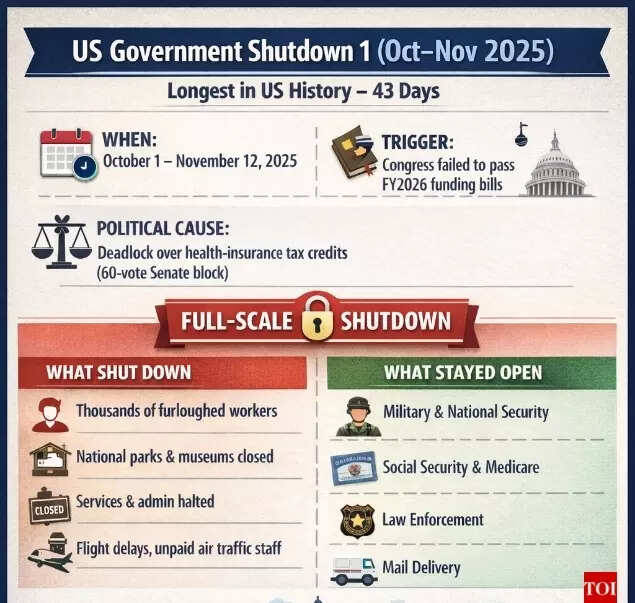
What shut down: Because multiple appropriations bills had lapsed, the crisis produced broad disruptions:
- Thousands of federal employees furloughed, meaning temporarily placed on unpaid leave
- Many agencies suspended non-essential operations
- National parks and museums closed down
- Administrative services slowed nationwide
Even critical infrastructure felt strain.Air traffic controllers, classified as essential employees, continued working without pay. Staffing shortages soon emerged as some workers called in sick, contributing to widespread flight delays and cancellations.To stabilise the system, authorities imposed temporary flight reductions across dozens of airports, including some of the country’s busiest hubs.What stayed open: Despite the scale of disruption, many parts of the government continued operating.Essential services remained active:
- Military and national security operations
- Federal law enforcement
- Social Security and Medicare payments
- Mail delivery
Eventually, once funding legislation was approved, agencies began gradually restoring operations. Furloughed employees were recalled, while essential workers, who had continued without pay, awaited backpay, historically authorised by Congress after shutdowns.However, not all programmes rebounded immediately. Several federal initiatives faced delays in resuming normal operations. System capacity, staffing levels, and programme funding often take days, sometimes weeks, to stabilise.The economic data also revealed effects that lingered well beyond.According to the Bureau of Economic Analysis (BEA), as cited by Reuters recently, US economic growth slowed sharply in the fourth quarter of 2025, with gross domestic product expanding at an annualised rate of 1.4 per cent, significantly below economist expectations of 3.0 per cent and a marked deceleration from the 4.4 per cent pace recorded in the third quarter.Meanwhile, federal government spending contracted at a 16.6 per cent annualised rate, the steepest decline since the third quarter of 1972, reflecting fewer public services, delayed purchases of goods and services, and temporary disruptions to programmes including Supplemental Nutrition Assistance Program (SNAP) benefits.That pullback reduced GDP growth by 1.15 percentage points, the largest drag from federal spending since 1994.For the full year, federal government spending fell 1.2 per cent, its biggest annual decline in three years.In a little silver lining though, the broader economy proved more resilient in some aspects.Consumer spending — which accounts for more than two-thirds of US economic activity — grew at a still-solid 2.4 per cent rate, while business investment remained supported by a surge in intellectual property spending, which rose 7.4 per cent, largely driven by research and development tied to artificial intelligence.Although, some losses are forever.The Congressional Budget Office (CBO), in January estimated that while much of the lost output would reverse, between 7 billion dollars and 14 billion dollars in economic activity would be permanently lost, reflecting cancelled consumption, missed services, and foregone production that could not shift across quarters.
Shutdown 2: Brief, quiet, partial
Merely months after the full shutdown was resolved, another funding lapse emerged.Between January 31 and February 3 this year, parts of the government again shut down.However, this episode was very different. Unlike the October crisis, Congress already passed appropriations for many departments till September 2026. Only agencies tied to unresolved funding bills were affected.This was a partial shutdown; short and limited but still a shutdown
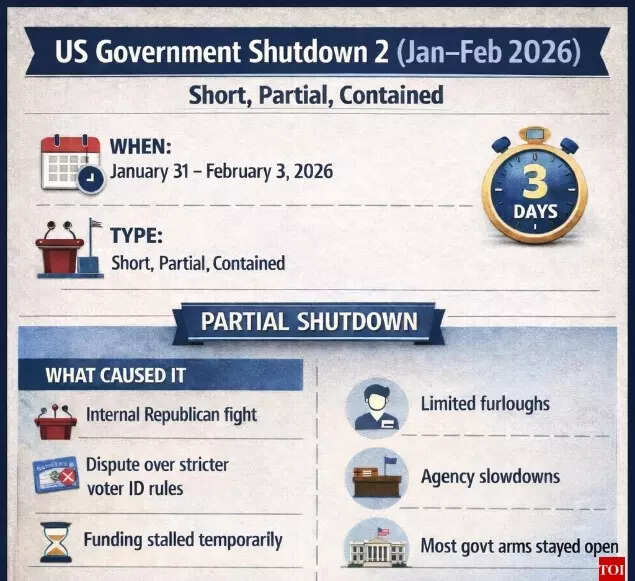
Trump moved quickly to contain the fallout, signing a sweeping spending package into law that ended the lapse after just three days.The legislation, passed following intense internal Republican negotiations, funded roughly three-quarters of government agencies, providing what lawmakers described as long-awaited certainty after months of fiscal brinkmanship and the bruising fall shutdown.Yet the agreement came with an important caveat. Congress was unable to secure a full budget for one critical department: the Department of Homeland Security (DHS).Instead, lawmakers approved only a temporary funding extension, effectively creating another funding deadlock just two weeks later that is still continuing.The political tensions behind the standoff were revealing.House Republican leaders faced resistance from conservative lawmakers demanding stricter voter identification laws be attached to the funding package. The push centred on proposals requiring more rigid proof-of-identity standards for federal elections, an issue that has long divided lawmakers along party lines. A small but vocal faction initially threatened to block the bill, pushing party leadership, and Trump himself, into last-minute negotiations to prevent a prolonged shutdown again.The operational consequences reflected the shutdown’s limited scope:• Some federal employees furloughed — temporarily placed on unpaid leave • Affected agencies slowed or paused select functions • Most government operations continued normallyHowever, the resolution was mostly incomplete.With DHS funded only through a stopgap measure, lawmakers effectively deferred the most contentious budget fight; one centred on immigration enforcement, federal law enforcement powers, and ICE policy, rather than resolving it.As House Speaker Mike Johnson said publicly, “The real fight begins over the Homeland bill.”
Shutdown 3: The DHS funding crisis
The third chapter in the US shutdown story of 2025–26 began last week — and is still unfolding.This time, the trigger was the funding for the Department of Homeland Security (DHS), which lapsed after lawmakers failed to agree on a new appropriations package. Unlike previous shutdown fights, this standoff was driven by a policy clash over immigration enforcement authorities and oversight.Everything else remained funded; but again, a partial shutdown — with highly visible consequences.
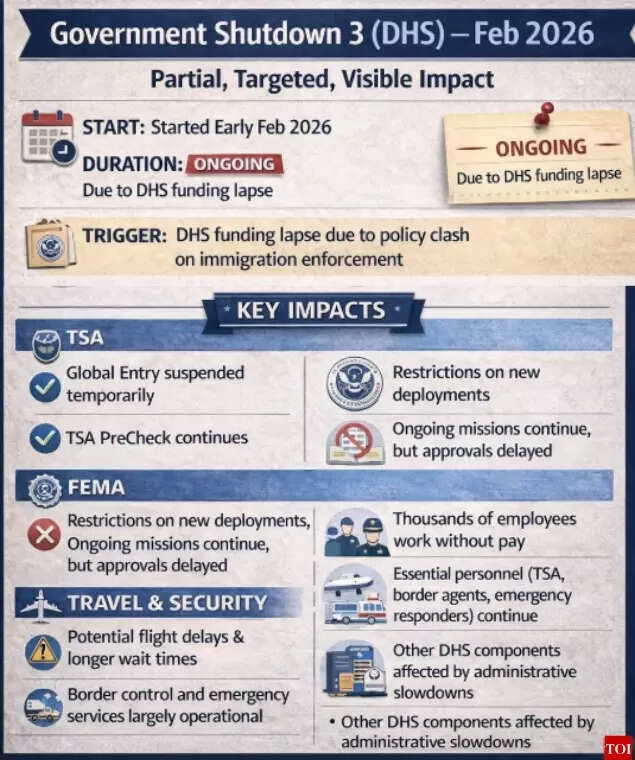
The deadlock escalated amid disputed immigration enforcement actions in Minneapolis that put federal agents under national scrutiny. In early January, 37-year-old Renée Nicole Good, a US citizen, was fatally shot by an Immigration and Customs Enforcement (ICE) agent during a federal operation in Minneapolis, a death later ruled a homicide by local authorities and sparking massive protests. Days later, another Minneapolis resident, ICU nurse Alex Pretti, was killed in a separate encounter with federal agents, intensifying public outrage and political pressure.In response, many Democrats in Congress linked new DHS funding to statutory reforms aimed at tightening use-of-force rules, requiring judicial warrants, and increasing oversight — conditions Republicans and the White House pushed back against, arguing that appropriations bills were not the right vehicle for rewriting enforcement authority.The result has been the irony that ICE itself continues to operate under existing appropriations, even as the DHS shutdown constrains other components of the department.Thus, as the DHS oversees TSA, FEMA, Customs and Border Protection, Immigration and Customs Enforcement, and multiple border and security functions, even a targeted funding lapse is rippling into daily life.Impacts include:
- TSA suspended Global Entry, which allows pre-approved, low-risk international travelers to clear customs and immigration quickly. TSA PreCheck was also initially slated for suspension, but that decision was quickly reversed, so millions of domestic passengers can continue using expedited security lanes.
- Restrictions on new FEMA deployments, affecting the Federal Emergency Management Agency, body responsible for coordinating disaster response, emergency logistics, and federal relief operations. Ongoing missions continue, but fresh approvals and administrative actions face constraints. For instance, the government, last week, ordered the suspension of deployment of hundreds of aid workers to disaster-affected areas.
- Thousands of employees are working without pay. As in previous shutdowns, personnel deemed “essential” — including TSA officers, border agents, and emergency responders — remain on duty under contingency rules, with salaries deferred.
- Airport security, border control, and emergency response are operating in large part, but administrative, training, enrollment, and discretionary functions are disrupted.
- Several airlines warned that the risk of unscheduled absences by TSA workers have increased, potentially causing flight delays and longer airport wait times for passengers.
This shutdown feels large because DHS is large — and because its services intersect directly with travel, border control, and disaster response.
Why shutdowns keep happening?
Not just financial collapse — also political stalemate.These three recent chapters illustrate a structural reality of US governance, which is: The federal government is not funded through a single master budget.A key factor is the fiscal-year calendar and staggered deadlines. The US government’s fiscal year begins on October 1, and Congress must pass 12 separate appropriations bills to fund all federal agencies. Some bills are passed on time while others are delayed, creating partial funding gaps.To prevent immediate disruptions, lawmakers often adopt temporary continuing resolutions (CRs), which are stopgap measures that extend funding for a limited period while negotiations continue. However, CRs themselves have expiration dates, and if Congress cannot agree on a full bill before a CR ends, another shutdown occurs for that concerned department. This cycle can repeat multiple times within a fiscal year, which is why the US often experiences recurring, staggered shutdowns.Which means:
- Funding can lapse for one department, while the rest of the government runs normally.
- Deadlines become leverage.
- Policy disputes become funding disputes.
- Funding disputes become shutdowns.
One more aspect is, it is rarely just about accounting deadlines or technical funding mechanics. All these shutdowns were ultimately shaped by deeper political clashes between Democrats and Republicans, where budget negotiations became vehicles for larger ideological disputes.The October 2025 shutdown, for instance, was not triggered just by a disagreement over overall spending levels, but the root cause included a standoff over extending expiring health-insurance tax credits, a policy fight over the federal government’s role in subsidising healthcare costs. The January 2026 lapse reflected tensions inside the Republican Party itself, as conservative lawmakers pushed to attach stricter voter identification legislation to a funding package leadership wanted passed quickly.The current DHS shutdown, meanwhile, centres on immigration enforcement powers, oversight of agencies like ICE, and competing views on federal law-enforcement authority.
Govt shutdown – Can it happen in India?
Government shutdowns are a recurring feature of US politics largely because of how the American system is designed.US follows a presidential model where the Executive and Legislature are separate. The President does not automatically control Congress, even if the same party holds power.This structure makes funding deadlines natural pressure points. In the Senate, most major legislation requires 60 votes to advance, which forces bipartisan agreement. When negotiations break down, budget delays can quickly turn into shutdowns.India’s system works differently.India follows a parliamentary model where the Executive is drawn from Parliament itself. A government that cannot secure passage of financial legislation effectively faces a confidence crisis. Budget failure is therefore a political threat to the government, rather than a trigger for administrative shutdown.More significantly, the Constitution has provided safeguards. Under Article 116, Parliament can sanction a Vote on Account, which enables the government to draw money from the Consolidated Fund of India for meeting essential expenditures during the debate on the budget. This ensures that the normal operations of the government, such as payment of salaries, pensions, subsidies, and interest payments, are not interrupted at the beginning of a financial year.In simple terms, India does not face the kind of funding crisis that can abruptly halt ministries or departments. The budgeting process is unified, and constitutional provisions prevent sudden spending paralysis.That’s why US-style shutdowns, triggered by funding disputes and political deadlocks, are virtually impossible under India’s governance structure.

Leave a Reply