
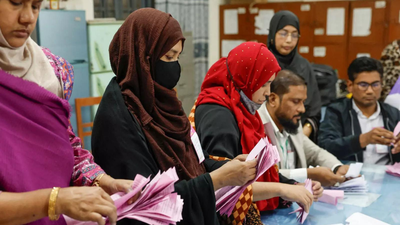
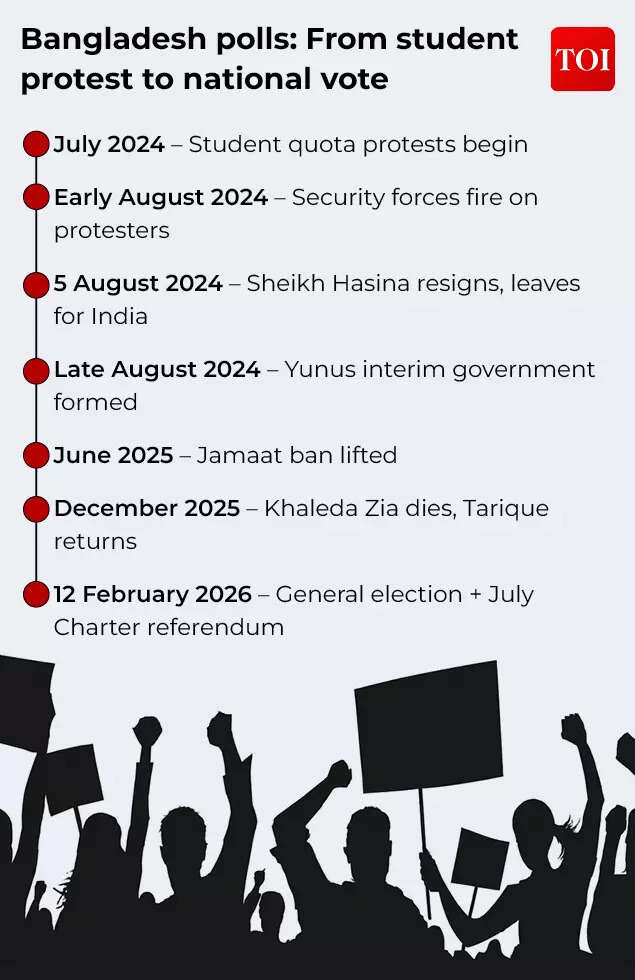
The 13th general elections in Bangladesh were different in several ways. They were held after a deadly uprising in 2024 that dismantled the old political order, and did not feature the country’s electoral giants — Sheikh Hasina or Khaleda Zia.The polls were also unique because voters were asked to cast ballots twice — once to choose their next Prime Minister and again to give their consent to the “July Charter”, which seeks to overhaul the nation’s governance structure.
The referendum was conducted across all 64 districts under tight security and international observation. Early counts on Friday suggested a commanding lead for the “Yes” vote, with most constituencies reporting strong backing from both urban and rural regions, as most major parties — even those with minor disagreements over details — campaigned in favour of the Charter.According to the latest trends, the July Charter has garnered over 65.3% of the vote. If confirmed, the new Parliament will function as a Constitutional Reform Council and will be required to complete the reforms within 180 working days.This is the first time Bangladesh has held a referendum since 1991, and the first time it has allowed widespread mail-in and overseas voting. The Charter effectively ends the “winner-takes-all” system by granting the opposition greater institutional power. For instance, the Deputy Speaker must be from the opposition.
What is ‘July Charter’?
The July National Charter (Constitutional Amendment) Implementation Order, 2025, is a 28-page political agreement signed by 25 political parties and the interim government led by Muhammad Yunus. Its goal is to transform Bangladesh into what many call the “Second Republic”—a state designed to prevent any future return to authoritarianism.
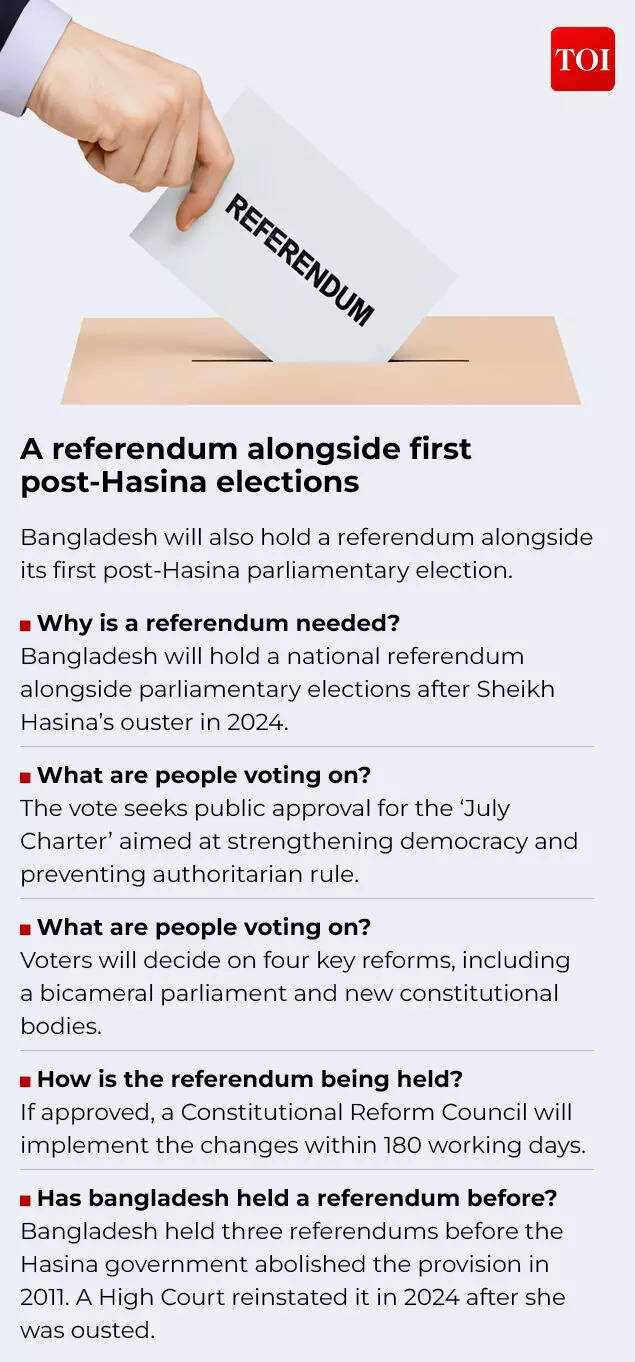
Here are the key points that the referendum outlined:
Power limits for prime minister
- Term limit: No individual can serve as Prime Minister for more than 10 years (or two terms) in their lifetime.
- Dual roles banned: The prime minister can no longer simultaneously serve as the ‘head of the party’ and the ‘head of government.’
- Emergency powers: The PM can no longer declare a state of emergency alone; it now requires the written consent of the cabinet and the leader of the opposition.
Parliamentary reforms
- Bicameralism: Establishment of a two-house parliament. The existing ‘Jatiya Sangsad’becomes the ‘Lower House,’ and a new 100-member ‘Upper House’ (senate) will be created.
- Abolishing Article 70: This controversial rule, which currently fires any MP who votes against their own party, will be removed or significantly weakened to allow independent thought.
- Opposition Role: The Deputy Speaker of the Parliament must be elected from the main opposition party.
- Women’s Representation: Reserved seats for women in the Lower House will be increased to 100 seats (out of a total of 400).
Electoral system & caretaker government
- Caretaker government: Restoration of a Non-Partisan Caretaker Government to oversee every general election.
- Voting method: Mandatory use of Paper Ballots; Electronic Voting Machines (EVMs) are largely rejected due to trust issues.
- Election commission: The commission will be restructured to include independent experts vetted by a parliamentary committee.
Identity & state principles
- National identity: The official nationality of citizens changes from “Bengali” to “Bangladeshi” to include non-Bengali indigenous groups.
- State language: While Bengali remains the state language, all other mother tongues spoken in Bangladesh will receive official recognition.
- Core principles: The four state principles (Nationalism, Socialism, Democracy, Secularism) are replaced by Equality, Human Dignity, Social Justice, and Religious Harmony.
Judiciary & legal rights
- Judicial independence: A “Supreme Judicial Council” and an independent Judicial Appointments Commission will be formed so the PM cannot hand-pick judges.
- New fundamental rights: The right to uninterrupted internet service and the protection of personal data will be added as constitutional rights.
- Presidential pardons: The President can no longer pardon a criminal without the consent of the victim’s family.
Administrative & anti-corruption reforms
- Independent commissions: The Anti-Corruption Commission (ACC), Human Rights Commission, and Information Commission will be granted full financial and administrative independence.
- Police reform: Transforming the police from a “force” used by the ruling party into a “service” for the citizens, with an independent oversight body.
- Indemnity for protesters: Legal protection (indemnity) for all students and citizens who participated in the July-August 2024 uprising.
Referendum outcome so far
A referendum is accepted when it meets the simple majority of getting the “Yes” votes over 50% of the votes cast.As per the early counting, the July Charter has garnered over 65.3%, in which case the new Parliament will function as a Constitutional Reform Council and must complete the reforms within 180 working days.This was the first time Bangladesh held a referendum since 1991, and the first time it allowed widespread mail-in and overseas voting. The ‘July Charter’ effectively ends the “winner-takes-all” system by giving the opposition more power. For instance, the Deputy Speaker must be from the opposition.While 25 parties signed the July Charter, the student-led NCP and parts of the BNP expressed concerns that some reforms didn’t go far enough or lacked a “legal basis” until this referendum.

Leave a Reply