
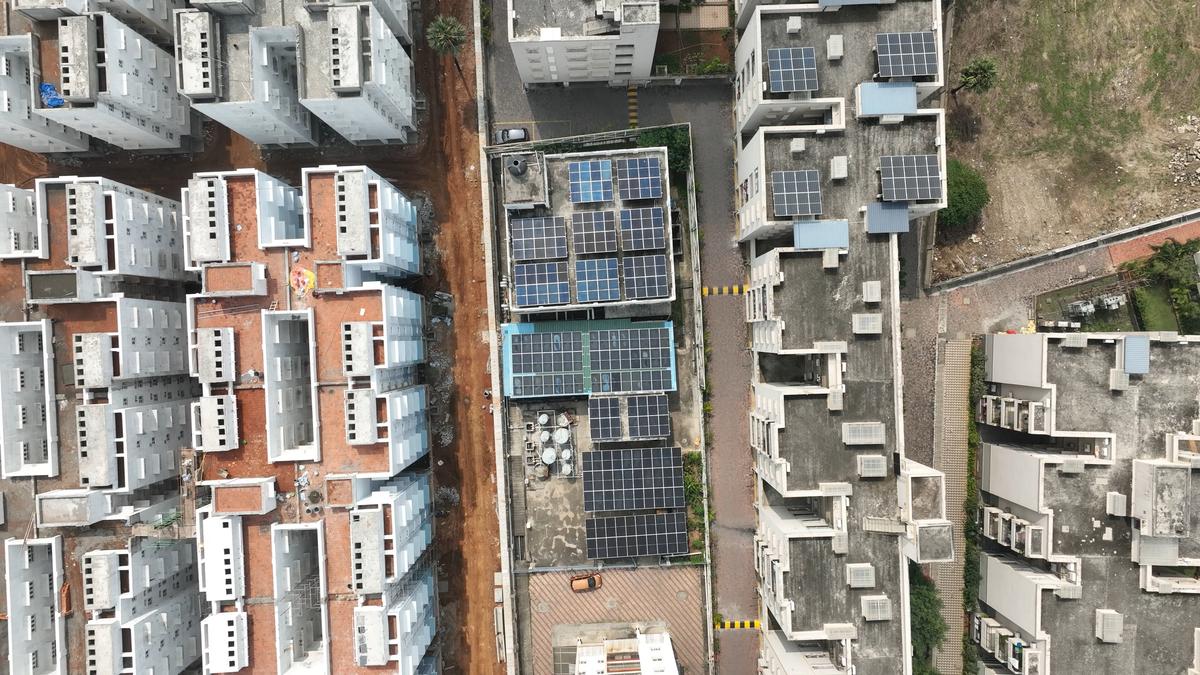
Bollineni Hillside Phase I in Perumbakkam off Old Mahabalipuram Road sprawls across 45 acres and consists of 1295 dwelling units. For ease of administration, the community is cleaved in the middle, the north side servicing a half of those dwelling units and the south side the other half.
Both segments have a separate STP-WTP unit. These units are eminently useful, but are a criminal guzzler of energy, a fact that sticks out painfully when the EB bill arrives. Sajeev Kumar, president of Bollineni Hillside Residential Township Owners Association (BHRTOA), estimates the community’s monthly electricity bill at ₹10 lakh. “Electricity expense is one of the top three expenses,” he points out.
The effort to whittle down that expense was launched recently, when the community had an operational solar power system in the end of January, 2026. The installation: a 97 kW solar system at one STP-WTP unit, and another 97 kW solar system at the other unit; a whopping 194 kW system in total. The decision to go solar first at these units was shaped by the consideration of significant savings on the EB bill as well as quicker recovery of the investment cost.
By virtue of going solar at this scale, BHRTOA has bagged an award from Tamil Nadu Solar Energy Developers Association (TNSEDA) for the biggest solar power installation in the RWA category across Tamil Nadu.
K. Thirugnanam, secretary, BHRTOA and an advocate, observes that the exercise synergies the various skillsets (BHRTOA president Sajeev is an IT professional) found within the community. To illustrate, he points out a retired senior official from the Tamil Nadu Electricity Board who is a resident of Bollineni Hillside was informally consulted to navigate regulatory nuances, particularly those pertaining to load thresholds and fixed charges that increase for installations exceeding 100 kW. Hence, the split into two units, each racking up 97 kW.
In sheer numbers
The question of subsidy processing
BHRTOA president Sajeev Kumar underlines the toughest part of the effort: settling on a vendor. Our vice-president Senthil Prabhu visited many RWAs that have gone solar, including those in Coimbatore.
BHRTOA treasurer Senthil Kumar S reveals that the vendor finally brought on board was found through the Federation of OMR Residents Association (FOMRRA). Senthil Kumar explains: “I had posted a message in the FOMRRA group that we were looking for an empanelled solar rooftop installation vendor. And in the group I had also asked if anyone installed rooftop solar systems and got a subsidy for it. The overwhelming response was ‘we installed, but we did not get the subsidy’. And one member in the group pointed us to this vendor who was known for diligent and effective subsidy processing.”
BHRTOA secretary K. Thirugnanam says the selected solar energy company, Vesat Renewables Private Limited, based in Coimbatore has had a presence in the solar space for multiple decades, starting back then with solar water heaters and extending all the way to rooftop solar installations now. Contrary to the views held by many other vendors that had been approached earlier, this one was aware that RWAs were eligible for subsidy under PM’s Surya Ghar Scheme. And BHRTOA was convinced of the company’s end-to-end execution capability, particularly subsidy processing.

Leave a Reply