

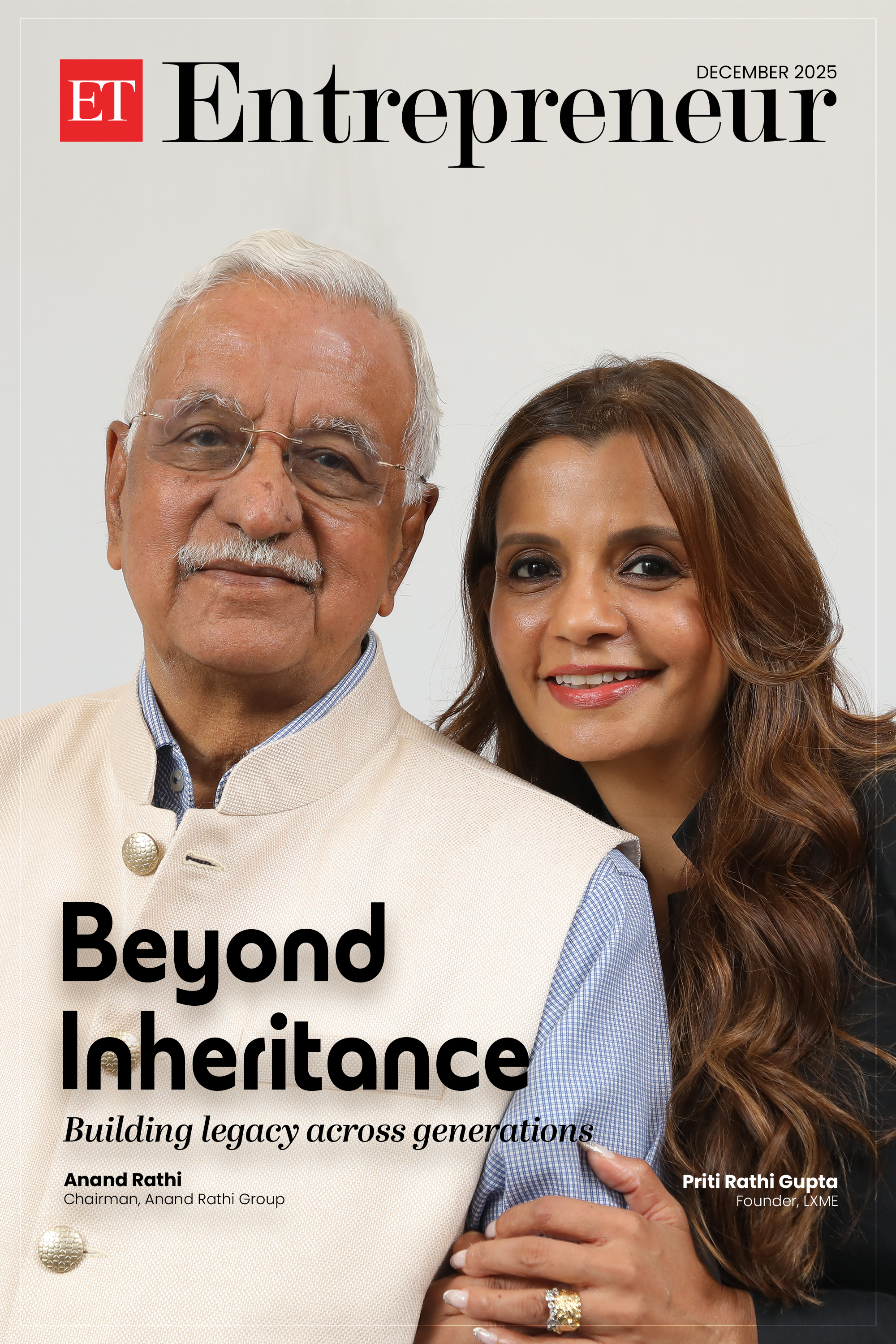
 This father-daughter duo prioritises long-term institution-building over short-term wins.
In Indian family enterprises, legacy is often understood as succession within a single business. But increasingly, it is being shaped across parallel journeys where the next generation builds independently, while remaining anchored to shared values.
In this exclusive conversation with ETEntrepreneur, Anand Rathi, Chairman of the Anand Rathi Group, and his daughter Priti Rathi Gupta, Founder of LXME, reflect on what it means to balance autonomy with responsibility, legacy with reinvention, and ambition with trust. As a father-daughter duo working across different ventures, their conversation offers a grounded view of institution-building that prioritises long-term thinking over short-term milestones.
Family businesses are anchored in values before valuation. Which family principles most strongly shape how you lead and build your venture today?
Priti Rathi Gupta: Growing up, business was never discussed only in terms of scale or success, but in terms of responsibility. Integrity, long-term thinking, and accountability were core family values, and those continue to shape how I build LXME today. There was a strong emphasis on doing things the right way, even when it’s harder or slower.
Credibility and trust were seen as non-negotiable assets, once lost, they are almost impossible to regain. That perspective deeply influences how I think about customers, partnerships, and growth. Another important principle was independence with responsibility. While values were shared as a family, each individual was encouraged to build their own path, take ownership of decisions, and stand by them.
Running a business, for me, is also about creating value for all stakeholders, investors, employees, customers, and clients. That balance of ethical grounding, personal conviction, and stakeholder focus is something I consciously bring into my leadership style at LXME.
Despite building separate businesses, how do you ensure autonomy without diluting the family’s shared values and long-term vision?
Priti Rathi Gupta: Autonomy has always been encouraged in our family, but it comes with a strong sense of responsibility. Each of us builds independently, yet the values we operate with, integrity, long-term thinking, and respect for stakeholders, are non-negotiable.
For me, autonomy doesn’t mean working in isolation. It means having the freedom to make decisions, take risks, and learn from outcomes, while staying anchored to a shared ethical framework. That alignment fosters trust, even when our paths and industries differ.
The long-term vision isn’t preserved through constant oversight, but through consistency in how decisions are made. When values are deeply internalised, autonomy strengthens the family legacy rather than diluting it.
LXME focuses on women’s financial empowerment. How does this mission reflect the Rathi family’s broader ethos around responsibility, inclusion, and long-term value creation?
Priti Rathi Gupta: LXME’s mission to empower women financially is a natural extension of our family ethos. Responsibility, inclusion, and long-term thinking aren’t just business principles; they guide how we create lasting impact.
For years, at Anand Rathi, we conducted investor awareness camps across the length and breadth of the country. It was only when I realised that women weren’t attending these sessions that it became clear a different access and delivery model was needed for them.
Running a venture, for me, is about creating value for all stakeholders: investors, employees, customers, and clients. By focusing on financial literacy and access tailored specifically for women, LXME enables them to make informed decisions and build sustainable wealth. In that sense, LXME reflects the same principles that have guided our family enterprise for decades, creating value not just for shareholders, but for communities and future generations.
Family enterprises are often judged on continuity. How do you balance legacy thinking with the need to constantly reinvent in a fast-evolving market?
Anand Rathi: As a founder, I have always believed that legacy is not something you inherit; it is something you consciously build. When you start an enterprise from scratch, you learn very early that markets reward relevance.
From day one, we built Anand Rathi on strong values, family culture, integrity, and an entrepreneurial organisation and those values form the only true continuity. At the same time, I have been clear that the business must never become dependent on the founder’s way of thinking.
We have institutionalised professional leadership, encouraged younger teams to question established models, and embraced change in technology, products, and processes. For me, balancing legacy and reinvention means building an organisation that respects its founding principles and values, while being confident enough to reinvent itself repeatedly, even beyond the founder.
Ringing the bell at the BSE is a defining milestone. What did that moment represent for you personally, and what did it symbolise for the legacy you are building?
Anand Rathi: Ringing the bell at the BSE was an emotional and humbling moment for me. Personally, it represented the culmination of decades of hard work by thousands of people across the Anand Rathi Group, not just my own journey. It was a tribute to the trust our clients, partners, and employees have placed in us over the years.
From a legacy perspective, it symbolised a transition, from a founder-led entrepreneurial institution to a professionally governed, publicly accountable organisation. For our family, it was not an end point, but part of a long, values-driven journey.
It reminded us that we are now custodians of public trust, and that the legacy we build must be measured not only in financial performance, but in how responsibly, transparently, and ethically we contribute to India’s financial ecosystem over the next several decades.
When business ambition and family identity intersect, how do you draw boundaries, manage disagreements, and preserve trust?
Anand Rathi: In a family business, ambition and identity naturally intersect, and disagreements are inevitable. The key is clear communication and mutual respect.
We consciously separate personal relationships from professional decisions, ensuring that discussions remain focused on ideas rather than egos. Transparency and trust are reinforced by openly sharing perspectives and intent.
Even under public or market scrutiny, staying anchored to core values, integrity, long-term thinking, and stakeholder responsibility, helps us navigate differences without compromising relationships or trust.
Looking ahead, how would you like your journey to inspire the next generation of entrepreneurs and family-business leaders?
Priti Rathi Gupta: I hope my journey shows that it’s possible to build independently while staying true to shared values. Autonomy doesn’t mean operating in isolation; it means taking responsibility, making bold decisions, and learning from outcomes, all within a long-term framework.
For the next generation, I would like to demonstrate that success isn’t measured only by scale or valuation, but by the impact created, the people empowered, and the legacy strengthened through integrity and innovation.


Leave a Reply