

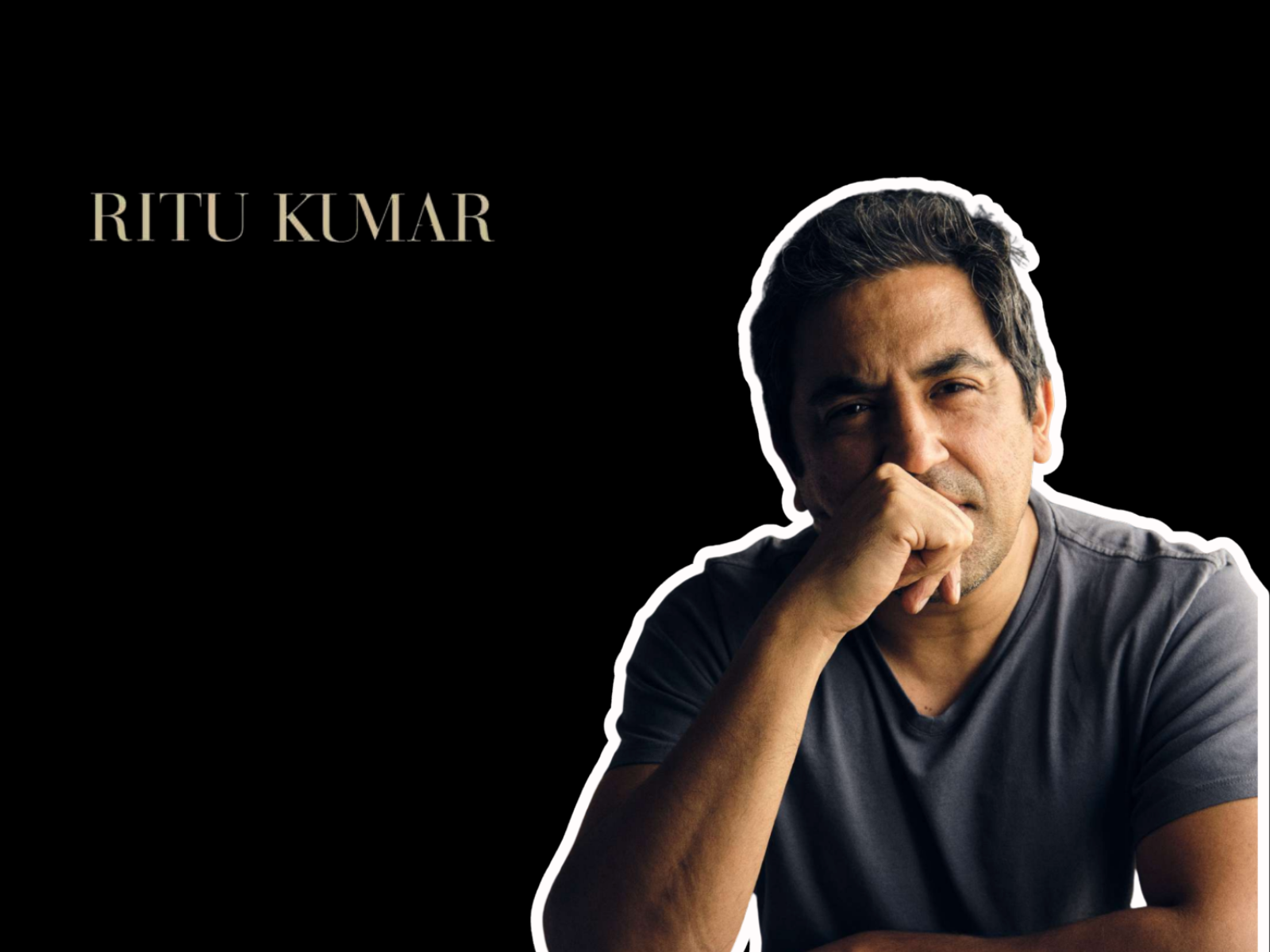
 Growing up in the same intersection of creation and commerce, Amrish Kumar, the second-generation entrepreneur, tells us about how every clothing that has ever been born in the fashion clothing house was made with sheer purpose.
To speak of Amrish Kumar only as the son of Ritu Kumar is to misunderstand the nature of inheritance in creative families. What passes down is rarely confined to business or a name, but more on refusing to take shortcuts.
It was in the late 1960s when the custodian of couture started her brand with four hand block printers and two tables in Kolkata. Her legacy was never merely about revivalism. It was about craft that echoed the dignity of Indian aesthetics.
From bridal lehengas to contemporary Indo-western wear, the fashion house today speaks to Indian women who seek elegance without forgetting their roots.
Growing up in the same intersection of creation and commerce, Amrish, the second-generation entrepreneur, tells us about how every clothing that has ever been born in the fashion clothing house was made with sheer purpose.
“They knew the product. They knew the fabric. They knew which embroidery would work well on which fabric,” Amrish told ETEntrepreneur.
He was referring to the ‘masis’—regal women artisans who stitched magic into cloth, defying all sides of hierarchy. Many came from cities such as Amritsar or Calcutta, having learned the trade, and of the business, from the inside out.
“It was still a mom-and-pop type shop,” he recalled. “You would have skilled, experienced, mainly women who would grow in the roles. They knew the customer. They may not have been business graduates and they may not have had ideas of symmetric scaling or marginal utility of the product,” he added.
Learning before leading
When Amrish joined the company in 2005, it was still largely a family-run operation. The systems were informal, and the business was built more on relationships.
In 2007, he played a key role in launching Label Ritu Kumar, marking the brand’s move into mainstream fashion. It began as a single rack inside a store and gradually grew into over 50 standalone outlets across India.
Over time, Amrish reorganised the legacy line, splitting it into pret and couture to better match customer demand. The brand later expanded into lifestyle with Ritu Kumar Home in 2019, followed by aarké by Ritu Kumar in 2021, aimed at offering designer-led fashion at more accessible prices.
In his early years, Amrish chose not to impose a new vision. Instead, he focused on learning the business and understanding each function before attempting to change it.
“The first maybe five, seven years… I was learning the ropes of different functions. From the get-go, the idea was just how do we develop and scale something that looks and feels perhaps like what global brands look like,” he explained.
Two decades ago, that ambition was still untested. India had very few premium or luxury brands that had managed to scale in any meaningful way.
Retail itself was in a crux, the malls that would later reshape urban consumption were yet to appear, and high streets were still taking form. Then came the internet, followed by the rise of the country’s large e-commerce platforms.
The brand grew amidst these developments, sub-brands emerged to protect the core identity without diluting it.
“We’ve been through all those cycles. The underlying ambition was always to create something we could scale. Most businesses think about scale, but for us it was also about building India’s first truly scaled brand—one that drew its identity and heritage from what my mother had built. That’s been our philosophy from day one, and it continues even today,” Amrish added.
But the work went beyond building product lines. Amrish also put in place the infrastructure required for a designer brand to scale in India. Following a fundraise from Everstone Capital in 2013, he took on the role of CEO and oversaw operations across design, supply chain, e-commerce, and retail.
Under his leadership, the brand grew to more than 100 touchpoints across 30-plus cities, while also establishing a steady international presence in the US, the UK, and the Middle East.
If there is one habit Amrish carried forward from those early years, it is a reluctance to make decisions in isolation.
“Even today,” he says, “I won’t take a call on a product unless I’ve heard from the person on the shop floor. If you grow up in an entrepreneurial family, you learn early that you have to roll up your sleeves and understand the business from the ground up. There’s no shortcut.”
That room, Amrish adds, must include voices from merchandising, production, and fabric sourcing—people who understand the garment not as a concept, but as something that must hold up to the wear and customer scrutiny.
Reinvention of the legacy brand
Over the past 15 years, the brand has moved through cycles familiar to many legacy businesses: periods of rapid expansion, high capital intensity, fluctuating consumer demand, and uncertainty. Retail, Amrish points out, is an unforgiving business.
Then come the more personal questions.
“When years are not doing very well,” he said. “You ask yourself a million questions about whether I’ve done this right or not.”
When Label Ritu Kumar was launched, it occupied an uncomfortable middle ground. For years, it looked too much like the parent brand, limiting its ability to attract new customers. When the shift became more pronounced, existing customers resisted.
“The regular customers were like, this is not what we want. The new customers hadn’t gotten used to the idea,” he recalled.
“However, with a legacy brand like this, that push and pull is always there. Our fundamental competitive advantage is in aesthetics. A lot of people make clothes. What differentiates us is the aesthetic, and it is rooted in Indian identity,” he added.
He is similarly unconcerned with external validation. Indian textiles, he notes, have travelled the world for centuries, through trade and fashion.
“Twenty years ago, we didn’t make dresses. Today, we make dresses with the same print schools in Calcutta that we made suits and saris out of,” Amrish proclaimed.
Over the years, the brand has earned a strong following among celebrities, becoming a familiar presence on Bollywood’s style circuit, worn by the likes of Alia Bhatt, Tara Sutaria, Aishwarya Rai, Priyanka Chopra, and Kriti Sanon, among others.
“We’ve managed a certain amount of scale at the level we’re operating at, with the kind of product line that we make. The work has predominantly been about making it more accessible to a larger audience, not just keeping it niche. But it’s still a bridge-to-luxury kind of brand. But we’ve managed to do that,” he added.
Outside fashion, his creative interests extend to writing. Gods of Willow, a coming-of-age novel set in 1990s India, which was written during the pandemic.
For Amrish, his attention now is a split between two priorities: continued investment in high-skill craft at the top end, and wider accessibility on the other. For a homegrown brand that has crossed the border, scale now perhaps lies much more on endurance.


Leave a Reply