
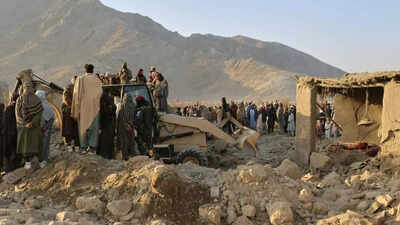
People watch as rubble is cleared after a Pakistani cross-border strike in Nangarhar of Afghanistan, Sunday (AP photo)
On February 27, the Afghanistan-Pakistan border turned into a front line. In Kabul, witnesses described night skies interrupted by jets and blasts. A taxi driver, Tamim, told Reuters that he woke to the sound of an aircraft and then watched ordnance fall on what looked like a weapons depot: “We woke up, and the plane came and dropped two bombs, then flew away again. After that, we heard explosions,” Tamim said, adding, “Everyone, in panic, ran down from the second floor of the house. The ammunition inside the depot kept exploding on its own.”In Islamabad, Pakistan’s defence minister Khawaja Muhammad Asif announced a threshold had been crossed: “Our cup of patience has overflowed. Now it is open war between us and you (Afghanistan).” In a separate post on X, Asif framed the escalation as the end of forbearance: “Our patience has now run out. Now it is open war between us,” he said.
Across the border, the Taliban signaled that Afghanistan’s new state is not only willing to absorb punishment, but to advertise retaliation. Afghan Taliban “successfully conducted” air strikes using drones to hit military targets in Pakistan, according to Afghanistan’s defence ministry and a government spokesperson.
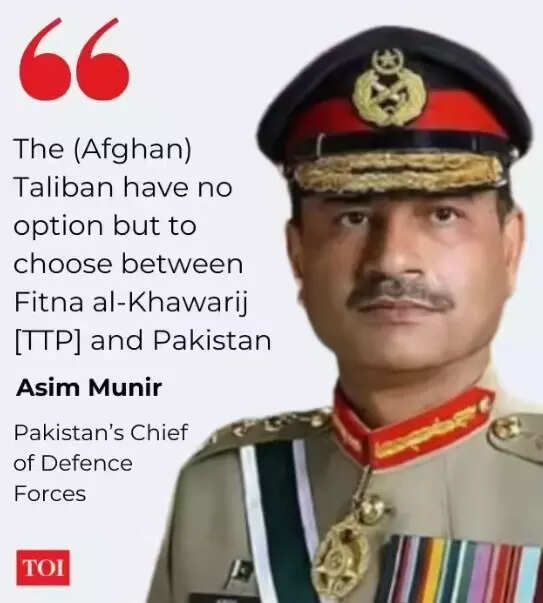
.
Why it mattersThis isn’t just another border skirmish.* It risks locking the two neighbors into a wider fight along a 2,600-km frontier, with both sides issuing casualty claims that Reuters and AP said could not be independently verified.* Pakistan has far stronger conventional capabilities, but the Taliban have years of insurgent experience and can raise the political temperature quickly inside Afghanistan by framing the conflict as a sovereignty fight.* Regional powers are already moving: China publicly urged restraint and a ceasefire, saying it is “deeply concerned about the escalation of the conflict,” while Iran offered to “facilitate dialogue”.Zoom in: The 5 reasons Pakistan and the Taliban are fighting1) The TTP question: Sanctuary, denials, and the logic of retaliationAt the center is the Tehreek-e-Taliban Pakistan (TTP), or Pakistani Taliban, an insurgent movement that seeks to topple the Pakistani state. Pakistan’s core accusation is that TTP fighters find shelter on Afghan soil and stage attacks back into Pakistan. Reuters described the conflict as rooted in “a long-running dispute over Pakistan’s accusation that Afghanistan harbours militants carrying out attacks inside Pakistan.”The Taliban deny this framing and, crucially, try to relocate responsibility. The Taliban have said Pakistan’s security is an internal problem, which is a neat rhetorical move: it turns a cross-border militancy complaint into a domestic governance failure. For Islamabad, that denial is not just irritating; it is strategically unacceptable. If the violence is transnational and the sanctuary is across the frontier, then Pakistan’s military logic pushes toward cross-border strikes, especially when domestic pressure rises after major attacks.Stark numbersThe numbers are stark. One Pakistani research group, the Pakistan Institute of Peace Studies, recorded 699 terrorist attacks in 2025 that killed 1,034 people, a jump of more than 30% in incidents and over 20% in fatalities compared with the previous year, according to Foreign Affairs. Another think tank, the Pakistan Institute for Conflict and Security Studies, said 2025 was Pakistan’s deadliest year in a decade, with most of the violence driven by terrorist outfits including the TTP.The TTP itself boasts of thousands of operations: its media arm Umar Media claimed 3,573 attacks and 3,481 people killed in 2025, per Foreign Affairs. These numbers are almost certainly inflated, but they point to a clear reality: Pakistan’s generals and politicians believe they are facing a resurgent insurgency emanating from Afghan territory. 2) The border itself: Sovereignty on a line neither side experiences the same wayPakistan and Afghanistan share a 2,600-kilometer frontier that has a history of “a protracted conflict.” Maps call it a border; communities along it often experience it as a seam. The Durand Line, drawn in the colonial era, has long been disputed by Afghan governments, and the Taliban’s state inherits that ambiguity even if it does not always foreground it.When Pakistan’s strikes reportedly reached into Kabul and Kandahar, they were the first time Islamabad had directly hit Taliban installations rather than militants “allegedly backed by them.” That shift matters. Hitting suspected militant camps can be presented as policing. Hitting what your neighbor calls government targets is an argument about sovereignty conducted by force. Taliban spokesperson Zabihullah Mujahid confirmed Pakistani forces carried out strikes in parts of Kabul, Kandahar and Paktia. The confirmation is not merely factual; it’s political, because it turns Pakistan’s action into a violation to be avenged.Retaliation then becomes almost mandatory, particularly for a movement that sells itself as the guardian of Afghan independence after decades of foreign intervention.3) Regime legitimacy: Each side uses the other to prove strength at homeNeither government is operating in a vacuum. Pakistan’s military, facing rising militant violence and public anger, needs to demonstrate control and deterrence. The Taliban, governing a poor country still struggling for international legitimacy, need to project that they cannot be bullied by a neighbor that many Afghans distrust.This is where language like “open war” is more than bravado. It is an internal message: a government showing it can escalate. It is also, in Pakistan’s case, a narrative that turns a security crisis into an externalized confrontation, the kind that can unify factions and temporarily drown out domestic criticism.In Afghanistan, defiance against Pakistan can serve as a nationalist credential. The Taliban can frame themselves as the state that resists Pakistani pressure, even as they face international isolation and economic hardship. It is easier to rally around sovereignty than to answer for governance.4) The India factor: Suspicion, alignment, and the fear of encirclementA thread running through Pakistan’s argument is that Afghanistan’s Taliban are not merely failing to restrain anti-Pakistan militants; they are flirting with Pakistan’s principal rival. Pakistan defence minister Asif alleged the Taliban had turned Afghanistan “into a colony of India”.This kind of claim does two jobs at once. It frames the Taliban not as a wayward neighbor but as part of a broader geopolitical plot. And it ties Pakistan’s western border problem to its eastern one, feeding the classic Pakistani security anxiety of encirclement.Michael Kugelman wrote in Foreign Affairs that what may be most alarming to Pakistan is “the Taliban’s new embrace of India,” arguing that warming ties between Kabul and New Delhi can intensify Islamabad’s suspicion that militant pressure is coordinated, even if evidence is contested. The point is not whether every claim is accurate; it is that the belief shapes policy. When states assume hostile alignment, restraint becomes politically costly.5) Refugees, trade, and leverage: pressure points that turn crises into escalationsFinally, there is the human and economic machinery that sits beneath the gunfire. Pakistan has conducted deportations and crackdowns on Afghans in recent years. That scale of displacement does not just create suffering; it creates resentment and political tinder on both sides.Trade is another pressure point. Afghanistan wants access to regional commerce; Pakistan controls key routes and crossings. When relations sour, borders close, supply chains seize, and each side looks for ways to punish the other without formally declaring war. Over time, those coercive tactics can create the very insecurity they are meant to prevent, especially when armed groups exploit the chaos.What’s nextNone of this guarantees a full-scale conventional war. The BBC reported analysts saying it would be “unlikely for the Taliban to fight a conventional war with Pakistan,” given the disparity in capability and Pakistan’s far larger forces. But conventional war isn’t the only danger. A pattern of strikes, retaliation, and deniable militant violence can produce a long conflict with intermittent spikes, especially when both sides believe backing down will invite more attacks.

Leave a Reply