

 When evaluating companies, Beams Fintech Fund looks for evidence of operating leverage and sustainable margins rather than just headline growth.
India does not have a shortage of fintech capital. It has a sequencing problem.
Early-stage money is abundant. Late-stage private equity is selective but available. The friction sits in between.
“India has, give or take, 500 to 700 VCs in the country,” said Sagar Agarvwal. “And every fund knowingly, unknowingly has a strategy to invest in fintech and financial services.”
But when those companies mature beyond early proof points, the funding dynamic shifts.
“When these early-stage companies become $5-7 million revenue businesses, private equity is not going to come down all the way to the bottom and start investing in these companies,” he said. “That mid-market bucket…that is the platform that we’re talking about.”
Beams Fintech Fund was built to occupy that space.
The missing middle
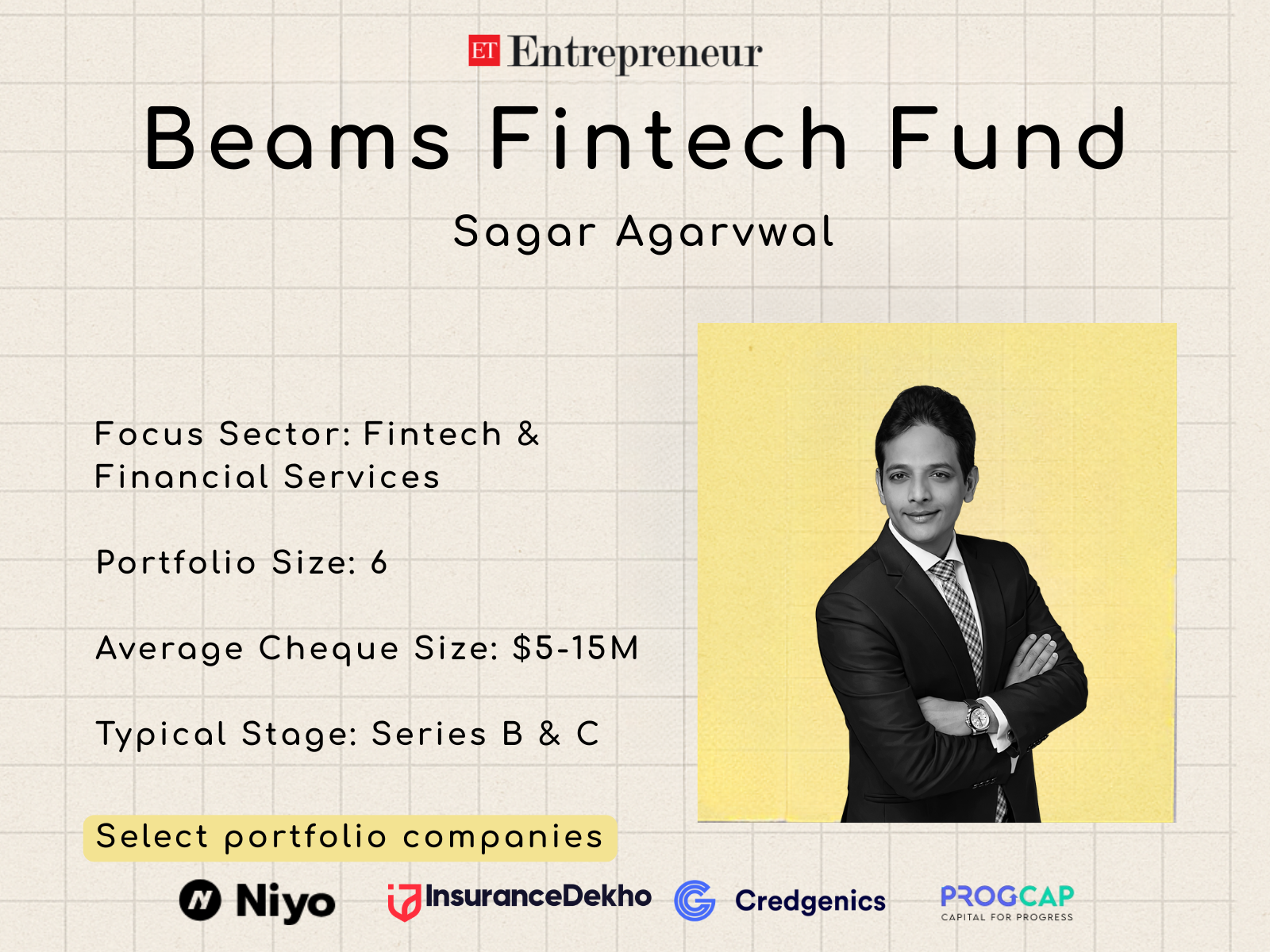
Beams today manages about ₹900 crore across its first fund and co-investment capital. The strategy is narrowly defined: write $10-15 million cheques into Series A+ fintech companies, take 5-8 per cent stakes, secure board positions, and help companies transition from $10-15 million revenue to $100 million revenue over time.Globally, Agarvwal argues, venture ecosystems tend to settle into three broad buckets: early-stage venture, mid-market growth, and buyouts. India has developed the first rapidly. The third is evolving. The middle needs depth.
“If early-stage deals have to succeed, you need somebody to come and back those companies in subsequent rounds,” he said.
Beams has already invested in seven companies across digital banking, supply chain finance, insurance distribution, collections, and MSME lending, with three more investments planned before the fund is fully deployed.
The thesis is sector-focused but stage-disciplined, according to Agarvwal.
Growth risk, not mortality risk
Fintech in India has been shaped as much by regulation as by innovation. Over the past few years, policy changes across digital lending, payments, and insurance have forced companies to recalibrate quickly.
Beams prefers to avoid that uncertainty altogether.
“We don’t honestly invest in companies where we see risk of mortality,” Agarvwal said. “We don’t generally invest in unlicensed players and grey areas of regulation.”
If regulatory clarity is absent, he sees that as a structural red flag rather than a temporary inconvenience.
“If the regulations are not clear, there is a reason they are not clear,” he said.
That philosophy reflects a broader distinction he draws between two types of risk: existence risk and growth risk. In growth-stage investing, he believes the latter is acceptable. The former is not.
The focus then shifts to business structure.
When evaluating companies, Beams looks for evidence of operating leverage and sustainable margins rather than just headline growth.
“If you are a 50 per cent gross margin business, if you can show me a journey to 60 per cent gross margin, and your fixed cost is largely stable, and you know there’s a clear operating leverage in the business, that’s something we look for,” he said.
Valuation, he argues, is inseparable from growth.
“I really bring down the valuation conversation to growth,” he said. “If the companies don’t grow, then no matter what valuation you pay, it’ll always look higher.”
At the same time, he is wary of excess.
Across growth-stage companies, Agarvwal sees recurring patterns that slow them down: over-hiring, delayed efficiency discipline, and raising capital at inflated valuations.
“Either they’re not focused on operating efficiencies, either they have not hired the right talent and sometimes they’ve taken too much capital at too high of a valuation,” he said. “Once you raise too high, you’re always catching up.”
Ecosystem as infrastructure
Beams’ pitch is not limited to cheque size.
The fund’s limited partners include banks, NBFCs, and insurance companies. Agarvwal believes that alignment allows Beams to support portfolio companies beyond capital, particularly in a regulated sector like financial services.
“We not only provide capital,” he said. “We also offer an ecosystem.”
That support spans equity raises, debt partnerships, licensing guidance, business strategy, and revenue development. In fintech, growth is often tied to underwriting models, distribution partnerships, and regulatory approvals as much as product-market fit.
“We almost roll up our sleeves like founders,” he said.
This hands-on positioning reflects Agarvwal’s view that mid-market fintech companies need institutional scaffolding as they scale. Capital alone is insufficient.
Structural tailwinds, measured optimism
Despite regulatory tightening and valuation corrections, Agarvwal remains confident that India’s fintech opportunity is structural rather than cyclical.
Credit demand remains high. Insurance penetration is still limited relative to population size. Financialisation of savings is expanding, from mutual funds to digital investment products.
At the same time, he tempers that optimism with realism.
“India is not a high-paying market,” he said. “Consumers and businesses are value payers.”
Competition is intense. Technology, including AI, must translate into measurable financial outcomes rather than narrative appeal.
“AI will play a role across the bucket,” he said. “But it has to fundamentally improve underwriting, distribution, and personalization.”
Fund II, which Beams plans to raise after completing deployment of the first fund, will likely expand across themes such as payments infrastructure, credit expansion, financial protection, digitisation of banking infrastructure, and embedded finance.
Exits, Agarvwal said, are guided by return targets rather than round labels.
“Four to six years is a sweet spot to create an exit in any portfolio company as long as you meet your target return,” he said. “Discipline in exit is what we want to be known for.”


Leave a Reply