
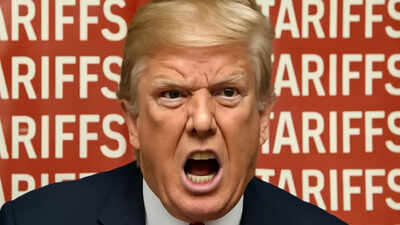
In what is a big blow to US President Donald Trump, the Supreme Court has struck down his sweeping reciprocal tariffs that were imposed after the Liberation Day in April 2025. In a 6–3 ruling, the court examined duties introduced under an emergency powers statute, including the broad “reciprocal” tariffs applied to nearly all countries.The case marked the first significant element of Trump’s wide-ranging policy agenda to be directly reviewed by America’s highest court — an institution he influenced during his first term by appointing three conservative justices.The court anchored its ruling in the text of the US Constitution that outlines the division of authority among the three branches of government: “The Congress shall have Power To lay and collect Taxes, Duties, Imposts and Excises.”The court was not convinced by the Trump administration’s contention that a war-like emergency justified bypassing the Constitution’s separation of powers framework. “The Government thus concedes, as it must, that the President enjoys no inherent authority to impose tariffs during peacetime,” Chief Justice John Roberts wrote in the ruling.“And it does not defend the challenged tariffs as an exercise of the President’s warmaking powers. The United States, after all, is not at war with every nation in the world.”The judgment does not affect the separate, sector-focused duties that President Donald Trump introduced on imports such as steel, aluminum, and certain other products.In the decision, the court’s three liberal members aligned with three conservative justices to affirm earlier lower court rulings that found the tariffs imposed under IEEPA to be unlawful. Conservative Justices Brett Kavanaugh, Clarence Thomas, and Samuel Alito dissented.
Supreme Court Verdict on Trump Tariffs: Key Points
- Writing for the majority, Chief Justice John Roberts said that the Constitution clearly assigns the authority to levy taxes — including tariffs — to Congress. He emphasized that the framers did not allocate any portion of the taxing power to the executive branch. Delivering the majority opinion, Chief Justice John Roberts emphasized that IEEPA makes no mention of tariffs or import duties.
- The court ruled that the International Emergency Economic Powers Act (IEEPA) “does not authorize the President to impose tariffs.”
- Chief Justice John Roberts clarified in the opinion that the court’s role was limited to determining whether the authority to “regulate … importation” under the IEEPA extends to the imposition of tariffs. He concluded that it does not, referencing the statutory language cited by President Donald Trump in defense of his broad tariff measures.
- Roberts further explained that had Congress intended IEEPA to grant the president the specific and exceptional authority to levy tariffs, it would have done so explicitly, as it has consistently provided in other tariff-related legislation.
- Referring to an earlier ruling of the Supreme Court of the United States, Roberts stated that a president must be able to identify clear authorization from Congress when asserting such sweeping tariff powers. In this instance, he wrote, that requirement had not been satisfied.
- The court observed that if Congress had meant to grant the sweeping and exceptional authority to impose tariffs through the IEEPA, it would have stated so explicitly, as it has consistently done in other tariff-related laws.
- The major questions doctrine is front and center: For Roberts (joined on this part by Gorsuch and Barrett), this is a classic “major questions” case: the government is claiming a “transformative” expansion of presidential authority over a core congressional function (tariffs) based on ambiguous language (“regulate … importation”). Given the economic and political stakes—multi-trillion-dollar implications and a claimed $4 trillion deficit reduction—the Court says a reasonable interpreter would expect “clear congressional authorization,” which isn’t there.
- The statutory text is read narrowly: “regulate” ≠ “tax”: The majority leans heavily on ordinary meaning and statutory pattern. “Regulate” means to control or direct by rule; it’s used all over the U.S. Code and never understood to smuggle in taxing authority. When Congress wants to delegate tariff powers, it uses words like “duty,” “tariff,” “surcharge,” and explicitly caps rates, duration, and triggers. IEEPA’s silence on tariffs, juxtaposed with these other trade statutes, is treated as decisive.
The ruling does not bar Trump from introducing tariffs under alternative statutory authorities. Although those laws impose stricter constraints on the scope and pace of such measures, senior administration officials have indicated their intention to preserve the broader tariff structure through other legal mechanisms.President Donald Trump has relied heavily on tariffs — duties placed on imported products — as a principal instrument of both economic and foreign policy. These measures became a cornerstone of the global trade conflict he launched after starting his second term, a confrontation that strained relations with trading partners, unsettled financial markets, and heightened uncertainty across the world economy.The court’s ruling came in response to lawsuits filed by companies impacted by the tariffs, along with 12 US states — most led by Democratic governors — challenging Trump’s unprecedented decision to use the statute to impose import taxes on his own authority.Earlier in May, a federal trade court concluded that Trump had exceeded his legal authority by implementing broad-based levies and prevented most of them from being enforced. That ruling, however, was temporarily suspended while the administration pursued an appeal.

Leave a Reply