

US President Donald Trump’s hike in H-1B visa fee – an important visa programme – may have a limited impact on India’s IT sector which currently uses this visa provision extensively. Trump has introduced a weighted H-1B visa selection criteria and also increased the application fee to $100,000.In fact, India’s unique talent pool would be its biggest strength in weathering the US immigration crackdown, according to a new Moody’s Ratings report.
“US immigration policy changes, including a $100,000 H-1B visa application fee, are likely to slow growth in India’s services-sector exports. Operating costs for India’s IT services sector, which represents about 80% of its total services exports, will increase. However, the companies’ high profitability, robust financial positions and persistent skill shortages in the US will partially offset the impact of new restrictions,” says Moody’s.
The Indian IT Sector Resilience
H-1B visa reliance is high in the computer-related technology sector, which accounted for nearly 70% of the H-1B visas issued in the last 5 years. It’s actually the largest consumer of the H-1B programme. Indian IT sector firms like TCS, Infosys rank among the top sponsors of H-1B visas. Other companies such as HCL Tech, Wipro, Tech Mahindra, LTIMindree, Mphasis are also major users of this visa programme.The model is simple: deploy staff from offshore locations, such as India which has a big supply of skilled talent, to on-site client locations in the US. This is the reason why these companies rely heavily on H-1B visas.
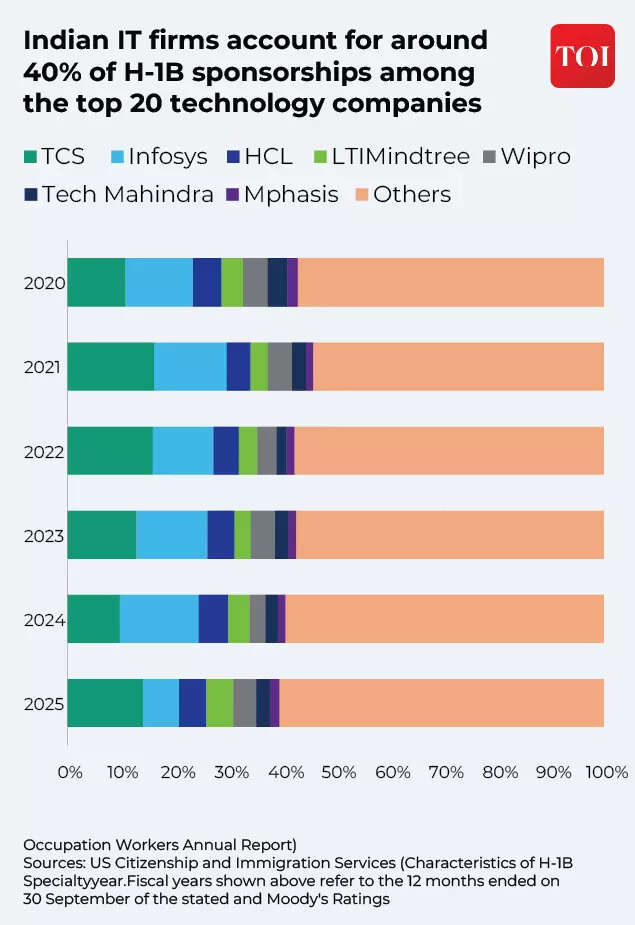
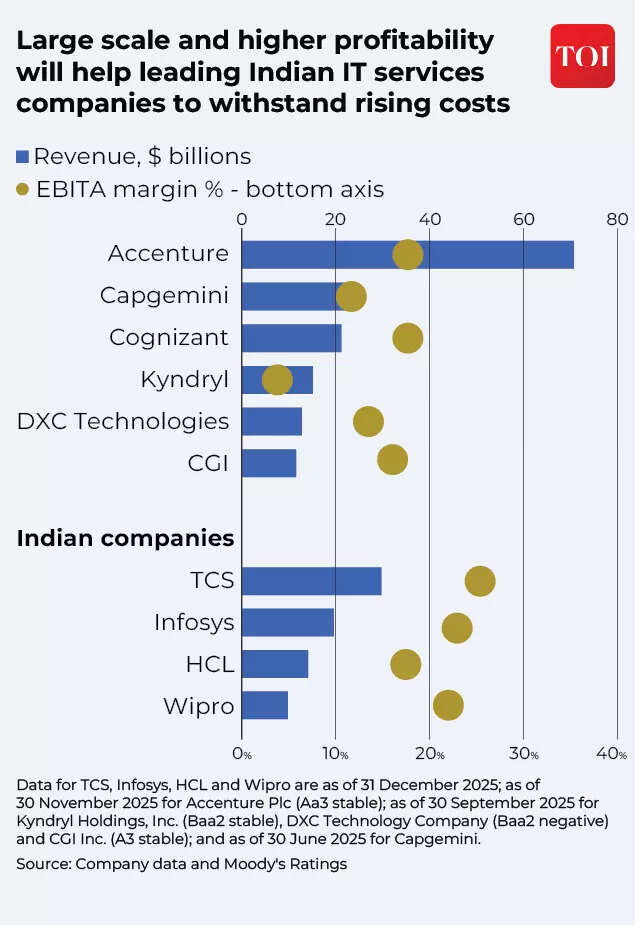
Moody’s is of the view that most of these IT sector firms will be able to absorb the higher visa costs without a significant deterioration in their operating or financial profiles.“Companies such as TCS, Infosys, Wipro and HCL Technologies benefit from significant operating scale and rank among the world’s largest IT service providers by revenue. Moreover, their EBITA margins of 19%-26% exceed those of global peers, which range from 10%-17%. Indian IT services companies’ higher profitability boosts their capacity to tolerate incremental increases in costs,” says Moody’s.Even if Indian IT companies maintain the historical levels of H-1B visa sponsorships, the resulting increase in operating expenses – which Moody’s estimates at $100 million to $250 million – will constitute just around 1% of revenues.
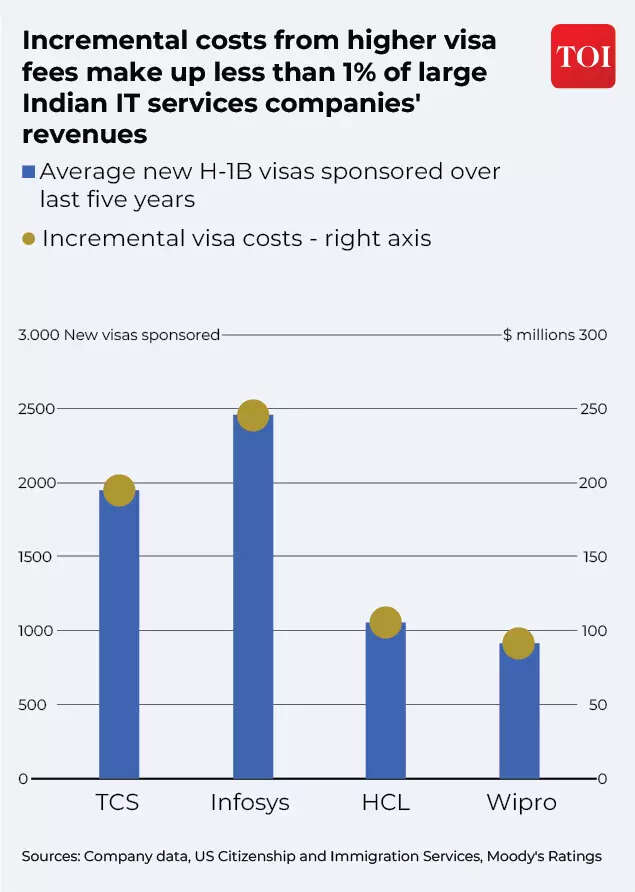
“Even with the full cost burden, the EBITA margin impact would be limited to around 100 basis points, still resulting in Indian IT services companies remaining more profitable compared to their global peers. In addition, many of these companies maintain substantial net cash positions, reinforcing their financial strength,” says Moody’s in its report.
However, the report notes that the small and mid-sized companies may find it difficult to absorb these additional costs.
What does it mean for India’s services exports?
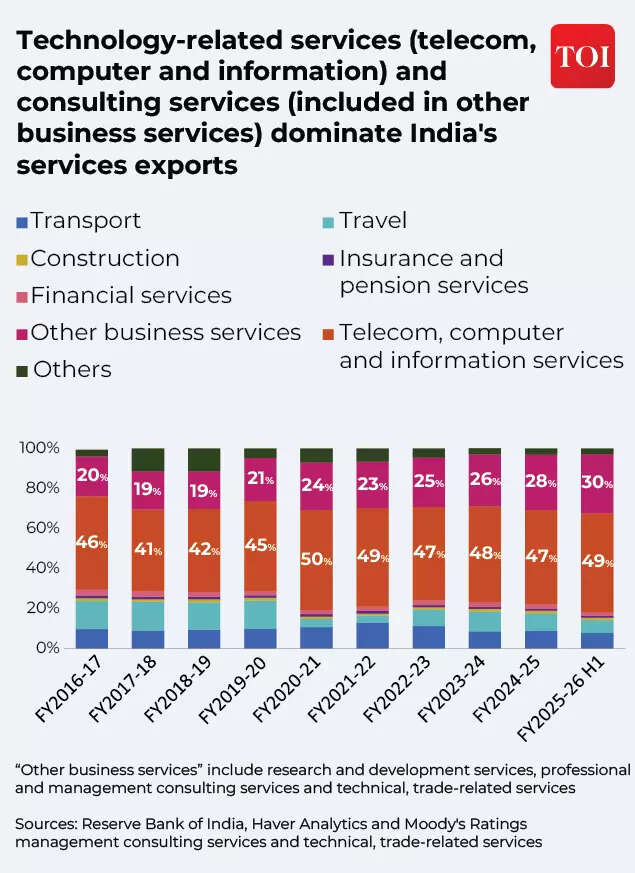
The Indian IT sector forms the backbone of the country’s services exports. India’s services exports have seen a significant growth in the last decade or so. They have grown at a CAGR of 12% from fiscal year 2016-17 to fiscal year 2024-25. In fact, services exports now account for almost half of India’s total exports. They may surpass goods exports by 2030, according to India Brand Equity Foundation.Technology-related services such as telecommunications, computer and information services) and other business services such as research and development, and consulting services, among others, make up services exports in major part. For India, these two service-export sectors account for almost 80% of total services exports. These have seen a CAGR of 12% and 16%, respectively, during the same period.
The ongoing changes in the immigration policies of the US under the Trump administration are likely to raise the costs for Indian IT companies, which in turn may hit the services exports, constraining its growth prospects in the US market.However, Moody’s in its report says that the negative effects will be partially offset by increased local hiring in the US, nearshoring and the expansion of global capability centers (GCCs) in India as a result of US companies’ continued demand for skilled IT labor.“Large Indian IT services companies have strong profitability, solid balance sheets and robust cash reserves that support their credit strength,” it says.At present, the United States of America is India’s largest market for services exports, hence the IT sector is exposed to risks emanating from the Trump administration’s immigration policies.What are software services? According to RBI, these are computer services and IT-enabled services, including business process outsourcing services.Exports of software services by Indian companies increased 7.3% during fiscal year 2024-25 to $204.7 billion, according to RBI data quoted by Moody’s. “On-site services, the proportion subject to visa restrictions, accounted for about 10% of total software services exports. Higher growth in software services exports to Europe and Indian firms’ increase in local hiring in the US will mitigate some of the impact of US immigration restrictions,” says Moody’s.
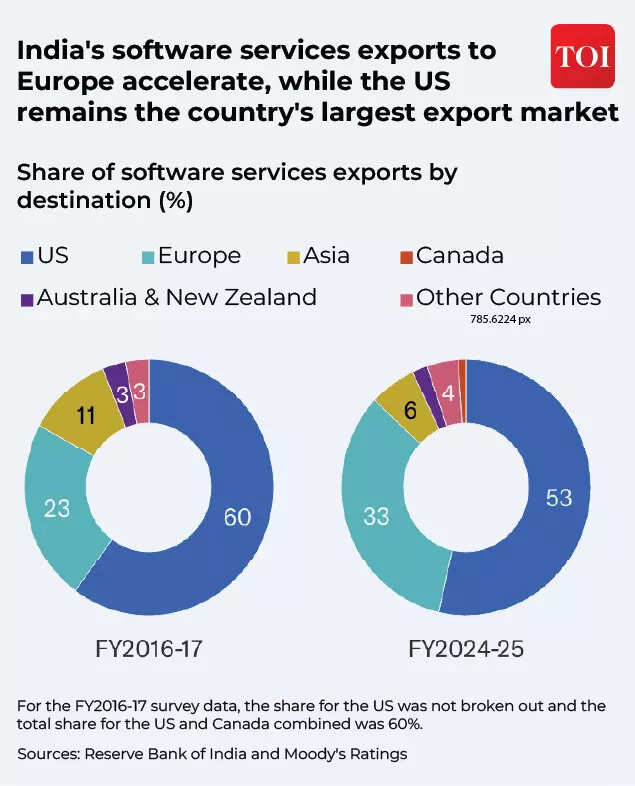
It’s also important to note that Europe is also becoming a major player in India’s software services exports, and the reliance on H-1B visas is coming down.“The share of exports to Europe jumped to 33% in the most recent fiscal year from 23% in fiscal 2016-17, while that for the US declined to 53% from around 60% in fiscal 2016-17,” says Moody’s.“In addition, on-site services have declined to 9.3% of total software services exports from 17.2% in the same eight-year period, indicating a declining reliance on visas,” it adds.The recently announced India-EU free trade agreement also holds the potential to further increase India’s services exports to the EU. This will benefit India’s IT services providers among other service sectors.
India’s unique talent win
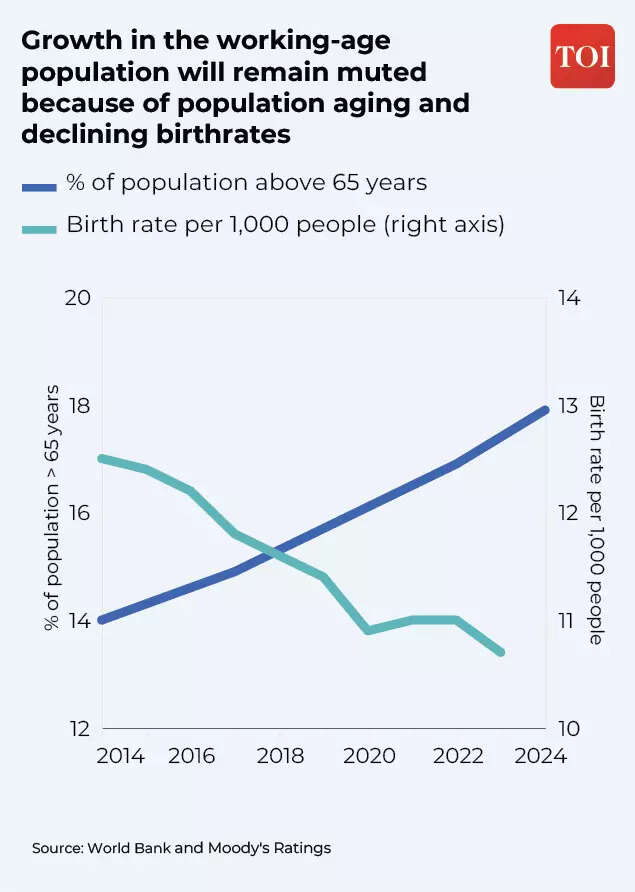
India is in a unique position to bridge the talent gap that the US is facing. Moody’s explains that the US is set to face increasing labour shortages because of declining birthrates and a population that is fast aging.“The US Bureau of Labor Statistics projects the country’s labor force participation rate will remain below pre-pandemic levels through the next decade, even as demand for skilled labor rises across multiple industry sectors,” says Moody’s.
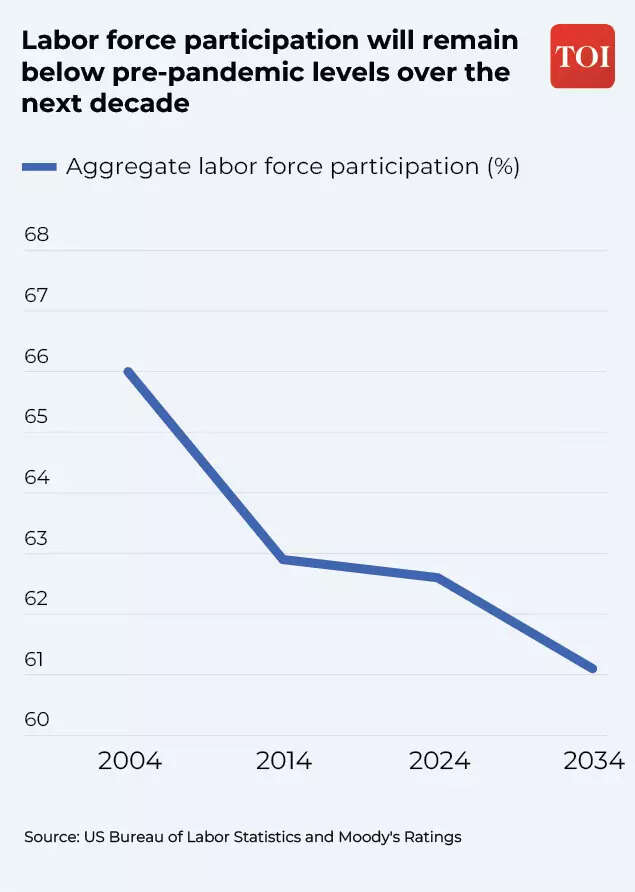
The report cites an important example: the US computer and information technology sector will have about 300,000 job openings annually through 2034. This will be driven by digitalization and AI adoption. However, only around 100,000 computer science graduates with US citizenship or permanent residency enter the workforce each year. This means that there is a shortfall of 2 lakh positions every year that needs to be dealt with.Fundamentally, the above example helps understand the role that foreign talent will continue to play in the economic growth of the US. “The current period of slow economic growth and a weak labor market may temporarily mute the impact of immigration curbs. However, prolonged restrictions would deepen talent shortages and are likely to impede innovation, delay digital transformation programs and erode competitiveness in emerging technologies such as AI – particularly given the growing contribution of AI-related investments to real gross domestic purchases,” Moody’s says.
So what does this mean for India? According to Moody’s, India is “uniquely positioned” to bridge this gap, given its large, English-speaking and technically skilled workforce. As the report notes, since 2020, Indian nationals have accounted for 70%-75% of all H-1B visas issued. This reflects India’s staggering share in meeting the demand for skilled labor in the US. “India produces around 2.5 million of STEM (Science, Technology, Engineering and Mathematics) graduates annually, compared with around 850,000 STEM graduates in the US, highlighting its role as a key talent supplier in the technology sector,” says Moody’s. “Even as US firms explore alternatives such as nearshoring to neighboring countries or the expansion of GCCs across various countries, the domestic shortfall ensures that foreign talent – particularly from India – will remain critical for US technology growth. As a result, demand for Indian IT services will remain steady despite tighter US immigration policies,” Moody’s adds.
The GCC Advantage for India
Moody’s also notes that the need of US tech companies to get access to skilled workers may increase their appetite to set up their own GCCs in India. This would bolster foreign direct investment in India. India’s current account deficit will widen moderately because of weaker growth in services exports and reduced growth of workers’ remittances stemming from a decline in the inflow of skilled workers to the US, the report says.“Remittances ranged between 7% and 10% of current account receipts in the last five fiscal years. However, rising demand for skilled workers in other countries can partially offset the negative impact. In addition, the potential return of highly skilled IT workers and other Indian nationals to India because of dampened job prospects in the US could also boost India’s IT ecosystem and capability, drawing more business toward India-based GCCs,” Moody’s says.
The role of AI-driven automation
The role of H-1B visas will reduce over a period of time, feels Moody’s, led by a faster adoption of Artificial Intelligence (AI) tools. According to Moody’s Indian IT giants like TCS and Infosys, are now betting on generative AI for several offerings such as maintenance, testing and routine coding. With increasing investments in AI, the need for employees, especially in on-site customer locations will come down, it says.However, it’s important to note that AI investments come at a capital and a strategic cost. “Capital spending on building AI infrastructure, employee training and reskilling, and ecosystem partnerships continues to grow,” notes Moody’s For example, TCS recently announced it will invest $6 billion-$7 billion to build one gigawatt of data center capacity over the next few years. “Over the medium term, AI adoption will improve delivery efficiency, reduce reliance on visa-dependent on-site roles and create additional revenue streams across new service lines,” the Moody’s report says.Nonetheless, the timing mismatch between upfront investment and productivity gains means that free cash flow will remain under pressure over the next 1-2 years, particularly as companies balance these outlays with shareholder returns and wage inflation, it adds.

Leave a Reply