
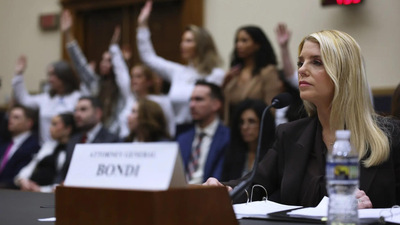
Attorney General Pam Bondi’s appearance before the House Judiciary Committee was meant to steady the ship after months of controversy over the Justice Department’s handling of the Jeffrey Epstein files. Instead, it descended into one of the most combative hearings of her tenure.For more than four hours, Bondi faced furious questioning from Democrats and pointed scrutiny from at least one Republican over redactions, the exposure of victims’ personal details, and accusations of a political cover-up. With Epstein survivors seated directly behind her, the optics were stark. Lawmakers accused the department of failing both transparency and basic care for victims.
Bondi, however, chose confrontation over contrition. She forcefully defended President Donald Trump, dismissed allegations of a cover-up, and repeatedly clashed with members of the committee. Here are five key moments that defined the hearing.
Survivors in the room — and a refusal to apologise
One of the most powerful moments came early, when Democratic Representative Pramila Jayapal asked Epstein survivors seated in the hearing room to stand. She then pressed Bondi to apologise not only for the abuse they endured — which Bondi had acknowledged in her opening remarks — but for the Justice Department’s failure to properly redact sensitive information in the released files.Bondi declined to apologise for the redaction failures. Instead, she accused Jayapal of engaging in “theatrics” and said officials had done their “very best in the time frame allotted” under the legislation mandating release of the files. She insisted that any information released inadvertently had been “immediately redacted” once identified.At one point, when urged again to address the survivors behind her, Bondi refused to turn around, saying she would not “get in the gutter”. The moment underscored the central tension of the hearing: whether the department had prioritised speed and politics over victims’ dignity.
The Massie clash: ‘Bigger than Watergate’
While Democrats hammered Bondi, one of the most striking exchanges came from Republican Representative Thomas Massie, who helped push the legislation forcing disclosure of the Epstein files.Massie accused the department of improperly redacting names of individuals who were not legally entitled to protection. He specifically raised the case of billionaire Les Wexner, whose name had initially been blacked out in a section referencing potential criminal conduct.Bondi responded that Wexner’s name had been restored “within 40 minutes”. Massie shot back: “Within 40 minutes of me catching you red-handed.”Calling the issue “bigger than Watergate”, Massie argued the handling of the files reflected a cover-up spanning multiple administrations. Bondi dismissed his line of questioning as a “political joke” and accused him of being a “failed politician” with “Trump derangement syndrome”.The exchange cut through the broader partisan noise. Unlike many Democratic attacks that dissolved into shouting matches, Massie’s questioning directly challenged the department’s credibility on specific redactions — and left Bondi on the defensive.
Trump takes centre stage
Though the hearing was about Epstein, it frequently became a platform for Bondi to defend President Trump.“You sit here and you attack the president and I’m not going to have it,” she told lawmakers. At another point she declared, “There is no evidence that Donald Trump has committed a crime. Everyone knows that.”When Democratic Representative Ted Lieu referenced unsubstantiated tips in the files mentioning Trump, Bondi angrily replied: “Don’t you ever accuse me of committing a crime,” after Lieu suggested she was misleading the committee.Bondi also praised the stock market’s performance under Trump, citing record highs in the Dow and Nasdaq, and suggested lawmakers should focus on that instead. Critics quickly noted that market performance was not the Judiciary Committee’s remit.Her repeated alignment with Trump marked a departure from traditional Justice Department distance from the White House. Rather than positioning herself as an independent law enforcement official, Bondi openly cast herself as the president’s defender.
Misfires and walkouts
Bondi’s aggressive approach did not always land cleanly.In one exchange, she criticised Democratic Representative Becca Balint over a vote related to antisemitism. Balint responded that she was the granddaughter of a Holocaust victim and shouted, “Are you serious?” before storming out of the hearing.Bondi also sparred with Jamie Raskin, the committee’s top Democrat, calling him a “washed-up loser lawyer” during a heated exchange over time limits and questioning tactics.Meanwhile, Democrats repeatedly accused her of running a “massive Epstein cover-up” and siding with perpetrators over victims. They also pointed to the department’s recent attempt — rejected by a grand jury — to indict Democratic lawmakers, fuelling claims of political weaponisation.Bondi insisted the department was focused on reducing violent crime and restoring its “core missions” after what she described as years of politicisation. But by the end of the session, it was clear she had not come to concede ground.
A rare moment of unity over threats
Amid the rancour, there was a brief pause in hostilities.Democratic Representative Eric Swalwell shifted the focus to threats made against him and his family. He asked Bondi whether they were being investigated and appealed for help in protecting lawmakers’ families in an increasingly volatile political climate.Bondi responded: “None of you should be threatened ever. None of your children should be threatened. None of your families should be threatened, and I will work with you.”

Leave a Reply