
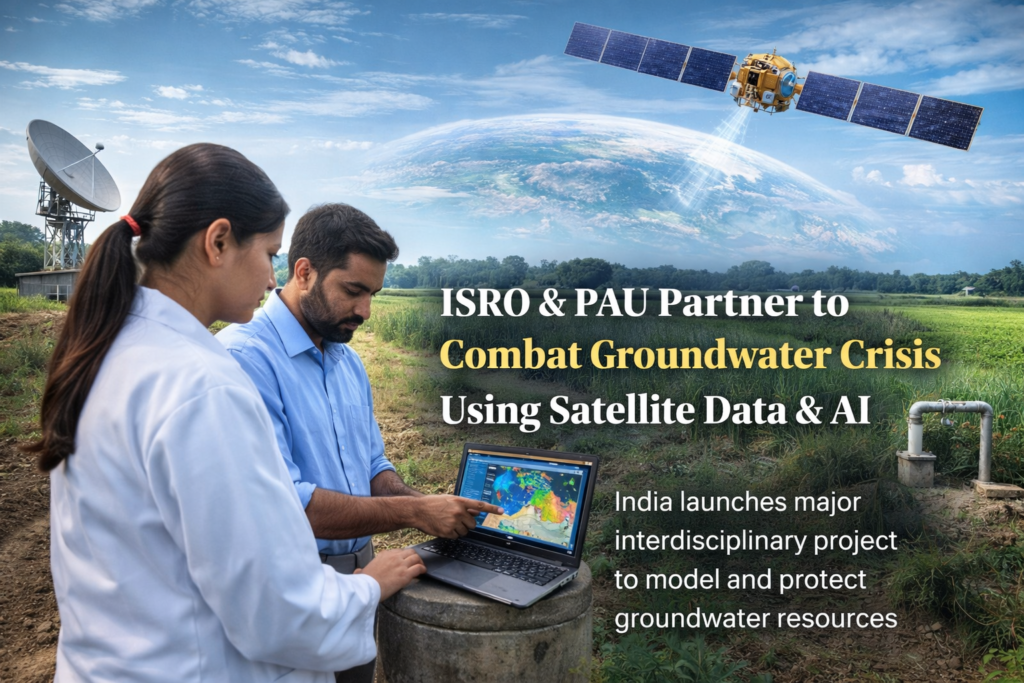
Ludhiana / 28 Dec 2025: In a strategic move to tackle India’s worsening groundwater crisis, the Indian Space Research Organisation (ISRO) has partnered with Punjab Agricultural University (PAU) on a major interdisciplinary research initiative. The project, backed by a three-year research grant under ISRO’s RESPOND programme, aims to use cutting-edge satellite data, artificial intelligence and machine learning to model, monitor and develop sustainable solutions for groundwater management across the country.
What the project will do:
The project — titled “Groundwater Regime Impact and Climate Change towards Sustainable Development Goals” — will combine Earth observation tools with advanced data analytics to build predictive models of groundwater behaviour under different climate scenarios. Researchers will use satellite measurements (including data from NASA’s GRACE mission) to track changes in groundwater storage, identify vulnerability hotspots, and forecast future trends.
Why satellite data matters:
Remote sensing satellites like GRACE and others capture changes in Earth’s gravitational field, allowing scientists to estimate variations in water storage across vast regions — especially where traditional well-based monitoring is sparse. By incorporating this satellite information with AI techniques, researchers hope to develop accurate, scalable models that can complement or eventually supplement costly ground-based methods.
Tackling climate change & water stress:
Punjab and many other regions in India are facing steep groundwater depletion due to over-extraction for agriculture and variable rainfall patterns. Early analysis suggests that parts of Punjab may be losing nearly 50 cm of groundwater annually, highlighting the urgency of innovative approaches to water sustainability.
Team and expertise:
The PAU research team is led by Dr. Samanpreet Kaur (Principal Scientist, Soil & Water Engineering), alongside experts in climate science, agro-meteorology and electrical engineering. They will work closely with Dr. Rajarshi Saha from ISRO’s National Remote Sensing Centre (NRSC), combining academic expertise with advanced space-based applications.
Capacity building:
Beyond scientific outputs, the initiative also focuses on training students and young researchers in hydrology, climate science and geospatial technologies — building a new generation of scientists equipped to address India’s water challenges.
Looking ahead:
The project’s results are expected to influence future groundwater management policies and practices, helping decision-makers identify areas at risk, optimize groundwater extraction, and create science-backed strategies for long-term water security and climate resilience.

Leave a Reply