
New research offers hope for cleaner water worldwide: A team of scientists led by researchers at Rice University, in collaboration with international partners, has developed a new eco-friendly method that not only captures but actually destroys toxic per- and polyfluoroalkyl substances (PFAS) — commonly known as “forever chemicals” — from water far more efficiently than existing technologies.
What are “forever chemicals”?
PFAS are synthetic compounds used for decades in consumer products such as non-stick cookware, stain-resistant fabrics, food packaging and firefighting foams because they resist heat, water and grease. But their chemical stability also makes them extremely persistent in the environment, accumulating in soil, water and even human bodies, and linked to adverse health effects including cancer, immune system disruption, and developmental issues.
Why this breakthrough matters:
Traditional methods for removing PFAS from water — including activated carbon filters, ion-exchange resins and reverse osmosis — can trap PFAS but don’t actually destroy them, often creating concentrated waste that still must be safely disposed of.
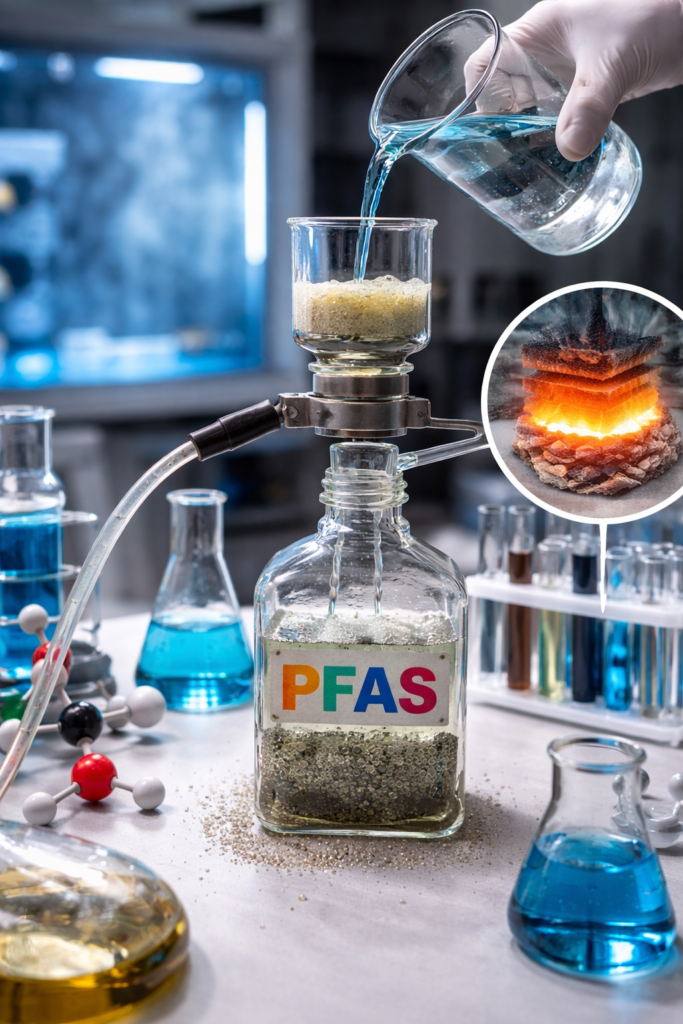
The new system transforms this approach by using a special material that both captures PFAS molecules from contaminated water and then breaks them down, rendering them harmless — a “one-two punch” that has been very difficult to achieve until now.
How it works:
- Scientists engineered a layered double hydroxide (LDH) material — a composite of copper and aluminium — that acts like a highly effective magnet for PFAS, pulling them out of water much faster than conventional filters.
- After trapping the chemicals, the material undergoes a thermal process (involving controlled heating) that breaks the tough carbon-fluorine molecular bonds characteristic of PFAS, a critical step that destroys the contaminant rather than just moving it elsewhere.
- Remarkably, the material can also be regenerated and reused multiple times, improving sustainability and reducing waste.
Real-world impact and future steps:
This innovation has the potential to transform water treatment worldwide — from municipal drinking systems to industrial wastewater facilities — by offering a scalable and more sustainable solution to a major public health and environmental challenge.
Scientists say further development is underway to refine the technology and support broader deployment, potentially making forever chemicals a problem that can finally be managed effectively.

Leave a Reply