
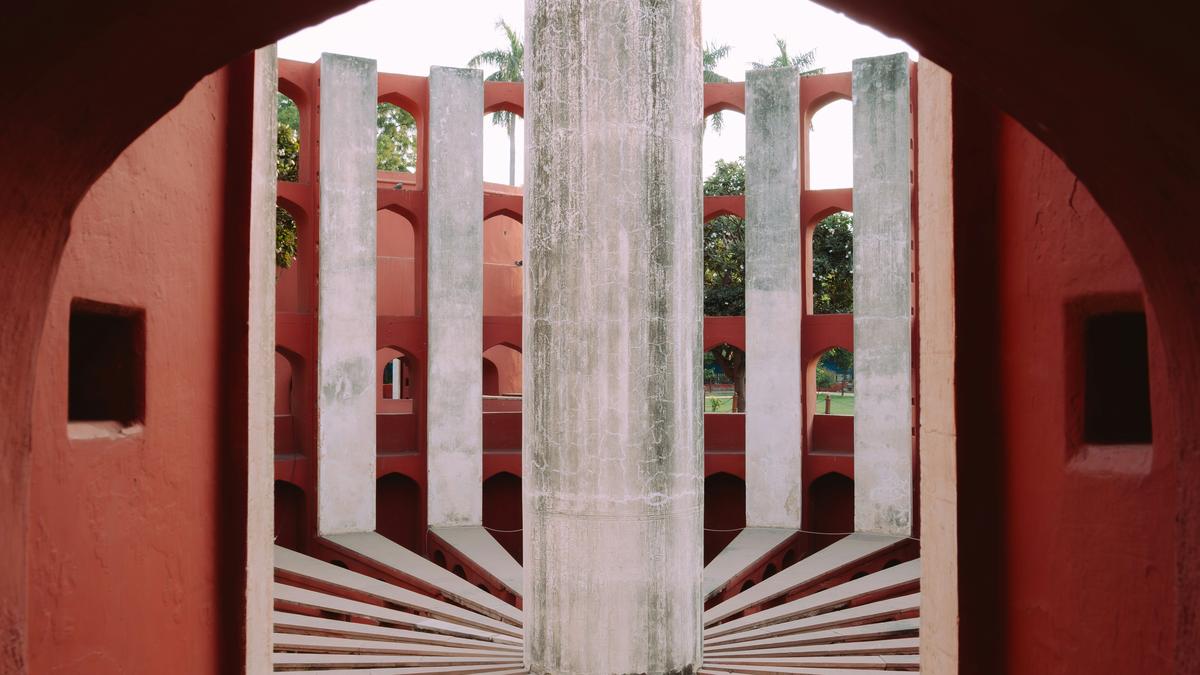
Commemorating December 22 as National Mathematics Day invites memories of biographies, theorems, institutes, and prizes. But India also has mathematical places: built environments that render the mathematical act of measurement public. Jantar Mantar in New Delhi is one of them.
It was commissioned by Sawai Jai Singh II and completed in 1724 as an architectural observatory. Its masonry embodies its instruments, using which observers can measure time and celestial positions with only the naked eye. Over the years the Jantar Mantar has also helped scholars produce and correct astronomical tables and calendars.
Designated space
It is also, by a subsequent and largely administrative turn, the address that the Delhi police and governments have used to route public demonstrations. Since the early 1990s, Jantar Mantar Road has functioned as the designated street of protest, after the Delhi government pushed protests away from other central spaces such as Boat Club. This second life sits next to the first: the protest site is typically the road outside the protected monument complex, not the monument itself, but the civic shorthand often merges them into one entity in name.
But shorthand or not, these two histories sit in the same account and share a political problem that’s become more crucial of late: how a state makes public life legible and how citizens contest that legibility.
Sawai Jai Singh’s observatories weren’t private retreats but instruments that produced knowledge in the public, whether they served courtly governance or scholarship. Their calibrated surfaces and shadow lines embed geometry and astronomy in built form, translating the sky itself into numbers that reveal a clearer view of the future.
This is important. The Delhi Jantar Mantar is not a library of proofs: it’s a demonstration that measurement is a social act, something we do together. In the same vein but at a smaller scale, a sundial or a hemisphere instrument is a device as well as a claim about what counts as ‘correct’ time and ‘correct’ position, and about who can certify that. Even in the 18th century, accuracy wasn’t just technical; it carried administrative consequences. For example calendars structured religious practices as well as taxation cycles, travel schedules as well as the timing of public authority.
Thus Jantar Mantar’s pre-modern life reveals mathematics as a social method to settle disputes about the world through shared processes.
Protest as urban service
The protest street right outside emerges from a different institutional logic. The state doesn’t merely permit dissent: it also attempts to organise its space. Accounts of Delhi’s protest commonly date Jantar Mantar’s rise as the protest street of choice to 1993, in a wider transition away from Boat Club as a central site. The reason is more obvious: to have protests happen where the police can better manage them, where dissent is proximate to power but also contained.
This isn’t benign convenience. A protest that can’t be seen by officials, legislators, and the press is easier to ignore. A protest that’s too visible is on the other hand harder to control. Designated protest spaces constitute an attempt to resolve this tension by saying “assemble here” and in return expecting protest to be disciplined and localised, and ticking to a particular schedule.
In October 2017, the National Green Tribunal (NGT) intervened after residents complained about noise pollution and other consequences from continuing demonstrations on Jantar Mantar Road. The tribunal directed authorities to stop dharnas and related activities on that stretch, citing deterioration in environmental conditions and public health concerns. Reports at the time also noted the direction to shift protesters to another site such as Ramlila Maidan.
The Supreme Court’s response in Mazdoor Kisan Shakti Sangathan v. Union of India (2018) framed the issue as a contest between the right to peaceful assembly and the rights of others to live peacefully, and rejected an “absolute” or “complete” ban. Accordingly it directed the government to frame guidelines for permissions and miscellania. The judgment describes how protest on that road had shifted from transient gatherings to more protracted encampments with semi-permanent structures, ultimately sharpening the conflict between residents and administration.
Maths as institution
The instruments at Jantar Mantar embody the tenet of “show, don’t tell”. They make measurement inspectable: anyone can see the shadow line move; anyone can test the reading. If you disagree, you’re welcome to resolve the issue by referencing a shared procedure.
Protests, in their best form at least, have a similar demand. Citizens assemble to force the state to make its own work legible: budgets, enforcement, compliance, timelines, whatever. When protesters insist on accountability, they often insist on counts and comparisons: how many deaths, how many jobs, how many days without payment, how much exposure, how much compensation. The protest is then not only an act of speech or a show of strength, it’s also a claim that the state’s numbers are wrong or missing or that they’ve been manipulated, and that policy must answer in terms of publicly checkable facts.
Thus both the observatory and the protest street are places where public claims are tested.
Ramanujan-Hardy collaboration
Srinivasa Ramanujan is often remembered as a generator of results. National Mathematics Day, marked on his birth anniversary, sometimes freezes him in anecdotes. Perhaps a more useful way to recall his work is in the way it has moved across communities that enforced different standards of verification.
For instance, Ramanujan’s early notebooks and letters contained many claims with minimal derivations. But to G.H. Hardy and others this was less a defect and more a mismatch between a working style that put results first and the norms of early 20th century British mathematicians that placed proof first.
The subsequent collaboration between Ramanujan and Hardy, as well as efforts by mathematicians to derive and systematise Ramanujan’s formulae — including work associated with his notebooks and later the famous “lost notebook” — are thus a history of converting private and almost magical insights into mathematical forms that submitted to debate and verification, and thus reuse.
The state’s repeated attempts to solve dissent by designating a space for protests has produced recurring litigation because it tries to compress competing rights into a single street. The NGT treated the problem as environmental and public health harm. The Supreme Court treated it as a conflict between fundamental rights that warranted rules rather than blanket prohibitions. If there is a workable approach at all, it has to be more explicit about the trade-offs.
In the final analysis, mathematics isn’t just an ornament or the crucible of genius. It’s a public institution because it shows how, in modern India, the struggle over public reason still happens on the streets, sometimes within walking distance of instruments built to measure the sky.

Leave a Reply